Awami Workers Party in elections
There are seventeen AWP members running from Khyber-Pakhtunkhwa, 6 for the National Assembly and the rest for the provincial. The major focus of our elections will be Khyber-Pakhtunkhwa. In the Punjab, we expect 10 AWP candidates
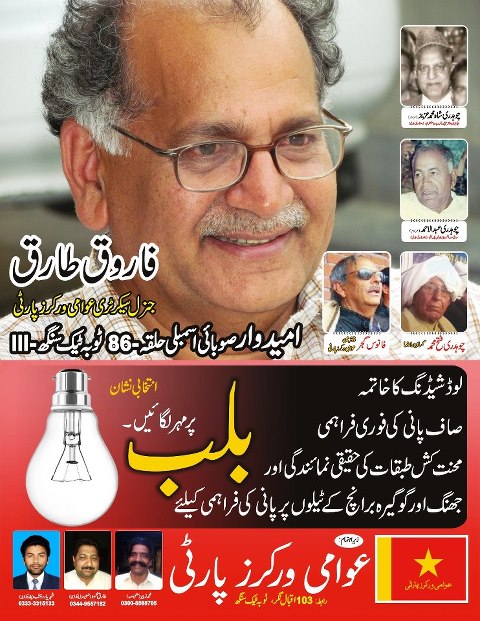 Farooq Tariq, general secretary the Awami Workers Party (AWP), is contesting elections for the Punjab Assembly from Toba Tek Singh. He is documenting his campaign diary which is available on the party's official Facebook page: https://www.facebook.com/AwamiWorkersParty.
In an interview with Viewpoint, he speaks about the up-coming general elections scheduled for May 11 and the participation of the left, particularly the AWP. Read on:
The left has been largely irrelevant when it comes to elections. Looking at the up-coming elections and the historical context in which the left has participated in the elections, how do you view the idea of elections and the left?
The left has never, as a united-left, taken part in elections in Pakistan. In 1951, trade unionist Mirza Ibrahim contested elections from Lahore for the Punjab Assembly with the backing of the Communist Party of Pakistan. In 1952 Chaudhry Fateh Muhammed, contested elections from Toba Tek Singh.
But on the whole the left has never had a strategy to run from all constituencies in Pakistan. Unfortunately, their strategy up till now has been desperate, in the sense that elections were contested on an individual basis. The idea being that the individual who wins becomes a symbol of change.
This strategy, based on the perspective of making an individual a symbol was not a solid plan. In the 1970 elections, the Pakistan Peoples Party offered to make an alliance with the Communist Party and other left parties. The left is said to have been offered approximately 20 to 25 parliamentary seats. The PPP at the time was putting forth a leftist agenda. The left rejected that offer and an opportunity was missed. As a result those who stood in the elections on a left platform, including people like Habib Jalib and Mirza Ibrahim, were unable to do well in the elections.
The results of the 1970 election indicated consensus that perhaps elections are not a path towards progress.
In the context of the left, elections have also been a reason for splits. How would you explain that?
Unfortunately the question of who to support and with whom to build an alliance [Benazir or Nawaz Sharif] has always been source of debate. But the left cannot compromise and make an alliance with such status-quo entities.
That is why the Awami Workers Party has a very clear policy that we will not go into an alliance with anyone. A public alliance is out of the question. One of the reasons is that that party is in its formative stages. Soon after its formation it was facing general elections.
Since the AWP is a merger of three parties, unity on electoral strategy is lacking.
Some AWP members believe that elections are not important and that we should not go into them without preparation. Regarding that bar for preparation there is no concrete answer. Then there is another trend which thinks that wherever possible, whoever asks for a ticket should be allowed to run in the elections.
Looking at the current political situation and the current state of the left, how do you view the question of elections?
My opinion is that we should participate in the elections. This strategy has to be there. If the Awami Workers Party had been in a position to field over one hundred candidates for the National Assembly and bank a small percentage of the vote nationally, it would have been a victory. We have fielded candidates in constituencies where we hoped to get decent share of the vote. Through elections we can learn how to connect with the masses and engage in dialogue with the people.
On a daily basis, since I have been on the campaign trail, there have been opportunities to bring our ideas into practice. Unfortunately, on the left there is a lot of debate over the elections, but little practical experience of how to contest the election in a radical manner.
The AWP President, Abid Hassan Minto, filed a petition in the Supreme Court regarding electoral reforms. Can you give a background on that?
This is an historical step in Pakistan’s history. The Electoral Reforms Petition that Abid Hassan Minto Saheb filed last year and the resulting Supreme Court ruling is a victory for progressive forces. The court banned certain canvassing methods such as billboards, wall-chalking etc. Working class candidates cannot afford it all. As well, as a result of our writ petition, a code of ethics has been designed.
Still, many of our suggestions were not taken into account. Despite this, now you cannot bus in people to polling booths or set-up camps near polling stations. Those expenditures which guaranteed certain unfair support have been stopped as a result of this petition.
Recent guidelines released by the Election Commission of Pakistan (ECP), regarding conduct in the elections, mentions only one party, the Workers Party which is now incorporated in the AWP. The ECP states this election code of conduct evolved in light of the Workers Party petition. That the courts have taken up this petition in the public’s interest is a great development.
Because of our petition action is being taken against the big capitalists including the former Prime Minister. The petition has strengthened the election commission. It has given birth to a new election commission that is stronger and able to work on the issues highlighted in the petition.
I am not referring to those disqualified on the basis of religion. That was not part of our petition. It was the failure of the ruling PPP government at the time that they were unable to take out Article 62 and 63 from the constitution during the 18th amendment. They left that untouched and didn’t touch Zia’s laws.
Despite this, implementation is still only limited. Recently it was reported that the newly introduced ‘None of the Above’ (Nota) option on ballot boxes has received staunch opposition from mainstream political parties such as the PML-N, PPP, or even PTI. Was this expected?
This is because the petition was against these parties. It was against the capitalist and bourgeois political parties and the ‘None of the Above’ option was part of the petition. Nota is an achievement for progressives.
Bilal Minto, Abid Hassan Minto, and Salman Akram Raja, all gave very good arguments for the Nota reform. I personally appeared before the Chief Justice in the Supreme Court on behalf of the Labor Party at the time.
In light of this petition these big parties have lost a lot. In Toba Tek Singh implementation has happened. I announced in every Jalsa [public meeting] that I would protest any violation of the petition. I said I would write a note to the election commission regarding any violation and that if any candidate violates the petition I will personally tear down their billboards. I have taken a very militant stand on this.
There is also a petition regarding anti-feudalism which is connected to electoral reforms petition. What is the status of that?
That petition is in the Supreme Court under hearing and its completion has not occurred. It is now known that the case will be heard by the court. In the last hearing the judges did hear a bit of it. Until the eight judges sit the petition will not move forward because the Shariat Court’s five judges gave the decision that land-reforms are un-islamic.
Our position is that land reforms are not un-islamic and that as a natural right should be accepted. This was guaranteed in the 1973 constitution and should not be undone. The1973 constitution supports private property but it contains a special provision which states that those people who received their lands through land reforms are provided with a special cover in the constitution.
The Shariat Court ignored this provision and allowed the feudal lords to take back their lands. There is a debate there but this is not an issue in this election. We are referencing this petition in our election campaign.
Has the AWP fielded any woman candidates?
One of the weaknesses of the AWP is that in this election we have not been able to field any female candidates. There was a debate on whether to symbolically field candidates or find serious candidates. There are few candidates who are going to be running in the elections from Khyber-Pakhtunkhwa.
How many candidates do you expect will be running for the AWP’s platform in the up-coming election?
There are seventeen people running from Khyber-Pakhtunkhwa, 6 for the National Assembly and the rest for the provincial. The major focus of our elections will be Khyber-Pakhtunkhwa. In the Punjab, we expect 10 AWP candidates.
What are the current issues that you feel will be the defining points in the upcoming elections?
People are tired of the load shedding so I think this will be major issue. Aside from that the elections will be around unemployment and inflation. For the peasants another important issue is the water shortage. This is also a major issue within Punjab. Despite the fact that Punjab is generally thought to have a lot of water, the reality is that in peasant populated areas there is minimal water and in areas where the feudals rule there is excess water.
 |
|