Deconstructing Zaid Hamid (II)
Is Zaid Hamid trying to imply here that politicians are immoral people so they should not be given any chance of governing people.? Maybe. If Politics is an immoral science, why did the person on whom you are basing your program take active part in Politics?
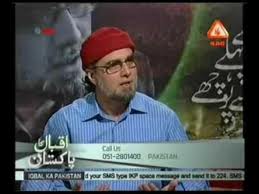 Zaid Hamid is a media phenomenon popularized by his programs “Brass Tacks” and later “Iqbal ka Pakistan”. He has been frequently criticised in the mainstream media due to his espousal of conspiracy theories about global domination of Jews and their economic policies. Previous week two episodes of Iqbal ka Pakistan were analysed and we found many minutes of lies during his speech. Below are the next episodes.
Episode III
The Documentary “The revolution will not be televised” was mentioned at the start of the program.
Here is what NFP has to say about that “In a terrific set of documentaries called “The Revolution Will Not Be Televised” and “South of the Border,” directors Kim Bartley and Oliver Stone convincingly push forward the idea that the right-wing coup that toppled Venezuelan President, Hugo Chavez in 2002, was engineered and propagated by a string of private television channels that are owned by the country’s industrial and business elite.”. I don’t understand the significance of mentioning that documentary in this program. Granted, this program is meant to spearhead a revival of some sorts and Bolivarian Revolution was also about revival but the message is very different.
ZH:-Iqbal jitna great philosopher beeswin sadi ne nai paida hua. (A philosopher of the caliber of Iqbal was not born in the 20th Century).
Comment:- This is an example of hyperbole, I am sorry to say. Zaid Hamid probably should Google “Vladimir Lenin”, “Edward Said” (fun fact:- 31,100,000 results show up for Lenin, 102,000,000 results for Said as compared to 3,130,000 results for Allama Iqbal. You do the math.), or maybe Antonio Gramsci (about whom Eric Hobsbawn said “Gramsci was an extra-ordinary philosopher, perhaps a genius, probably the most original revolutionary thinker of the 20th century in Western Europe), Francis Fukuyama, Samuel P Huntington etc. Interestingly, Iqbal even wrote about Lenin.
He said in Payam e Mashriq,
“For a long time, man in this old cavern
Like the grain was crushed in the quern.
Victim of the Czar’s wiles and Caesar’s charms.
Entangled by the snares of the church.
Haven’t you seen how the starving slave has torn
The master’s shirt, red in his blood?
The proletarian fire has burnt all that is rotten –
The garb of the priest and the robe of the king.”
ZH:- Pichle daidh do sau sal main jo industrial age ai ha. (The Industrial Age that is going on for the last 200 years.)
Comment:- It is universally agreed by historians that Industrial age was from the 18th century to the 19th century. It gave way to the Atomic Age, the Jet Age, Space Age and the Information age(Presently going on).
ZH:-Siyasat aik immoral science ha. (Politics is an immoral science.)
Comment:- Is Zaid Hamid trying to imply here that politicians are immoral people so they should not be given any chance of governing people.? Maybe. If Politics is an immoral science, why did the person on whom you are basing your program take active part in Politics.? (Allama Iqbal was a prominent member of the London Muslim League and later the Indian version of Muslim League).
ZH:-If India changes its name to Pakistan, we can join them.
Comment:- Who is asking you by the way.? Is India willing to take in another 170 Million useless people to feed? Really? And should I quote Shakespeare now, “What's in a name? That which we call a rose, by any other name would smell as sweet." (Romeo and Juliet (II, ii, 1-2)
ZH:-Jamal ud Din afghani was born in badakhshan, Afghanistan.
Comment:- jamal ud Din Afghani was born in Asadabad,Iran. Reference:- Iraj afshar and asghar madhavi, Documents inedit concernant Sayyed jamal-al-din Afghani, Tehran, 1963.
ZH:-Jamaluddin Afghani was the pioneer of pan-Islamic movement.
Comment:- KK Aziz in his book 'The murder of History' chapter 2, page 192, writes ' He(Jamaluddin Afghani) was in India between 1854 and 1857, again in 1869, and once again in 1880-81. During these visits he delivered several speeches and wrote some articles; some of these were collected and published as Maqalat-i-Jamaliyyeh from Calcutta in 1884. This is the only original and definite record of his views on India. In it there is no mention of Pan-Islamism or of any scheme to unite the Muslims behind one leader, or in one state or grouping or commonwealth or anyhitng like that. In his Paris journal, al-Urwa-al-wuthqa, he wrote, “A religious bond doesn’t not exclude national links with people of various faiths. In countries like Egypt and Indian Muslims should co-operate with the Non-Muslims and there ought to be good relations and harmony in affairs of national interest between the Muslims and their co-patriots and neighbors of different religions”.
ZH:-Iqbal wrote commentary on Al-Jeeli's book. He wrote his first 4 books while in his 20s.
Comment:- Iqbal’s first published work 'Ilmul Iqtisad' (Science of Economics) was published in 1904 when he was 27 years old. By the time Iqbal finished his second published work(1908), which in fact was his doctoral thesis, he was 31 years old. Also, he didn’t write any BOOK about Al-Jeeli’s work, he just wrote an article.
ZH:-His father was a saint of the highest order.
Comment:- Another clear example of Hyperbole. Who bestowed this honor on Iqbal’s father? What even is the HIGHEST order in sainthood?
ZH:-Iqbal had an independent thought process.
Comment:-: Yeah. According to historians and researchers of Iqbal, he was heavily influenced by his teachers at Cambridge, namely John McTaggart, William Ritchie Sorley, James Ward and William James who were all influenced by the German philosopher Hegel. Here is a research paper on one such influence.
ZH:- Iqbal’s work is Immortal.
Comment:- Another example of hyperbole. No such claim was ever made by Allama Iqbal.
Episode IV
Yousaf Salahuddin and Imran Khan were also invited to get their views about the show. On my views about Kaptaan, you can read here. Both of them were class mates in Aitchison College and they enjoyed a lot of coloful life together. I would not use this space to attack the personal matters of these two people, for that matter you should read the court testimonies of Sita White.
ZH:- Unho ne Cambridge main LL.B main dakhla lia, and simultaneously got admission in Munich. (Iqbal took admission in LL.B at Cambridge and simultaneously at Munich University)
Comment : How is it possible? Where has this been mentioned in history? On this topic, Prof Dr M. Siddiq Shibli writes “Allama Iqbal got himself registered as an advance student in the Cambridge University. He wrote a dissertation for this degree. He submitted the same dissertation with a few modifications in the Munich University of Germany”
Also, according to the official biography of Iqbal given by Iqbal Academy (the largest source of Iqbal’s work till date and where proper research is conducted on every single aspect of Iqbal’s life and philosophy), “In his three years of stay abroad, Iqbal obtained a BA from Cambridge (1906), qualified as a barrister at London’s Middle Temple (1906), and earned a PhD from Munich University (1908).” Regarding the myth about LLB from Cambridge, it says “he had already obtained a degree in law (1898)”.
ZH:- He implies that people are turning to suicide bombing because west is trying to impose their democracy.
Comment:- About Iqbal’s views on Democracy, I have explained in detail in part 3 of this series, as the same discussion has been done repeatedly. Logically, a person gives up his life when
- He has no hope left. He has nothing to lose
- He is promised a greater benefit if he dies than if he lives on.
Where does democracy and imposition of democracy fit in this paradigm? I admit that according to the teaching of the spiritual fathers of Al Qaeda, Hassan Al Banna and Syed Qutub, democracy is a system of infidels and whoever accepts it willingly is an infidel as well. When Zaid Hamid uses this logic, he gives away his ideological leanings.
ZH:-Islamic ideology was better than Persian or roman ideology and that’s why they were defeated.
Comment:- Another illogical assertation. If it was a matter of Ideology, why did all those wars happen?
ZH:-The Ratio of Muslims was 1:10 in battles against Rome and Persia.
Comment:- Zaid Hamid, as usual exaggerates the facts. In the famous war of Qadisiya, there were about 1,20,000 Persians and 30,000 Muslims. The ratio is 1:4.
ZH:- Iqbal was an absolute expert in Persian.Comment:- Says who? Zaid Hamid, obviously. Persian language has three distinct varieties, Farsi, Darri and Tajik. Iqbal did his poetry mostly in Farsi. How can he be the absolute expert? He said at one instance
(Gar chi Hindi dar uzubat shakar ast… tarzi guftaar dari shireen tar ast)
Means: even though in sweetness Urdu (Hindi) is sugar, but Dari is sweeter than that.
Iqbal’s poetic works are written mostly in Dari rather than Urdu. Among his 12000 verses of poems, about 7000 verses are written in Dari, and from 15 of his collection 12 of them are in Dari language.
ZH:-Iqbal is one man army, one man trooper, and one man commander in chief. All he is, he is.
Comment:- I seriously don’t think Iqbal was that much pompous about his own abilities. All we know is that he was a very modest man. The concept of superhuman powers that ZH is trying to pin up to Iqbal, the concept of Super-man (not the DC-comics, wearing-his-underwear-over-his-pants version) was actually given by one of Iqbal’s Inspirations, Friedrich Wilhelm Nietzsche. More on this topic can be read here.