Musings of a random microbe
Can human beings come up with a model of survival that does not depend on constantly wiping out all other species?
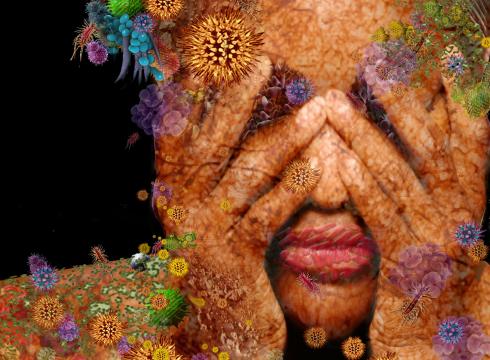
When grandpa once told me that human beings evolved out of our ancestors that sounded like a sensible hypothesis. We microbes are the earliest living organisms on Earth and humans came much later, so the logic is at least impeccable.
When the old man went on to say the main purpose of human evolution was to provide us bacteria with safe, efficient transport and lots of entertainment I was horrified. After all there must be a higher purpose to the evolution of humans- like making good cinema and discussing Marxist theory or at least, tasting good wine?
That was years ago (a few nanoseconds on your time scale) and I was very young then. I am older and much wiser now and I believe human beings are indeed a great form of transport and fantastic entertainment. Living as I do in Calcutta these days, I can see it is all exactly as grandpa made it out to be.
Oh Calcutta! How I love this city! A niche for every species and every species a niche on its own! Big and small, narrow and wide (those fair, round creatures on hand pulled rickshaws!), mammal and amphibian, visible and invisible!
And not just the biological diversity, look at the sheer, awesome numbers! I mean, there is no other place on the planet where a microbe like me can cross an entire metropolis in the flash of a second! It is a seamless, moving walkway everywhere around. The density of life per square inch is such - dogs, cattle, birds, humans- I don’t need to flap a single fin to get anywhere. And an occasional human sneeze here or there can send you to your destination at supersonic speed!
As for entertainment, what more could any microbe ask for- this after all is one of the greatest cities of culture anywhere on the planet. No, I am not talking Tagore or Ray here. When a microbe says ‘culture’ he/she means any process that allows the flourishing of all kinds of life, especially the tiniest, invisible form. In other words, Calcutta lets us breathe, feed and above everything else breed like mad. The humans have a silly expression ‘multiply like rabbits’. They have no idea of the mathematical capabilities of some of my family members.
Humans of course, offer great entertainment in other ways too as they fall in and out of love, fight over ‘property’, envy their neighbours and perpetually worry about remaining ‘young’. In Calcutta though, you will also find the noblest of souls- of no use to anyone- but very noble indeed.
More seriously, I have always felt that studying human societies and how they behave with each other I think is important to understand how microbes themselves behave. Some of my friends laugh at the idea that there is any similarity between microbial and human societies but I think there is a wonderful germ of an idea here.
Take for example this concept that humans have of being ‘individuals’ and shapers of their destiny entirely on their own. That is simply not true and what we observe is the tremendous amount of interdependence they have with other members of their own species. The simple truth is, even if they constantly fight among themselves, they just can’t live without each other. I mean what’s the point in being ‘rich’ if you don’t have a neighbour to show off your wealth to? Or being a ‘patriot’ if you don’t have an enemy?
Also, I have noticed that the behaviour of these ‘individual’ humans changes dramatically when they are with other members of their species (especially of the opposite gender!). There also seems to be a threshold number of human beings beyond which all these ‘individuals’ fuse into a bloody mob! Perfectly sane, normal and quite decent folks turn murderous as part of the mob- quite frightening but also fascinating.
I say fascinating because we microbes also do similarly ugly stuff sometimes – for instance, releasing toxins when we reach a certain ‘quorum’. There is something about overcrowding that brings out the worst in both humans and microbes. Microbes also do a lot of good things together and collectively of course but that is again something that one observes from time to time in the human species.
I know I am beginning to sound terribly arrogant by now. But then, there is nothing really to be humble about if you are a microbe, as these simple facts will show:
- - Take all the visible species on the planet, like humans, different animals, trees and so on and put them on one side of the weighing scale. Put all the microorganisms on the other side and the former will weigh only one fourth of the latter. In other words microorganisms constitute 80 % of all the biomass on Planet Earth (a lot of it under the oceans, but so bloody what?)
- - There is no form of life on this planet that can survive without us. We microbes do everything from helping plants make organic matter through photosynthesis, regulate the amount of oxygen in the atmosphere to ensuring production of food for all. And when all that is done we also take the waste away for recycling. We do all this for free – but then we have to keep the transport and entertainment going!
- - We are everywhere and I mean EVERYWHERE. We can live at 120 degrees Celsius, grow in frozen snow, in solid rock three kilometres down underneath the ground, in cooling pipes of nuclear power plants, and survive for tens of millions of years in salt crystals.
- - In each human body there are thousands of species of bacteria and ten times more microbe cells than there are human cells. Each adult human has several kilograms of microbes on them. We run everything from the human immune system to the digestive system. And yet these Johnnies think they are some pristine, stand-alone machines that are the ‘highest form of life’!
Don’t get me wrong. I have nothing against human beings. In fact, some of them are my best friends! They are, as I said before, useful animals for us microbes to have around. Thanks to their ingenuity with technology for example, I can look forward to catching a flight some day and visiting my distant cousins in New York (I am quite content in Calcutta though). Once upon a time a microbe could not go beyond a couple of hundred kilometres at the most but these days they chalk up thousands of mileage points in a single week thanks to air travel.
Human prowess with chemistry has also given us some nice new narcotics to experiment with. We get a high out of every ‘disinfectant’ that humans spray around everywhere to keep us away, not knowing that we love the stuff. I once got stoned on a whiff of Dettol and boy was that some trip!
The human penchant for meddling around with chemicals in the environment has also created thousands of new contexts for microbes to evolve and flourish. Take this thing they call the ‘antibiotic’, which is supposed to save humans from bacterial ‘infections’. Over eight decades ago when a British bloke called Alexander Fleming discovered it by accident they thought they could wipe all microbes out with this ‘miracle’ drug.
True, we did suffer some losses in the initial years, but all that suffering only made us stronger than ever before. Today there is not a single antibiotic anywhere that we cannot deconstruct. The more antibiotic they use the more number of Derridas that are born in our midst!
Let me tell you what I think the problem with these human beings really is. As you know we were the ones who helped them become what they are today. And yet, somewhere along the line they have got it into their head that they are some kind of superior creatures all the other species on this planet should be subordinate to.
To begin with, this pompous idea of ‘human being’ itself is a ridiculous one. From whatever little I have seen it is more of an ambition than a reality for much of this two-legged species. Only a few would qualify to use the title and even that after much penance!
Again take the term ‘antibiotic’ that humans use for the drugs meant to kill bacteria. ‘Bios’ in Greek means ‘life’ so ‘antibiotic’ really means ‘anti-life’. What arrogance to think a substance that is against life itself can be a ‘medicine’?
And why does the terminology of human medicine draw so heavily from the dictionaries of war- with the use of terms such as ‘magic bullets’, ‘invasion’, ‘elimination’ or for that matter ‘resistance’? Of course, today modern medicine in turn has become the source of new terms for warfare whereby ‘terrorism’ is compared to an ‘infectious disease’ with the ‘terrorist’ dubbed a ‘virus’ and the response consisting of carrying out ‘surgical strikes’ to create ‘sterile zones’. It is an approach to which ‘resistance’ can be the only logical outcome and maybe it is time to change the way human beings look at both microbes and terrorists!
What the human species does not understand is that first of all they can’t kill all of us- we are simply too many- and secondly even if they did wipe us out they are finished too. For too long now humans have thought of microbes as nothing but a disease-causing nuisance. We have been conveniently painted as ‘villains’ and all human beings are supposed to be blameless ‘victims’!
But is it not time for humans to reflect a bit on the role they have played in bringing their own species to the brink of destruction? The urban civilization human beings have constructed over time is supposed to be a by-product of their search for security and certainty against the unpredictable forces of nature. What they have achieved instead is an artificial security created by sacrificing their natural abilities to deal with disease or dangers of different kinds.
Are not antibiotics then a mere quick fix – and now an increasingly ‘slow-fix’ solution to problems that arise from human modification of the globe’s ecology? A desperate, last-ditch attempt to correct in a very short time what has gone wrong over several millennia?
Given the fact that we microbes are so clever and successfully resist the best of human efforts to eliminate us – is it possible humans can actually learn something from us? And can we imagine a future where humans can coexist with microbes without constantly trying to kill us or provoking us into killing them? Can human beings come up with a model of survival that does not depend on constantly wiping out all other species?
|
Satya Sivaraman in a journalist and public health activist based in Santiniketan, West Bengal. He can be reached at |