The feudal lords treated their peasants worse than one would a slave, forcing them to work in their homes without any payment, treating the latter’s women as keeps. In the tribal regions the chief used his “seigniorial” right to spend the first night with any bride that took his fancy. The tillers of the land did the owners bidding and when Indians won a semblance of representative governments, the former served as a vote bank[i].
The inherent weakness of the political party of the Muslims was that, with a few honorable exceptions, the progeny of the same bunch of “traitors” led it. A special class of feudal is worthy of note. These are hereditary Pirs[ii].
Muslims were historically handicapped as well. They had governed India for nearly a millennium before they had lost power to the British. All trade, commerce, finance and administration had been left to Hindu business class. The latter had honed their political skills and were ready to offer services to the new rulers. The British having wrested power from Muslims naturally discriminated against them and patronized the Hindus. After 1857 Muslims were not just discriminated against; they were actively victimized. A few souls who were able to analyze the situation critically came to the rational conclusion that the only escape for them was through education and collaboration with the rulers.
The reformists did not simply intend to create a collaborationist class. They meant to bide their time, regain vitality and overthrow the Raj when the time was ripe. A lot of nationalist Muslims fought shoulder to shoulder with their Hindu compatriots against the British. Their ranks included a brilliant young lawyer- M A Jinnah.
But even Jinnah, past master though he was of tactics, could not overcome the combine of British chicanery, the alienation caused by Mahatma Gandhi introducing Hindu imagery and the illusion of Ram Raj into politics, the shortsightedness and low self image of Indian National Congress’ leaders who would not accept a weak center. Jinnah had to accept ‘a moth eaten Pakistan’, moth eaten to enervate it and sow the seeds of perpetual dissension between the two newly independent countries. That led the two nations at each other's throat, whose priority should have been development of social services, jobs, industry and education.
India inherited the machinery of established government, a fairly advanced infra structure, a vibrant entrepreneurial class, a much larger and developed economic base, and a truly bourgeois national movement and could cope much better with the dislocation and trauma of the Partition. Pakistan on the contrary was bereft of developed resources, administrative machinery or industry. It had a much smaller and little developed economic base. Its political party was feudal in character, not withstanding Jinnah and a few Bombay and Bengali lawyers. Jinnah tried his best, openly declared that the country would not discriminate on the basis of caste or creed. He ordained separation of religion and state. But that was not to be. He died and his successors put him on a pedestal and expediently forgot his instructions.
The obscurantist Mullahs till yesterday vehement opponents[iii] of Pakistan, rank opportunists that they were, climbed on the bandwagon, and as the proverbial jackals started feeding on the trough. They also potentiated the feudal class and pronounced fatwas (religious edicts) against reforms such as civil rights, equal status for women etc. Their main thrust was, however, against land reforms, the domain of their benefactors. In 1991, Justice Maulana Taqi Usmani, upholding the sanctity of private property in Islam declared Bhutto-era land reforms repugnant to the teachings of the religion. India abolished the feudal system in 1948. Feudal system still survives and thrives in what was then West Pakistan-now all of PakistanThis should, hopefully define with sufficient clarity, the reason India and Pakistan took different paths, why army has ruled Pakistan for most of its existence and why the Indian army sharing the same British heritage has been subservient to the civilian authority.
Pakistanis in the country and expatriates differ on the emphasis they should lay on the various sections of the society for perpetuation of the core evils of violation of civil rights, subjugation of women and their status as commodity to be bartered for land or in exchange for blood money, weddings to the Quran, honor killings, corruption, poverty, illiteracy, paucity of social services. Correct attribution of the proportion of blame is of prime importance as adoption of a line of action is dependent on critical analysis.
Let us take up the army first. Do we impute an independent class character to it? Army personnel are derived from all classes of the society though predominantly from a feudal/peasant base yet recruitment from urban bourgeoisie and bureaucrat classes, especially in the officer corp. is significant. They are put through a designed and deliberate metamorphosis. They obey the chief regardless of his ethnicity. The chief effectively sheds his ethnic culture. The armed forces are curiously enough a true reflection of the dominant society of the country.
Senior civil bureaucratic services of Pakistan are overwhelmingly of feudal derivation, with a little sprinkling of the progeny of urban bourgeoisie and a rare entrant from the other classes.
Capitalists have a quasi-national character. They are largely in service industries. Production industries are very much in the nature of consumables like food, cotton, plastic, rayon, leather goods and china. Heavy industry is minimal. Industrial workers correspondingly lack substance.
A valid query would be that if the army, political leaders and bureaucrats all belong to the same class, why does the army suppress the politicians? The answer should not require the intelligence of a rocket scientist. Family feuds are much worse, and country cousins kill more frequently for share of the land, than urban ones do for money. Bloody feuds over Zar, Zan, and Zameen antedate industrial revolution. No government, civilian or military, has taken any except cosmetic steps to abolish the feudal system. Army has in fact become the largest industry, commercial and financial concern and the largest farmland and urban property owner (defense housing societies) in the country. Retired and active duty army officers serve as bureaucrats, deans, principals and even vice-chancellors of educational institutions.
The course advocated by civil libertarian-reformists would have us agitate, appeal to our over lords, and some how have "free and fair" elections. Concept of fair and free elections in Pakistan does not have any more validity than voting with a gun on their heads- remember the US line; if you do not vote against Sandinistas, we will make sure you will starve.
In Pakistani context the same bunch of nincompoops returned in 2008, and only asked that their hands be allowed in the till too.
It was “democratic” Bhutto, who by indiscriminately nationalizing all industry and commerce and handing them over to his cronies debilitated the nascent capital and set it back for decades. That step alone revitalized feudalism[iv].
He imprisoned dissidents, curbed civil liberties and emasculated the press much more than any military dictator[v]. The new set up pursued the same policies of privatizing everything at the behest of IMF and World Bank. They let global capital control the very lives of the people, pushing cost of living so high that life would not be worth living.
We must not forget that except for the Ghazi of Kargil, all army chiefs were invited to take over by the civilians. Nawaz Sharif had an "overwhelming" mandate. He had been successful in dislodging a Chief Justice, a Naval Chief and lo and behold even an army chief. When he was over thrown nobody went out on the streets. Most of his minions joined hands with the usurper. Benazir's PPP leaders also joined the ranks of collaborators[vi].
It was only a misstep over the sale of the Pakistan Steel Mills to an international corporation which happened to be a subsidiary of the Indian Steel Magnate, Mittal that galvanized the judiciary, not because of the fire sale price negotiated by Shaukat Aziz, the Citi-Bank implant as PM of Pakistan, but because the buyer was an Indian. The opposition followed in the wake.
Musharraf made a deal with BB, but she was killed. Her husband, Zardari inherited the mantle, elections were held and both PPP and Nawaz factions served under Musharraf. The army in the meanwhile decided that it needed a breather, so gave Musharraf a traditional flag send off. Real power remains in the hands of the army as it did in the BB/NS Musical chairs between Zia and Musharraf regimes.
Pakistan's tragedy is that it was never allowed to develop institutions. With its internecine feuds the left, dominated by communists, failed Pakistan. Politicians are so keen on regaining some measure of power, however unreal it may be that, that they are prepared to countenance, nay embrace Musharraf, if only he will take off his uniform. This obsession with uniform can only be explained if we accept the contention that the politicos want only the semblance and not the reality of power.
Should we opt for NGOs? Remember funded by corporations-foundations, NGOs function as the covert arm of the Imperium, distracting attention from failure of the state to do its job. The edge of conflict is dulled. The march to revolution is slowed. The incentive to confront the jackals is diminished. But for the NGO band-aid people might rise in desperation. "Marta Na To Karta Kya" (roughly: do or die).
But we have to use the available instruments. We participated in student union affairs, as it was the easily accessible vehicle at hand. While looking for a more dynamic way we should not discount the NGO path taking care that they do not hijack our agenda.
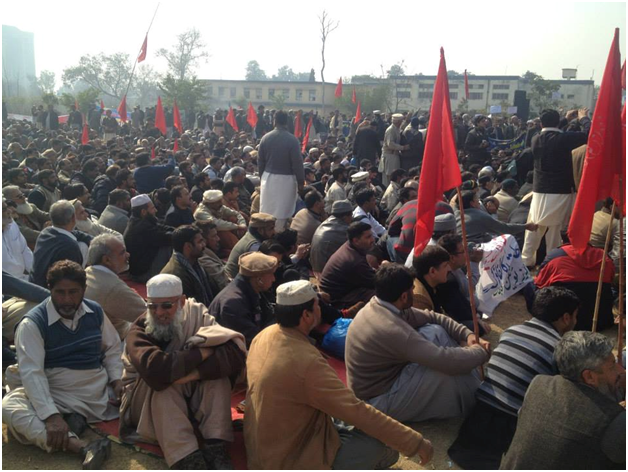
True and lasting social justice will be obtained through a political party of workers, the dispossessed and the politically aware intellectuals. Academic criticism by small groups of people over a period of time contributed significantly to mass and popular movements as happened in anti slavery, feminist and civil rights movements. Our rallies, protests and seminars might be worth it, if they resulted in heightened consciousness. Let us, though, not forget that the movements were led by a vanguard with fire in their belly, and they were not funded by the governments.
But times have changed. There is hope. In the era of instant communications, the Imperium and its agents can not get away with what the Europeans, mainly the British, the pioneers of biological warfare, got away with, in the past. They used small pox laden blankets against Red Indians and poison gas against the Iraqis post WWI. Churchill openly declared that use of gas against inferior races was justifiable.
Historical process is on the side of the people of Pakistan. It and the rest of under developed world, is groaning under the burden of the Imperium and their toadies. They will progress.
Notes:
[i] They engineered alienation on religious grounds, so that what were friendly neighbors till yesterday, butchered each other today. The more sensitive ones wore a mask while torturing and raping. The devious ones invited their co-religionists to abduct, bash the heads of, and incinerate innocent children.
[ii] They were not a colonial creation. In fact they owe their origin to the Sufi trend in Islam, which emphasized love, tolerance and respect for all creeds, colors and races. The founders of the houses had invariably been men of great character and integrity had exercised overwhelming influence over the populace and were largely responsible for mass conversion of Indians to Islamic faith. They never claimed semi-divine status or a special relationship with God, but their devotees- Hindu and Muslim- attributed miracles to them- exercise their power in a more sinister way. Their serfs are not only in physical thrall; they are in spiritual bondage as well. They send their progeny to universities, but education does not persuade them to shed their semi-divine status. They have a captive constituency, which they unabashedly use to advance their political ambitions. They will use any means to keep their land holdings in the family, and that includes marrying their daughters and sisters to the Quran. In the national assembly they will vote to repeal laws discriminatory to women. “Progressive” parties have to cater to their inbuilt clout
3 They had opposed creation of Pakistan on the spurious argument that all Muslims belong to one nation called the Ummah. Mullahs who had the courage of their conviction stayed back in India. Maulana Maududi founder of the most coherent Islamic party the Jamaat e Islami had been in the forefront of opposition to Pakistan. He migrated to Pakistan, but to be fair to him he never allowed the party to participate in electoral politics deeming the system un-Islamic. After his death the party fell in the hands of “ pragmatists” who wheel and deal like all politicians whose sole aim is to gain power.
[iv] Capitalism is sine qua non for democracy. A glance at the conflict between feudal and capitalist interests of the UK since the industrial revolution will suffice. Capital wanted democracy to abolish the hereditary privileges and power of aristocracy. Thanks to the clergy industrial workers were beholden to them and would vote for their nominees who would pass laws against the entrenched feudal interest.
[v] (Fascists like Hitler, Mussolini, Saddam and ZAB have historically been way more effective than military dictators. They have the support of the dominant section of civil society. How they go about obtaining it is a separate discussion.)
[vi] I am not prepared to accept that the politicians were helpless. I am not prepared to accept the argument that people are afraid of guns. We confronted Ayub's martial law in 1961, when the army had not yet been castrated by the 1971 civil war and people still had a modicum of respect for the institution. Students, supported by the people again went out on the streets in 1968 and shook the foundations of the army rule. When Ayub hounded ZAB out of Pakistan it was students who sustained him. He was living in self imposed exile in England making the rounds of pubs-I met him in one-lamenting to any one who would listen, how Ayub had victimized him, how he had fought for the gains the army had made in 1965, how Ayub had betrayed the country etc. We held his hand and offered him our unstinted support in Pakistan.| S.M.A. Ehtisham is a veteran progressive activists who was one the members of the University of Karachi Students who participated in the meeting of NSF in Karachi in 1955 when the process of takeover of NSF by progressive students started. Later he moved to Dow Medical College and participated actively in left-wing students’ politics. He is also author of a book titled “A medical Doctor Looks at Life on Three Continents” |