[Hindus frequently ill treated in Pakistan sends a chill down the spines of Muslims in India, the dirty minority politics of both the countries is a matter of big concern. Here is a brief review of the past and present Minority Politics of these nations. ]
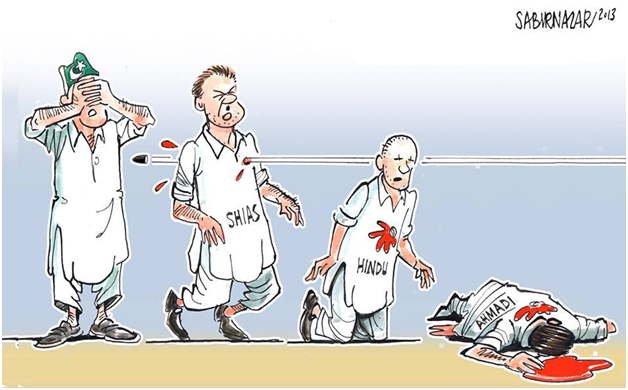
Pakistan has long ceased to shock me, it’s kind of Lebanon; Lebanon of the 80’s, when it was difficult to discern who was killing and who was making a killing of it? When senses get numbed, the killings get anesthetized. Nevertheless those 85 dead worshippers at the church on 22 September last year; and the recent cold blooded murder of Hazara Shias on board a bus succeeded, in sending a chill down my spine. The murders were also said to be put under headlines like; Cleaners cleansed! Since the creation of Pakistan such attacks have continued in numerous forms. Furious attacks on its minorities are also seen in Bangladesh. The Sachar Committee report is a mirror to the plight of the minorities in India. [Read more about it here ] In the sub-continent, minorities face, serious threats to life and property, riots and pogroms, forcible conversions, marriages and discrimination at the various levels of the civil society, and misuse of the blasphemy law. This has not just kept the minorities, Muslim and non-Muslim on their toes, but has also compelled them to live their endangered lives, tiptoeing to the vagaries of the bullish majority. Let’s have a look at different aspects of this issue.
A Brief Introduction to the Minorities of Pakistan:
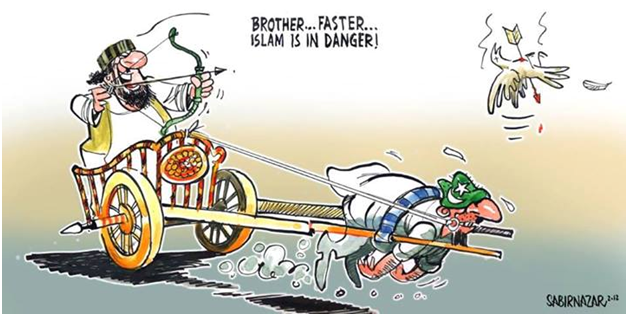
In 1947, Pakistan’s independence led to c.14 million people moving across the borders, with Pakistan receiving more than 8 million Muslims from all over India. Most came to West Pakistan (present-day Pakistan) and l.2 million Muslims were received by East Pakistan or present day Bangladesh.(1) The percentage of non-Muslim minorities was 23% of the total population of Pakistan at the time of Partition. Tellingly enough now it is reduced to only 3%. Increasingly the non-Muslim [Hindu] minority hasbeen seeking asylum in the parent country India, finding the livingin Pakistan getting harder and harder by the day.In Pakistan there are a number of minority groups, Muslim and non-Muslim. Shia is the biggest, almost 20 to 25 % of Pakistan population. Then there are ethnic Hazaras who also happen to be Shias, hence face double-edged sword of discrimination. They speak Persian, and are spread in and around Quetta. The Kalash community, said to be between 5000 to 6000 in number, lives around Chitral district, Khyber Pakhtunkhwa province and follows an animist faith, labeled as a Pagan group. Interestingly, the Kalash community as a tradition celebrates death! After a demise, they engage in festivities, for three days at the very place where the dead body has been placed. They have been complaining of threats and forced conversions. Another group that goes by the name Kihal is regarded dirty for they relish crocodile meat. Due to their being a nomadic tribe, they don’t have a permanent address and hence denied national ID cards, which translates into meaning that they are unable to vote. The country they live in, does not consider them citizens. They are denied even alms for the same reason. Ahmadi or Qadiyanis are regarded as heretics, for not believing in the essential concept of Prophet Muhammad [p.b.u.h.] being the last prophet. Christians are even worse off as they (unlike Hindus) are mostly in Punjab where there is more intolerance than Sindh.
According to a view, the Mohajirs [Muslim migrants from India who settled mainly in Sindh province, particularly in Karachi] too can be considered, a minority group. Elaborating further on this, a university professor friend from Pakistan confesses that, the Mohajirs today find themselves alienated. The reason ,according to him , is that, those who settled down in this sea side port had brought with themselves a distinct culture of their own and found assimilating in the new Punjabi/Sindhi ethos of Pakistan difficult. They were far more proud of their Indian roots, heritage and Urdu culture, [belonging mainly to Northern Indian state of UP] hence became fiercely protective of it. This trend continues even to this day.
Giving the Minorities A Square Deal:
A study of what our leaders wanted for their respective minorities would be quite significant to discern. In his famous speech at the Lahore session of Muslim League in March 1940 Mr. Jinnah was not one for the unity. He had said,
Islam and Hinduism are not religions in the strictest sense of the word, but are, in fact, different and distinct social orders…..The Hindus and Muslims belong to two different philosophies, social customs, and literatures…To yoke together two such nations under a single State, one as a numerical minority and the other as a majority, must lead to growing discontent and the final destruction of any fabric that may be so built up for the government of such a State.
Despite this rhetoric Mr. Jinnah seemed genuine when he promised the minorities that they would get a Square Deal. His epoch speech on 11 August 1947 asserts that, religion would have no business to do in the business of Pakistan! Going further he said something which can be taken as blasphemous in today’s Pakistan, he had said.
in course of time Hindus would cease to be Hindus and Muslims would cease to be Muslims…in the political sense as citizens of the state.
Our Mahatma being the all-knowing didn’t bite the bait and insisted that Jinnah’s promises needed to be weighed with the, corresponding deeds of ‘his’ fellow Musalmans. Their views about dealing with the respective minorities are illuminating. Contrary to the Mahatma, Mr. Jinnah took on Lord Mountbatten when the latter alluded to Emperor Akbar’s justice for the weaker sections of the society, circuitously imploring him to treat the minorities in Pakistan reasonably well. The formidable lawyer in return threw at the last Viceroy the original allusion from Prophet Mohammad’s times, saying:
tolerance and regard and respect for their [minorities] faith was in Muslim blood. (2)
He was referring to the teachings of brotherhood in Islam. Mr. Jinnah blamed the deeply complex social structure of India as an impediment in the way of its freedom. It would be a free country for sure, long ago, if not for this, he had regretted. The issue of the minorities must be important for him; he himself was one, a Khoja Shia and had married RattiBai , a Parsi , herself a minority on both sides of the border. He adopted the Muslim League flag as the official national flag of Pakistan, but with a change, a white strip as a symbol of Peace and it was for Pakistan minorities. Appointing JogendarnathMandal as chairman of the Constituent Assembly of his new born country was a special gesture, though viewed with skepticism on the Indian side. Mr. Jinnah along with Sister Fatima Jinnah had made it a point to attend the ‘Dominion Day’’ service at Romanesque Parish Church of Holy Trinity in Karachi on August 18th, 1947. Even if Jinnah had not passed away so soon after establishing his dream state, he would have found it increasingly difficult to arrest the tide of hatred brewing since the Partition. Coming back to the GreatSoul, it’s a known fact that Mahatma Gandhi’s proposals at the time, though well meaning, were scorned upon as pure naiveté by some quarters. He had insisted that Hindus remain in Sind, even at the height of riots. A leading publication of those days, The Hindustan Times, was sarcastic to one of his ideas. The Great Soul Mahatma Gandhi, it said, after opposing the idea of Pakistan all his political career, had decided to spend the rest of his life in Pakistan to protect the interests of minorities namely Hindus and Sikhs. Earlier Mahatma had refused a plea, Punjab needed his healing presence ,from his favorite disciple Nehru. (3), to visit the burning Punjab where a massacre was happening from Lahore to Rawalpindi. The atmosphere was explosive. With mass migrations, murderous mayhem with a rare cruelty and rumor mongering at its lethal best, assurances from the big leaders of the time had become vacant sounds which had lost all their voice. Mr.Jinnah is known to have showed least concern for the,’leftover’Muslims , who didn’t want to migrate. He was indifferent to them. NeverthelessMr. Jinnah was conscientious enoughto express his displeasure with the way Hidayatullah ministry handled the non-Muslim minority issue at the time. He was rightly concerned about the possible fallout of such an irresponsible act of negligence. He was said to have feared a chain reaction, where provinces with Muslims as minorities might face the consequences of what their fellow religionists did elsewhere. This was and is the crux of this complex issue, a tit for tat politics, a tit for tat murder. You kill our man and we kill yours. This smells bad; same as the famed rhetoric of 2002, Every action has an equal and opposite reaction. Remember?
Now we also have him saying that Hindus from Bangladesh should be allowed to settle in India. The BJP Prime Minister designate is playing his favorite game again that had begun in 2002, with the only difference that now, after winning the state levels, he is now trying for the national level championships.
Part II
Minority Politics or Hostage Politics?
The news of minorities ill treated in Pakistan sends a very wrong message here. The most unfortunate result of this divisive communal politics discussed in part 1 of this essay; was emergence of the Hostage Politics. Roughly, what it means is that, if a Hindu was/is harmed in the Land of the Pure, then a Muslim had to pay its price, living in Hindostan. Politicians of both the faiths had no qualm in asserting this ugly truth. It was a hidden threat, the ugliest way to tell them, that, we would be doing the same, if you do it. It also had an inbuilt advantage of conveniently blaming the, ’other’ party for the mayhem one caused. Leaders of the pre-Partition era though were desperately trying to do something about this, sensing a huge threat of violence to the minorities, wherever people became one. J.B Kriplani, the socialist Sindhi leader and president of Congress party during the crucial period of the Partition, supported a joint committee to protect the minority rights. He urged the minorities in Pakistan to not lose hope and believe in Muslim League promises of safeguarding their interests. Being the politician that he was AcharyaKriplani had proudly declared,
Pakistan can’t afford to ill treat Hindus. If 20 million of Hindus were included in Pakistan, 45 million of Muslims came within Hindustan. (4)
Here you see resonant politics perhaps at its best (or worst?). Moulana Azad, whom Jinnah used to ridicule, as Show Boy of the Congress, for his presumed ineffectiveness, was worried too. On 29 June 1947, in a press statement, Moulana Azad astutely suggested a joint meeting of the constituent assemblies of the soon to be neighboring countries India and Pakistan, and making of a Common Charter of Rights of Minorities in the two countries. But voices like Kriplanis and Azads often remain lonely even among their own. Considering the pitiable condition and a most awful treatment of the minorities in Pakistan today, it is ironical to note that, under the Nehru-Liaquat Agreement of 1950, for the purpose of the protection of minorities;Pakistan had insisted on the creation of a new Ministry of Minorities, setting up of a minority commission, appointment of minority representatives in the council of ministers etc. in each state of free India! Home Minister of the time, Sardar Patel opposed this proposal tooth and nail, saying it was akin to putting poison in the Indian governmental machinery, and termed it,
submission to an external force called Pakistan who had itself liquidated its own minorities on its territory.
He continued,
We have conceded one Pakistan; that is more than enough. We cannot promote any further such mentality, let alone do anything which will perpetuate it.(5)
Are Minorities Loyal to their Country?
The issue is also that of the integrity and loyalty of the minorities being under the cloud of suspicion perpetually. The AzeemQaid of Pakistan too didn’t mince words when he spoke about the duties of a non–Muslim Pakistani. In a press conference in Delhi on July 13th, Mr. Jinnah emphasized the need for the minorities , ‘to be loyal’ to Pakistan.
They [minorities] will be in all respects the citizens of Pakistan without any distinction of caste, colour, religion, or creed. Along with it goes the obligation of citizenship…As long as the minorities are loyal to the State and true allegiance, (and) as long as I have any power they need have no apprehension.
[ Same is the case with the Indian Muslims who are continually under pressure to prove their loyalty. The tragic irony of the situation is such that the epithet ghaddar [traitor] or Pakistani!] has stuck with us. As KhaderMohiuddin, a poet from Hyderabad, puts it like this,
Long before I was born
My name was listed
Among the traitors,
Where circumstances “make me a refugee
in the very country of my birth.”
Commenting on the absurdity of questioning Indian Muslims’ loyalty, which has forever remained under doubt, the great Bengali intellectual ,M N Roy had written:
“The establishment of the largest Muslim state meant, leaving many millions of Muslims in the lurch. Having been fighters for Pakistan, the millions of Muslims left in the Indian union are in the most difficult position. Most of them feel betrayed. Jinnah was fully conscious of that tragedy, which must have haunted his last days. Indeed the homeland for the Indian Muslims was a Utopia; any territorial division was bound to leave many millions of them out in a very delicate position of being regarded as aliens, suspected of disloyalty to the land they must live in.” (7)
This whole business of their loyalty being under suspicion is something that simply bewilders Indian Muslims. We are forever in the dock. KhaderMohiuddin captures the predicament rather well:
My religion is a conspiracy
My prayer meetings are a conspiracy
My lying quiet is a conspiracy
My desire to have friends is a conspiracy
My ignorance, my backwardness, a conspiracy
On the other hand, says Khader!
It’s no conspiracy
to make me a refugee
In the very country of my birth
It’s no conspiracy to poison the air I breathe
And the space I live in
It’s certainly no conspiracy
To cut me to pieces
And then imagine an uncut Bharat
Recently some at Meerut university some 67 Kashmiri students were suspended for the folly of celebrating the Pak victory in the Championship league matches, in Bangladesh. Indo-Pak cricket games are the most reliable tools to make the matters tense. With regard to the relationship between cricket and India-Pakistan equation the poet says,
Cricket matches weigh and measure my patriotism
Never mind my love for my motherland
What is important is how much I hate the other land
The Indian Muslim has been carrying this cross of Partition around his neck since it transpired. ] Their condition as illustrated in the Sachar Committee report shows an ugly picture in the mirror of the Indian democracy. Voicing thisMajority-Minority dilemma, at a conference in New Zealand, its human rights commissioner Justice John Wallace spoke thus:
The minority is generally right, provided the minority can carry the majority with it.
But this game of Majority-Minority politics, is too precarious and too dangerous to speak about. The problem of resonant minority politics became severe with the partitioning of lands, rivers and populations of the Sub-continent. Y. B. Chavan the Home Minister in 1969 had astutelypinned the problem of Minority vs Majority politics down this way while replying to a debate on Ahmadabad riots.
There is the majority community’s communalism and there is the minority community’s communalism…But I would like to repeat that in a country like ours, the majority community has a special responsibility to demonstrate that their activities are more secular.
(in the Indian Parliament in 1969).
Internationally respected legal luminary,Fali.S.Nariman in his latest book, The State of the Nation, is eloquent enough to state thus:
When we in India discuss the state of the nation, we should never forget the historical context: Minority with a small ‘m’ must be the watchword. Minority with a small ‘m’ helps to carry the majority with it. And I would respectfully suggest to my Hindu brethren that ‘majority’ with a small ‘m’ also helps to carry the minority along! Thepossibility of conflict arises when one or other of these groups stresses the big ‘M’ factor.(9)
While the minorities of the subcontinent, Hindus, Muslims and Christians are struggling and pining for a peaceful, dignified and suitable survival in their motherlands; let’s hope that both the majority and minority communities of India, Pakistan and Bangladesh grow to be wiser and responsible, and seek to be majority and minority , always with the small, ’m’.
References:
1] Report: Religious Minorities in Pakistan, by Dr.Iftikhar H. Malik, Minority Rights Group International, London,pg.4
2] KhairiSaad R, Jinnah Reinterpreted, 1995, pg, 465
3] 21, August, 1947, in a telegram to Mahatma Gandhi.
4] AICC Papers: Nehru Memorial Museum and Library.
5] In a letter dated 6 April 1950, addressed to N. GopalaswamyAyyangar, who was a minister without portfolio.
6] In a press conference in Delhi on 13 July, 1947.
7]M.N.Roy ,The Men I Met, 1968, an essay on Muhammad Ali Jinnah in Independent India, September 19, 1948 , Janta Publications
8] in the Indian Parliament in 1969.
9] FaliS.Nariman, The State of the Nation,Hay House India, 2013
Note: By big ‘M’, Fali S Nariman implies the majority’s using their advantage of numbers as an instrument of power, hence leading to its possible misuse and by small ‘m’ a non –violent, practical community with the aim of eliminating the cause of the suffering.