 It looks the long agitation that began from Lahore on August 14 last year has finally ended in Islamabad with a happy ending for its leader Imran Khan who recently got married and not-so-happy outcome for the other leader Tahirul Qadri who left the country to rest in his permanent home in Canada.
The Dharna, ended without achieving its main objective of ousting Prime Minister Nawaz Sharif and his elected government, became a new kind of reality show on all TV channels with minute-to-minute reporting on a daily basis.
Beyond verbal insults and shallow arguments, however, the TV coverage never came up to the level of analyzing serious issues like the real objectives of the agitation, demonstrators’ social structure, their rationale to participate in the sit-in and the nature of political rhetoric employed by its leaders.
The two firebrand leaders---Imran Khan and Tahir-ul-Qadri---carefully selected themes of political rhetoric invoking religious, patriotic, rebellious, and emotional appeals to their captive audience. Both were successful in masterfully exploiting the growing public discontent on social, economic and political issues and unexpectedly sustained the protest for a longer period.
Revolution was the magical mantra for Tahir-ul-Qadri who was trying to convince the public that once the elected government is gone and he comes to power everything will be fine. By citing daily hardships of the people including power shortage, price hikes, terrorism and corruption, he was trying to transform public frustrations into a mass unrest.
Rightfully calling the system as corrupt and elitist, he promised a new social order based on justice and equity for all. How he would achieve these objectives through what kind of process was the real question left for everyone to ponder. The whole rhetoric was emotionally charged and extremely hostile with little details of the promised revolution.
Because the social formation of most of his audience was middle and low middle class religious devotees, he invariably provoked their religious sentiments in his daily sermons by skillfully playing with his followers’beliefs.
Patriotism, being an easy slogan to be exploited, became another consistent theme of his rhetoric where army was symbolized as the only patriotic, honest, and professional institution while political leadership was rejected altogether as corrupt and inefficient.
Imran Khan, on the other hand, was embellishing his popularity to reconstruct his image from a talented sportsman to a successful political leader. First, he reinforced his image as a successful player by using familiar cricket terms and repeatedly referring to himself as the “captain” who never lost a match in his cricket career. By doing this he was projecting himself to his male fans as a dependable catalyst for change and a qualified bachelor for his female followers.
Politically savvy, ignoring the real issues of provincial autonomy, terrorism, freedom of expression, minority rights and gender equity, he continued complimenting armed forces and even raising expectations of his audience declaring that the “umpire” would soon come to their rescue.
To resolve political, social and economic issues, “freedom” from the current leadership and building a “New Pakistan” with him as the new prime minister, were his major recipes. Beyond these catchy terms, however, nobody knew what he actually meant.
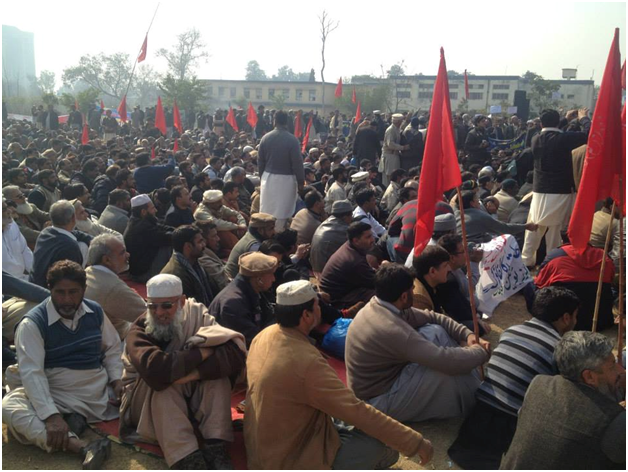
While the social formation of their followers was fundamentally different, both leaders worked together to achieve the same goal of dismantling the elected government. For Qadri’s followers, the sit-in was a religiously motivated ritual commanded by their spiritual leader where not only the family patriarch but the whole family was following the leaderas a sacred duty.
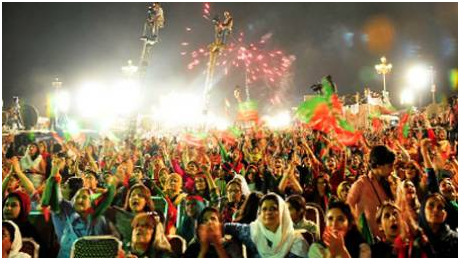
Imran Khan, on the other hand, banking on his fame, was appealing to the urban-educated youth who is frustrated by the prevailing status quo in the country. This middle class youth was searching for its role in the “New Pakistan” that Khan was promising to them.
By challenging the status quo, he was also trying to convert the public to a solid voting bloc in his favor for next elections which he failed to build in the last polls. Knowing that the frustrated youth also forms a large proportion of the Pakistani society, he was strategically positioning himself as their savior.
Both leaders also devised inspirational rituals to engage their followers throughout the sit-in.While the cleric was trying to involve a religious audience with religious rituals and prayers, the captain was entertaining the youth with innovative techniques of speeches interrupted by musical intervals and folk dances.
Besides the political rhetoric, participating men and women were in fact loyal followers of the two leaders who were already convinced and needed no political reinforcement. Apparently the participants were being used as street power while the real target audience was the general public out there watching the reality show on TV screens.
The prolonged agitation lost its credibility among the public when another senior leader of Imran Khan’s own political party, Javed Hashmi, exposed the whole drama as a well-planned conspiracy hatched in London a year ago, ostensibly sponsored and supported by the armed forces.
Although the political rhetoric terribly failed in achieving its goal of toppling the elected government, it successfully sustained demonstrations for comparatively a long period which signifies the public discontent over the inefficiency of the government in resolving their genuine issues.
It looks the agitation campaign has also been successful in unleashing a wave of political activism across the nation by several political parties organizing large public rallies in different cities.
Besides the credibility of this extraordinary political drama in Pakistan, the real question remains: Would a genuine leadership in the future be able to transform this public outrage into a real struggle for social change?
(An earlier version of this article has been published in Asia Times).
Qaisar Abbas, Ph. D., is a university professor/administrator, media analyst and political commentator based in Maryland, United States. He has worked in Pakistan as a News Producer for Pakistan TV and Information Officer in the province of Punjab. He can be reached at This email address is being protected from spambots. You need JavaScript enabled to view it. .