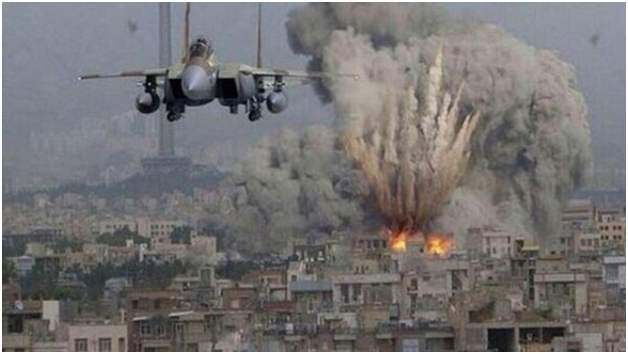
However, it is simplistic to attribute violence to a creed. The root cause of nearly all violent acts can be traced to economic factors. Religion provides a vehicle, legitimacy, or at best rationale to aggression
Violence in the current day and age is regarded by most Muslims living in the East as a reaction to inequity, injustice, and disempowerment, real or perceived. Stronger nations attack weaker ones when the latter have either refused to be compliant with the objectives of the former or have actually managed to hurt their economic interests.
In the western countries, violence is attributed variously to fanaticism, clash of cultures, poverty, lack of education so on and so forth. Muslim residents of western countries, by and large, condemn acts of violence against innocent people, but would want the people in the West to understand the reasons why a person would deliberately sacrifice his life.
Examples of violence by the strong on the weak are many and come from the very earliest times of known history. Egyptian, Greek, Roman, Persian, Arab, British, French, Spanish, Dutch, Portuguese, Italian, and Russian empires come easily to mind. They invaded the weaker people to plunder resources.
However, it is simplistic to attribute violence to a creed. The root cause of nearly all violent acts can be traced to economic factors. Religion provides a vehicle, legitimacy, or at best rationale to aggression.
All religions are based on the fear of the unknown. They were and are practiced to propitiate the supernatural for the common good. I am not committing heresy. All “non-divinely” inspired religions worshipped natural phenomenon, lightening, rain, storms, earthquakes, fire, floods, sun, and moon etc. Male dominance had not taken firm roots, so they had female deities in nearly equal numbers.
‘Divine’ religions exhort us to fear God, the Day of Judgment, reward for good, retribution for evil, sight unseen. God has sent messengers with a set of instructions on a body of beliefs, code of behavior, on how to propitiate Him, without a word on how to find or recognize Him. One is expected to believe in His existence without reason or rationale. We are told that our faculties are not developed enough or God has not endowed us adequately enough to be able to do so. God remains largely unknown.
All religions reacted to the prevailing milieu, and confronted the established order. They appealed mainly to the disempowered, the destitute and the poor. The rich, the powerful, and the learned had all the privileges already. They ignored the emergent creed, did not see any good reason for change, which would, in any case affect their interests adversely, and tried to suppress the new forces with naked force, bribes and temptation, whatever would work. The prophet of Islam was offered riches, women, and positions of authority, if he would only give up his “pointless” preaching. They failed in every instance with all the prophets.
Religions attempted to eradicate social evils, and economic inequities. The ruling classes took measures to preserve their authority. They controlled the ‘administration, the legislature, and the judiciary’. These offices did not exist in their current form, but members of the ruling class did administer, make rules and sit on judgment. They treated the poor abominably, indulged in slavery, tightened their stranglehold by such measures as exorbitant interest rates, forced and bonded labor, serfdom, and claim on the major part of the produce of the peasantry.
The ruled had no recourse. All the levers of power were in the hands of the ruling class. If they ran away and were caught, the punishment would be worse than death. If not caught, starvation would be the fate of most.
Religion did not hit at the root of privilege. It only aimed at amelioration of the living conditions of the powerless. Private property remained sacrosanct. Slavery was not abolished; the owners were exhorted to treat them humanely. Women remained the underclass.
All religions frowned upon usury. Once financial institutions and banking developed, interest became indispensable. During European renaissance, financiers got around the prohibition on interest by calling it commission, cost of labor, and payment to agents etc. Witness, the Pakistan government calls is ‘mark up’.
Judaism was less restrictive. Jews excelled in financial dealings. For their pain, the Popes cursed them, and Shakespeare immortalized Shylock.
Calling a person a Jew was an insult. You called them Jewish. This was so in mid-sixties Britain. Even as late as 1975, one of my patients in a Jewish Hospital in NYC, an old man of 94, told me that he was not ashamed of being a Jew!
It has been due only to the extended guilt trip since WWII, that the Popes and, other Christian clerics have stopped wishing perdition on the Jews and have invented the concept of Judeo-Christian civilization.
Fundamentalist Christians believe that the Messiah will not descend from the heavens till the Jews have captured all ancient territories of Judea and Samara. Only then would the redeemer annihilate all the Jews and usher in the kingdom of heaven on earth. They, therefore, support the state of Israel fervently. Former US president, George W Bush, does it for the same reason.
Jews happily accept Christian support, do not worry too much about the peril that they will be subject to, if the Christian theology were to prove to be correct, and are confident enough to let the future take care of itself.
Violence is initiated against a new faith/reformist movement to protect status quo ante.
Pharaohs persecuted the Jews, dumping them into the Nile. In their turn, Jews did not hesitate a bit, sending one of their own to the gallows. Christians were fed to the lions, and then Christians started burning heretics, conducting inquisitions and going on crusades, massacring Muslims till blood was knee deep in the streets of Jerusalem.
A Muslim, a slave Bilal by name, suffered the scorching sun of the desert with a heavy weight on his chest, others stood up to all kinds of physical and mental tortures, exile and privations, did not hesitate in even giving up life for their faith. But when they had attained power, turned around and offered the non-Muslims a) conversion to Islam with second class status relative to Arab Muslims- the relic of the practice has lasted to this day. In order to work, or do business in most Arab countries, you need a “Wali”, protector, b) payment of tribute, which would entitle them to exemption from military service, which they could in any case not enter, liberty of practice of their religion in private, family laws per their own faith, but in public domain they would remain subservient to Muslims, for example their status as a witness would remain subsidiary etc, c) the point of the sword.
Zoroastrianism was wiped out of its birthplace Iran/Persia.
Hindus, after a thousand years of Muslim rule, during which the “upper” classes adopted many mores of Iranian/Arabic/Mongol culture language, went for Muslim blood with a vengeance, as soon as came under the patronage of the new British masters.
This is not to say that all the adherents of a faith in each case went berserk. There are glowing and redeeming examples in the followers of all religions. I am only referring to the dominant, albeit tolerated by the majority, trends.
After replacing one establishment, all religions organized their own hegemony. The adherents then proceeded to use the faith to advance the cause of the followers of the faith. Hegemony inevitably develops a class structure.
Jewish priests objected vehemently and violently to Jesus Christ bucking the trend, challenging their right to privileges and a life of luxury. Voodoo practitioners keep their hold on popular mind by subjecting the deviants to exorcism. Christian priests accumulated great wealth, land, and authority rivaling that of Kings, the Popes actually had their own country, vestiges can be seen even now in the Papal state in Rome. The clergy firmly aligned itself with the landed gentry, supported the established order, exhorting the poor to obey the ruler, suffer deprivation cheerfully, palming them off with the lure that the Kingdom of heaven will be theirs, as long as they do as they are told in this life. It was symbiotic existence; feudal class supported the clergy and was legitimized by the latter.
The thread of supremacy of authority runs through all religions. Islam ordains that one should obey the ruler, as long the ruler does not interfere with the private practice of the faith.
Among the divinely inspired religions, only Islam founded a political state in its early infancy. But the late advent of a political control did not prevent the followers of other belief systems from going forth, marauding and plundering in the name of the faith. Conspicuous in this behavior were the Christians, who openly flouted the teachings of their prophet to offer the other cheek.
But first in the field of colonization in the name of their faith, were the Muslims. Jihad, and proselytisation were among the core articles of their faith.
Emerging from the wastelands of the Arabian desert, they managed to conquer most of the known world in a matter of a few decades. They had been energized by the conviction that everlasting salvation lay in the true path. They did not object if riches, land, and women fell into their lap in the process.
The vanquished did not surrender without a fight. Resistance was fierce. There is credible evidence that after the main battles, people fought on in guerrilla fashion. I have come across Christian equivalents of Nasim Hejazi novels (nostalgic tomes in which nubile girls in Spain, invariably fall in love with Muslim warriors, convert to Islam and live happily ever afterwards) in which heroines chaffed at being forced to accept Islam and were forever on the look out to reconvert to the true faith.
Communications were poor, the concepts of nationalism and patriotism were in the distant future, people accepted every ruler as long they were left alone to pursue their own private affairs. One ruler was pretty much the same as another, they did not worry too much about the rulers faith, race, nationality or color. Rulers also tended to, after gaining complete control, treat all the subjects equally well or poorly. So there were no instances of wide spread insurgency.
With decline of Muslim power- all empires run out of steam in due course- and nearly simultaneous European renaissance, Christian cast their covetous eyes on the riches of the East. Advent of the Industrial revolution in the same time-frame made them invincibly potent. They went forth as traders for spices, gold and handicraft. The first was critical, their own land being cold, and productive only during short summer months; they had to keep food for long periods of time. There was no refrigeration, natural ice and snow not being consistently reliable, food, especially fish, often went bad. Its odor had to be suppressed, hence the value of pungent spices.
They found riches beyond dreams of avarice. The rulers in the East were highly cultured and sophisticated, but unbelievably, in the eyes of rather coarse Westerners, indolent. Oriental potentates looked down, with good reason, on Europeans. They have derogatory terms for the foreigners, all meaning uncouth, unlettered, and uncivilized.
The Europeans swooped down on the East, as well the Americas, finding rich pickings everywhere. The idea of spreading Christianity was an added bonus. But that did not keep them from using all kinds of measures and subterfuges, immoral in their own books, to subjugate the natives. The much maligned, and justifiably so, Saddam Husain, had bible toting predecessors. The English immigrants, economic, religious, and political refugees, escaping starvation, discrimination and destitution in their home countries, were welcomed by the American natives, given shelter and food, and paid the debt back by gifting small pox infested blankets to their hosts. This was the first recorded use of biological warfare, and that too on non-belligerents. The natives not having been exposed to the virus before, had no immunity and died in their hundreds of thousands.
I do not believe Saddam was rescued from certain peril by the Shias and Kurds before he killed hundreds of thousands.
Power and dominance lend legitimacy. No one talks about the genocide perpetrated by the English. It is only a footnote in history.
The Europeans captured vast colonies and exploited the resources for their own ruling class. Remember, even at the height of their power, the ordinary British citizen, often, went with out a job, food shelter or protection under the law. Debtors jails were bursting at the seams, malnutrition common, child labor universal, twelve-hour working days, it all was the norm. Similarly, bonded labor and serfdom were accepted facts of life. The lord of the manor owned the peasants body and soul, often taking his pleasure in female (and male) bodies, prostitution was rife, physical punishment, beatings etc were permissible.
If you do not believe me, do read Charles Dickens and Somerset Maugham.
If the ruling class treated their own kind this way, you do not have to stretch your imagination too far to make an educated guess of the treatment meted out to the ‘natives’.
The British were the leading colonists. It is they who left a mess behind. It is they who were primarily responsible for the creation of Israel/Arab conflict. They gave mutually exclusive pledges to both sides, and cut and ran when the going got too tough. Let us concentrate on them.
By 1850, the British had all of India in their firm grip. On paper, though, they still ruled in the name of the Moghal ‘Emperor’ Bahadur Shah whose writ ran only over the famous Red Fort. But the Head of the East India Company had to appear before him, hat in hand, every year to pay ceremonial tribute. He had to stand during the audience, and walk back out of the sight of the ‘Emperor’. One of them requested that he be excused from making the annual appearance, or at least be allowed to sit in the presence and permitted to walk with his back to the King. Bahadur Shah indignantly turned the request down.
Indians, high and low, Muslims and Hindus, got together one last time in 1957 and nearly got the British out of the country. Mention of one of the reasons of the failure of the revolt, War of Independence if you will, is relevant to our discussion. Most of the Jihadis of Pakistan are the progeny of the Indians who had supported the British. Perhaps the historic guilt is driving them.
The British were, and are, past masters at the art of divide and rule. They had honed their skill during European wars, and patronized Hindus and Muslims in turn. After the crusades, in which the British had played a leading role too, it was they who used the religious divide as an instrument of policy. They also promoted Shia-Sunni conflict. One of their paid agents, a Maulana of the Frangi Mahal (a renowned house of Muslim Scholars) of Lucknow wrote a pamphlet in the nineteen forties that it was the Shias who had martyred Imam Husain. He insisted on taking out a Madhe Sahaba (adulation of the first four pious caliphs of the Prophet of Islam) procession through Shia localities. A Maulana from Lahore used to accompany him. The British gave permission for the procession to parade through the route. Quite a few Shia-Sunni riots ensued.
Insiders let the cat out of the bag. The Frangi Mahli Maulana had been gifted a printing press by the British administration and was on a regular, and generous stipend.
Post WWII, with the Empire gone they passed on the torch to international corporate hands.
They had left festering wound behind. Chronic infections metamorphose into cancer. Kashmir and Arab-Israeli conflicts no longer need promotion and have spawned generations of ‘terrorists’. Terrorist label, like most other labels invented by humans, has an unpredictable shelf life. Only the other day, a true blue American observer pointed out that fathers of this nation were dubbed terrorist by the British. In more recent memory, Menachim Begin, former Israeli prime minister, had a price on his head after he had blown up King David Hotel in Jerusalem. Yasser Arafat after heading the list of ‘terrorists’ for a considerable time was feted at the White House. The US officials are trying to open lines of communications with the Taliban.
Advent of oil and the consequent dependence of capitalist economy on it, catapulted the Middle Eastern countries into a position of consequence. These countries happened to be Muslims. The rulers, creations of colonists, one and all, were all too amenable to foreign control.
The conflicts in the Middle East have taken many forms. One aspect is ‘individual terrorism’.
Poverty, lack of education, and indoctrination are some of the favorite explanations.
There is an element of truth in all the proffered reasons. Not all suicide bombers are illiterate. Many come from affluent households. The TV pictures of Madrassahs (seminaries) with children reciting the Quran, which they obviously do not understand, would not appeal to an educated person. The British suicide bombers were born and brought up in Britain. That country offers free health service, nearly free college education (completely free in Scotland), and a decent welfare system. One of the bombers was teacher of children with learning difficulties. He was well respected and had to be a sensitive and considerate person to be able to cope with his job. How the Al-Qaida operatives got to him needs careful analysis.
Apologists lament that Islam does not sanction mindless killing, that suicide is a sin in Islam etc. But the promoters of the acts of terror appear to have equally valid authority to back up their claim that suicide bombers are fighting injustice and killing for good cause.
I do realize that in a body of belief a millennia and half old, there are bound to be difference of opinion. But I have yet to see a comprehensive analysis, from the East or the West, encompassing all the manifold aspects of the inspiration behind terrorism. The subject merits careful study and research into the mindset, methods, and inducements the terror operatives use, if introducing a just dispensation would curb their appeal and lure. Western academic indulge in platitudes. Governments have tried military solutions. Ideas, however nefarious, cannot be controlled by mindless force.
| S.M.A. Ehtisham is a veteran progressive activists who was one the members of the University of Karachi Students who participated in the meeting of NSF in Karachi in 1955 when the process of takeover of NSF by progressive students started. Later he moved to Dow Medical College and participated actively in left-wing students’ politics. He is also author of a book titled “A medical Doctor Looks at Life on Three Continents” |