 'Hai kahan tamanna kaa doosra qadam, Yaarab
Hum nay dasht-e-imkaan ko aik naqsh-e-paa paayaa’
"Where is the second footstep of longing, oh Lord?
The desert of possibility was but one footstep"
Divaan-e Ghalib, ghazal 4, unpublished verse.
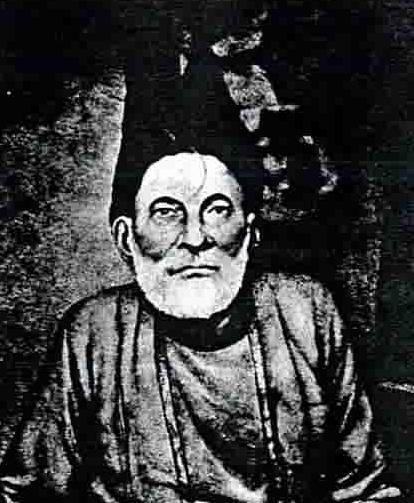
The abstruseness of Mirza Ghalib's poetry was legendary, almost from the moment he started writing it as a young man. In fact, it was one of the most common criticisms, and there were many, leveled against his work. Initially, Ghalib, with his customary cavalier attitude, dismissed such criticisms as the carping of lesser intellects. Eventually, though, he made an effort to acknowledge his critics and later still, admitted that some of them may have been correct. There are many reasons for the complexity of his works, not the least of which is that Ghalib lived in an era when Urdu was still coming into its own as the 'lingua franca' of Northern India. Persian, the language of the Mughal conquerors was still the language of the court and most people were conversant in both spoken and written Persian. In addition, although Urdu, the language formed during the Delhi Sultanate and the Mughal Empire, had been formalized by Ghalib's predecessor, Meer Taqi 'Meer', if one hoped to make a mark as a writer, poet or any kind of literary personage, Persian was the first choice. Persian was also a much more ancient and thus more richly developed language, more conducive to poetic metaphors and similes. Accordingly, most of Ghalib's poetry is heavily Persianized and assumes more than a working knowledge of it. In addition, unlike Meer, Ghalib made no effort to make his poetry accessible to the non-literary reader, quite by design. Although he was convinced of the greatness of his poetical works, he remarked presciently that the true worth of his poetry would only become evident after he was long gone.
The density of Ghalib's poetry strikes one as soon as we open his 'Divaan' (complete works). By tradition, the first poem of a Divaan is a 'Hamd', an ode to the Almighty and Ghalib's Divaan begins with one of his most loved and most recited ghazals:
'Naqsh faryaadi hai kis kee shoukhi-e-tehreer kaa
Kaghazi hai pairhan, har paikar-e-tasweer kaa'
'Against whose mischievousness is the image complaining?
Every figure is garbed in a paper robe'.
Ghalib himself explained the second verse (Anjum 1985) as referring to an ancient Iranian custom in which someone seeking justice would appear before the king wearing a paper robe as a symbol of protest against injustice. The first verse is more enigmatic still until one remembers that this is a 'hamd'. The 'image' is Creation itself, us, the world around us and everything in the Universe which is lamenting the whimsy of the Creator at having created it. Existence itself is like pictures, merely notional and, as such, it is a cause of grief and sorrow and suffering. He goes on:
'Kav kav-e sakht jaan-e-hai tanhaee naa puch
Subh karnaa shaam kaa laana hai ju-e sheer kaa'
'Ask not about digging through the tough life of solitude
Turning night to day is like carving the milk stream'
Here is a reference to the fabled Shahnama, an enormous poetic opus written by the Persian poet Ferdowsi around 1000 AD and a favorite subject of writers and poets through the ages .The Shahnama, considered the national epic of Iran, tells of the mythical and historical past of Iran from the creation of the world up until the Islamic conquest of Persia in the 7th century.
This verse refers to story of the love of the Sassanian King, Khosrow II towards his Christian princess, Shirin. It recounts the story of King Khosrow’s courtship of Princess Shirin, and the vanquishing of his love-rival, Farhad by sending him on an exile to Behistun Mountain with the impossible task of carving stairs out of the cliff rocks. In one version, the unfortunate lover, Farhad, is exiled and sent to carve a ‘stream of milk’ through a stone mountain if he wants to win the hand of Shirin. This story (and particularly the carving of the stream as a metaphor for accomplishing something close to impossible) finds reflection in the poetry of many poets of the region through the ages. Ghalib continues:
'Jazbaa-e-bay ikhtiar-e-shauq dekha chahiyay
Seena-e-shamsheer say bahar hai dam shamsheer ka'
'Oh, to observe the unrestrained passion of the sword
Whose breath spills out of its chest'
Mirza says the unrestrained passion of the lover to die for the beloved has infected even his sword which is struggling to jump out of its scabbard to slay him for love.
The next verse is an admission by the poet about the obscurity of his verses and the difficulty even the learned, or perhaps Ghalib himself, have in understanding them.
'Aagahee daam-e-shunidan jis qadar chahay bichaey
Mudda'aa Anqaa hai apnay aalam-e-taqreer kaa'
'No matter how awareness spreads its net of hearing
The goal of my speech is the Anqaa'
The 'Anqaa' also known in Persian as 'Simurgh' is the modern Persian name for a fabulous, benevolent, mythical flying creature. The figure can be found in all periods of Greater Iranian art and literature, and is evident also in the iconography of medieval Armenia, Byzantium and other regions that were within the sphere of Persian cultural influence.
The Simurgh made its most famous appearance in the same ‘Shahnama’ mentioned above which relates how Zal, the son of Saam, was born albino. When Saam saw his albino son, he assumed that the child was the spawn of devils, and abandoned the infant on the Alborz mountain.
The child's cries were carried to the ears of the tender-hearted Simurgh, who lived on top of this peak, and she retrieved the child and raised him as her own. Zal was taught much wisdom from the loving Simurgh, but the time came when he grew into a man and yearned to rejoin the world of men. Though the Simurgh was terribly saddened, she gifted him with three golden feathers which he was to burn if he ever needed her assistance.
Upon returning to his kingdom, Zal fell in love and married the beautiful Rudaba. When it came time for their son to be born, the labor was prolonged and terrible; Zal was certain that his wife would die in labour. Rudaba was near death when Zal decided to summon the simurgh. The simurgh appeared and instructed him upon how to perform a cesarean section thus saving Rudabah and the child, who became one of the greatest Persian heroes, Rostam.
In Arabic story tradition, the Anqaa's single defining trait is his not-there-ness. Whenever you try to catch him, he's gone. Thus in poetry and literature 'the meaning is an Anqaa', is also an idiomatic way of saying that something is meaningless. Ghalib thus, rather ruefully, admits to the obscurity of his verses and says their meaning is sometimes beyond even their author.
It should be noted that Ghalib was a great admirer of the metaphysical, Sufi poets including Bedil, Hafiz and others and his Divaan is replete with references to the same. The works of Sufi mystics are meant to be intelligible only to those who have been initiated into its secret meanings and are thus, inaccessible to the casual reader. While Ghalib proudly claimed that heritage, he was also never far from making fun of himself as in this verse:
'Yeh masail-e-tasawwaf, yeh teraa bayaan Ghalib
Tujhe hum wali samajhtey, jo naa baada khwaar hota'
'These matters of Tasawwuf (Sufi wisdom) and your poetry, Ghalib
We would accept you as a prophet, if only you weren't a drunkard'
He ends this ghazal with another characteristically dense verse:
'Baske hoon Ghalib, aseeri mein bhi aatish zair paa
Moo-e-aatish deeda hai halqaa meri zanjeer kaa'
'Although in bondage, Ghalib, I am restless (such that)
A singed hair is a link of my chain
'Aatish zair paa' (literally, 'fire under foot') is a beautiful literary simile for restlessness, the urge to not stay still but what could the second verse mean? As it happens, even litterateurs disagree.
On her comprehensive website “A Desertful of Roses: The Urdu Ghazals of Mirza Asadullah Khan ‘Ghalib’” Dr.Frances Pritchett cites some examples of what litterateurs make of this verse:
Bekhud Mohani thinks the circles of the chain look like eyes-- eyes which are fire-raining and from which sparks of the fire of love are emerging, and which make the prisoner of love restless and uneasy.
Vajid thinks Ghalib is referring to the fact that even though the lover is in chains, they cannot restrain him because the fire of his love burns the links of his chains like a hair exposed to fire (Moo-e-aatish deeda, literally, 'a hair that has seen fire'). Still others have dismissed the verse as meaningless.
Ghalib was well aware that many considered his poetry unnecessarily complicated, others dismissed it as indecipherable. He never attempted to remedy this although he acknowledged his critics in his poetry, remarking once, rather ruefully :
'Mushkil hai z-bas kalaam mera ae dil
Sun sun kay issay sukhanwaraan-e kaamil
Aasaan karnay kee kartay hain farmaish
Goyem mushkil w-gar na-goyem mushkil'
'Complicated is my expression, o heart
'"Simplify it!" say the learned ones upon hearing,
burdened am I if I speak,
And more so, if I do not'
Notes:
All translations are by the author unless specified otherwise
 |
The writer is a psychiatrist and a trustee of the Faiz Foundation, Pakistan and Faiz Ghar, Lahore (www.faizghar.net). He can be reached at |