When the Taliban took Kabul, they had to do various stages of decision-making to decide whether the zoo was halal or haram. They tried to stone the animals to death. American soldiers, who love their dogs at home, kill Afghan dogs for fun
 ‘Conflicts between animals and humans decrease the quality of life in strife and poverty-stricken countries the same as anywhere else,’ says Mariam Lailee.
A student activist of Afghan origin, Mariam Lailee spent the past several months in Delhi and Kabul. In an interview with Viewpoint, she discusses animal rights and their socio-political contexts. Read on:
Does it make any sense to talk about animal rights in strife-ravaged countries like Pakistan or Afghanistan, or in poverty-stricken countries like India?
Yes, it does make sense. To say otherwise is to treat these countries like they're unique basket cases in which things like animal rights, environmental justice, or anything other than violence and poverty cannot be addressed. It is also to treat animal rights like they are a luxury, to be dealt with only after other problems, like poverty, are solved. Conflicts between animals and humans decrease the quality of life in strife and poverty-stricken countries the same as anywhere else.
There is no special reason why strife-ravaged and poverty-stricken countries can't relate to animals in an ethical way, or have a positive relationship. There are no parts of the world that are 'not ready' for animal rights. It's like saying that Afghanistan is 'not ready' for democracy. These places have long histories with animals, complex relationships and traditions. For everywhere where the relationships are bad, there are also people – including poor people, poverty-stricken people, who sacrifice a lot to take care of animals. And animals who are loyal to them.
But more than that, all of these things are related. In Kabul, you can map out the types and chronology of violence in the city using events pertaining to cruelty to animals. Take the Kabul Zoo, for example. It was built in the 1960s as part of the modernization effort in which the zoo was introduced as a new commodified form of entertainment. I don't endorse the captivity and display of wild animals, however, in a country where a huge portion of the population is illiterate, the zoo was a way of interacting with other forms of life from other parts of the world. People have these memories of their childhoods, of visiting the zoo, that are cherished.
Marjan was this beloved lion. As a cub, he was donated to the zoo by Germany, in 1976. Shortly after his arrival, the government of Daoud was toppled. Marjan lived through the PDPA coups, the Russian invasion, the Mujahaddin, and the Taliban. And he saw different treatment based on the government. The communists, for the most part, left the zoo alone. The Mujahaddin shelled the zoo and animals died of starvation and injuries. After the Mujahaddin took Kabul in 1992, for fun they would go pelt the bears, lions, and wolves with stones, flick cigarettes at chimps, feed animals to lions – to watch the killing. They killed and ate animals that were considered halal, like ducks and deer.
In 1995, in a display of arrogance and superiority, a Mujahed fighter went into Marjan’s cage to stroke his mane. When he went towards the lioness, Marjan attacked him and killed him. Some time later, the man's brother came to 'avenge' him. He threw grenades into the cage, which the lion mistook for food and pounced, destroying his mouth and eyes.
But even still, this lion with special needs, was taken care of by people. The butcher donated meat, people removed the bones so that he could eat, and they wanted his story told. There's a bronze statue of him at the entrance to the zoo. He's considered a martyr of Kabul. Do an internet search for this lion and you'll see. He was adored by everyone.
People still came to the zoo, without being paid, putting themselves at risk, to take care of these animals. So the idea that in strife-ravaged countries there isn't a desire to have positive relations with animals and the environment is unfair to people who suffer through these things. Outside of the city, animals are a huge part of people's lives. Their herds are their livelihood. But not just the animals they eat. Also the animals they keep for protection, as companions – their dogs.
When the Taliban took Kabul, they had to do various stages of decision-making to decide whether the zoo was halal or haram. They tried to stone the animals to death. A zookeeper argued that the prophet Muhammad loved animals, and convinced them, so the animals were spared. Even so, there are specific cases of violence against animals during the Taliban era. In addition to the daily harassment of the animals, the skin of a bear's nose was removed because she scratched a Taleb.
It illustrates a sense of dominance over everything, to decide what's haram and what's not, what gets to live and what has to die. That sense of domination is harmful in human-animal relations and in social relations.
Should progressives be talking about animal rights? And why?
Yes. For one, there's a very basic moral argument for the fair treatment of animals and the protection of the environment. It's self-evident.
But there is also an economic perspective. The idea of animal rights includes animals that are raised for food. In unequal societies, the poorest segments of the population are eating the animals that have suffered the most – in factory-farming. In the west, there's a movement towards organic, clean food – but it's marketed to the elite, as a niche. So you can enjoy a healthy body and a healthy conscience if you have the money. So, ethics become something for the few, if they can afford it. Ethics becomes commodified.
Progressives talk a lot about equal, fair societies. That shouldn't be limited to humans. Indigenous people in the Americas have a movement and a lot of their movement also involves changing the relationship to the land, to the environment, and to animals.
In occupations, like Afghanistan and Iraq, there are known cases of using animals for target practice. Occupying soldiers take their trauma out on the local animals. American soldiers, who love their dogs at home, kill Afghan dogs for fun. Is the psychology so different from the supposed rogue soldiers who lose it and shoot unsuspecting villagers to “let off steam”? It's a hierarchy of life. The racist idea that there are different standards for different regions of the world, applies to animals too. Occupiers don't care about the people, or the animals, or the land. There's this huge phenomenon on Youtube where they show US soldiers going home to their dogs, the dog is excited to see the soldier, the soldier cries, it's a reunion, it's intimate, it's heralded as a touching moment between man and man's best friend. But in Afghanistan the dogs are as valueless as the people. In Haiti, in the 1980s, a US program oversaw the wholesale destruction of the local pig, the Creole pig. So the treatment of animals isn't separable from the politics.
There is a myth that the extinction of animals is caused by poor people. False dichotomies are created. For example, the poaching of rare and endangered species, tigers in India, or gorillas in Africa, is presented as poor people vs. conservationists. But poaching is a business, with an international network, and it should be subject to the same kinds of criticisms that any multinational business would be subjected to by progressives.
Violence against animals desensitizes us to violence against humans. This is something progressives need to pay attention to.
In the West people spend a lot of money on pets, don't you think keeping animals as pets is also a violation of animal rights? How big is the pet industry, and what are the environmental consequences of it?
It's not the spending of money that's the violation of animal rights, but it's treating animals – especially dogs, and cats to some degree – like they are humans. Families are getting smaller in the West. A lot of young couples opt not to have children. They adopt pets and they become parts of the family. That's in part because of the incredible isolation caused by a capitalist, consumer society. So you buy affection, you buy companionship. A lot of elderly people get pets, because they're lonely. Or for protection – the reasons are endless.
The violation of animal rights in all this is that the animal can't be an animal. Pet culture has us trying to distort the animal's nature to make it something other than it is. Popular shows like Cesar Milan's Dog Whisperer aren't saying anything that should be revolutionary. He's saying, treat a dog like a dog, not like a person. Dogs need exercise, they need discipline, they need affection, in that order.
How much money is spent on animals is a class question. There's a checklist that's expected – shots, rabies checks, vet bills, a dog license, a backyard – these are all elements, expenses, status expenses, that are part of the dog culture of the West. You used to buy your dog from a pet store. There aren't many pet stores selling live animals any more. Puppy mills, kitten mills have been shut down – and rightly so. But now you go to a shelter and rescue, or you go to a breeder and get a designer dog for hundreds or thousands of dollars. These are all class questions. The pet industry is not a fair and equal industry in which everybody can take part.
In subcontinental towns like Delhi or Lahore, there is a big problem of street dogs. Every year there are cases of dog bites and consequent deaths in certain cases. How to tackle this situation while not being cruel to dogs?
This is addressed in the article about Rishi Dev's research, in this same issue. First, let's have a sense of proportion. We want to minimize the conflict, and there are ways to do it, as Rishi Dev describes. These are scientific matters. The same way that people need to know that certain medicines are good for malaria or bringing fever down, that magical cures don't work, people need to know that lizards are not bad omens. They need to know that cats kill mice and rats. They need to know how to prevent dog packs from forming, that dogs have a special affinity for humans, that we find monkeys in the streets because the trees are being cut down. The patterns of animal life can be explained by the same processes that also affect human life. The loss of animal habitats – like trees for monkeys – makes city life harder and more polluted.
In Delhi or Lahore, traffic is a much bigger cause of death than dog bites. Dog bites are made more scandalous because people don't like, or know much about, these animals.
I'd also like to point out that in Delhi there's a booming pet industry of designer dogs from other parts of the world (and Rishi Dev's research shows that these pets are responsible for most of the bites), but it is the local, Indian dogs that get blamed. The Indian dogs are not desired. It's an interesting kind of colonialism that is going on. These Indian dogs have very specific characteristics. They are adapted to this part of the world. They vary in how they look. In different parts of the subcontinent you'll see different kinds of dogs. They are beautiful in their own right. They're hardy, they have less diseases than over-bred Western dogs, but you don't see a huge industry of these dogs because they're not from 'desirable' parts of the world.
There is a colonialism of dogs. Breeders grade dogs according to the desirability. Racism has been discredited, but it manifests again through the selection of dogs. What's considered the smartest dog in the world? Is it the Indian Spitz or the Combai? No. It's the German Shepherd. Shepherd dogs all share similar characteristics and behaviours, and many mutts (not defined breeds) have better health, ranges of desirable behaviours, hardiness, well roundedness, but they're not 'pure breeds'. And they're not 'pure breeds' from the 'desirable' parts of the world.
I was in Kabul and never saw an Afghan Hound. Afghans don't have a history of 'pure breeding' of dogs. Who created this hound? Who tried to keep it 'pure'? Who decreed it a special, 'pure breed'?
As for how to tackle the problem, it's not intractable. During the Commonwealth games, they took all the dogs off the street in Delhi – the government and some NGOs – they registered them, and they returned them to the same neighbourhoods they took them from. That's not a model for a good relationship, but my point is if they can do that, they can also feed the street dogs, adopt them into communities, and administer rabies shots and birth control to them. That's not just a service to the animals, but to the humans. It's a government service that should be provided as a matter of public health.
Often not just street dogs, but animals on the streets are generally treated cruelly in the subcontinental context. Is it that people are somehow brutalized and the violence they suffer is reproduced by inflicting atrocities on animals? Also, why is it that animals are treated well in the West but people hardly oppose when their governments launch wars and kill human beings in the south?
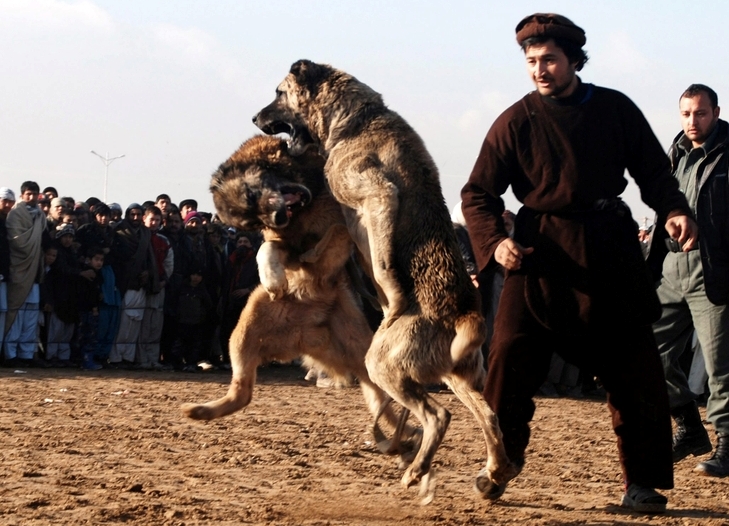
I want to be careful about psychologizing people. I don't know much about the relationship between people being brutalized and animals. But there are connections between brutalized people and brutalized animals. I take Kabul as an example, because of the places I've seen in the world, it's the most overt violence against animals that I've seen. Partridge fighting, buzkashi, dog-fighting, mongoose and cobra fighting (also loved in India), cock-fighting. During the Taliban era, public executions of people became a source of entertainment. I think these things are correlated. I think that non-violent forms of entertainment would be revolutionary in places like Kabul. And I think those traditions did exist! It isn't a country that is essentially violent and destined to be violent forever. There were rich cultural traditions that people had, and throughout different periods of history those were either erased or repressed, or replaced with other forms of entertainment. It's a heavily armed society, violence is normalized, there are different types of violence. Physical violence, and also indirect forms of violence.
But mainly, I want to say that animals are not treated well in the West. The West is not the model of animal rights that the rest of the world should aspire to. Factory farming is totally inhumane, and kills hundreds of millions of animals in a totally mechanical way. Creating a society where the only way to interact with animals, like dogs and cats, is through captivity, is not animal rights. The absence of street dogs in the West is not a victory for animal rights.
There's also huge numbers of birds that just die pointlessly in the West simply because we don't care to turn the lights off in our office buildings at night. It confuses their ability to navigate, they hit the sides of the buildings, and die. In huge numbers.
The violence against animals in the West follows a similar pattern as the violence against poor and oppressed people in that part of the world. They “clean the streets” of homeless people. They make it illegal to sleep on park benches. They harrass homeless people constantly. It's a sanitizing form of violence, to try to make these people invisible.
And that is the model applied to animals. They take them off the streets, and eventually kill them. They ban whole species, like pit bulls, and euthanize them en masse. There's a sterilized version of nature that's allowed. Everything must be neutralized, controlled. You can get fined for letting “weeds” - “undesirable” plants - grow on your lawn.
So to the last part of your question, about people hardly opposing it when their governments bomb and kill people in the south. Now that we've confronted the myth that animals are treated well in the West, we should also note that inequalities and hierarchies of human life occur in the West. There's a class war against poor people, indigenous people, homeless people in the West. The issue of bombing and killing people in the south doesn't tie up neatly with proper treatment of animals. The people who oppose wars in the South are more likely to care about animals. The people who want the streets cleaned of dogs, also want the streets cleaned of poor people, and they also support wars in the South. That's why I think we should be talking about it, why I think we shouldn't exclude animals from these discussions.