
The real indicator of women’s interest in politics is that almost 150 women filed nomination papers for general seats in 2013, a 129 percent jump from the 2008 election
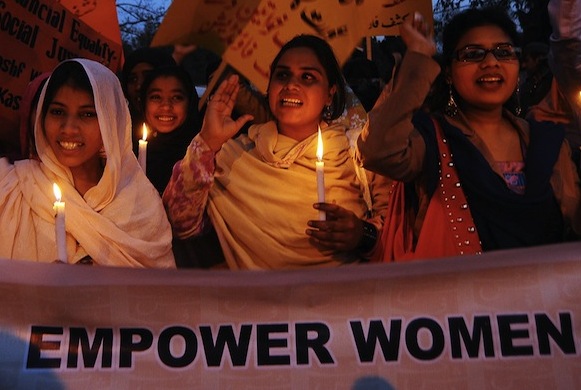 Fauzia Kasuri's quitting of Pakistan Tehreek-e-Insaf (PTI) created quite a stir. Her complaint was that the PTI ignored her 17-year service and gave priority to other members on the list of reserved seats for women, whose record had been less illustrious. Her differences with the party leadership highlighted the flaws in the election of women on reserved seats, which is not governed by any criteria of past record for candidates. Currently, 60 out of 342 seats in the National Assembly are reserved for women, which constitute about 17 percent. A similar percentage is reserved in the Senate and provincial assemblies.
There is almost across the board agreement on the principle that women should be represented in all legislative bodies, but the manner in which the reserved seats are filled has often received criticism. These seats are filled through nomination of party heads rather than direct election by the constituents. Parties present lists of women candidates in order of priority to the Election Commission before election. After the election, each party is allocated women's seats according to its strength in general seats. Women returned on reserved seat are accountable to party heads instead of their constituents like the rest of their colleagues and do not have as much leverage within the party. It suits the political parties to keep this system intact because it helps them increase their strength in proportion to the general seats.
Women reaching the assemblies by contesting on general seats enjoy greater legitimacy within the party and have roots in their constituencies. On the other hand, women returning on reserved seats often invite scrutiny of their kinship with male members in their party rather than their service record. Instead of giving a chance to party workers rising through the ranks, more often than not, party heads prefer to reward people of their choice by nominating their women relatives on reserved seats. The PTI leader Imran Khan drew ire of women parliamentarians in December last year when he declared he was against a quota for women in parliament. One might not like his style, but he was essentially arguing that the current method of indirect election is non-representative.
This, however, does not take away from the contributions women parliamentarians have made on women's issues and other areas of national importance such as foreign policy, education, food, environment, etc. Despite having little experience in campaigning, interaction with constituents and parliamentary rule of business, women MNAs surpassed all expectations and have performed remarkably since 2002 when the number of women’s reserved seats was substantially increased by General Pervez Musharraf.
For the first time, women led debates on the floor of National and provincial assemblies on highly controversial issues affecting women, such as honour killing, Hudood Ordinances, domestic violence, workplace harassment, and managed to get appropriate legislation passed. Compared to their male counterparts, their performance has received accolades in all areas of law making, from the introduction of new bills and resolutions to participation in debates and standing committees. The presence of a large number of women in assemblies added a gender perspective and promoted encouraging trends in society.
More women contested the election on general seat in 2013 than ever before, though fewer managed to make it to the assemblies than in 2002 or 2008 elections. Six women were elected on general seats of the National Assembly, bringing the total strength of women MNAs to 66. Ten women won on the general seats of provinces. In 2002 elections, 12 women MNA won on general seats, and in 2008 election this number was 15. This decline should not be interpreted as a decrease in women's interest in politics.
Most women who won on general seats in the previous two elections had been fielded as proxies of their male relatives who could not stand for election due to the educational requirement of having passed BA that was introduced by General Musharraf. This condition was removed before 2013 election. For instance, former foreign minister Hina Rabbani Khar, who contested 2002 and 2008 elections in lieu of her father, did not contest in 2013 election to make way for her father to run in her constituency. The real indicator of women’s interest in politics is that almost 150 women filed nomination papers for general seats in 2013, a 129 percent jump from the 2008 election. For the first time in Pakistan's history, women from tribal areas, such as Bajaur and Dir, ran as independent candidates in this election.
Affirmative action to mainstream women in politics has borne fruit. It is now time to take into account the concerns of women's advocacy groups, which have always called for direct election of women on reserved seats, which is essential for grooming new leadership and voicing concern of ordinary women. Several methods have been recommended in various reports for conducting a direct election on reserved seats that would train contesting women in electoral campaigning and give them greater legitimacy and say within their respective parties.
Earlier, the idea of a direct election for women was not entertained because it requires campaigning in large constituencies and substantial amount of money. By contesting on a large number of general seats as independent candidates in this election, women have sent out a message that they are ready to take on these challenges through innovative campaigning techniques. Political parties should also facilitate their women candidates by aligning their campaign withpartycandidates contesting on general seats.
Women’s representation in legislative bodies is essential for addressing their concerns in the national policy making. However, merely reserving seats will not mainstream women's participation in politics. It also requires ensuring that women voters are allowed to vote, there is no bar to entry of women into politics and female leaders are involved in decision making within political parties. Although the recent election brought some good news on this front, we still have a long way to go.
| Ishrat Saleem is a freelance journalist based in Washington, DC. She tweets at @ishrats and can be reached at |