Bugti's killing provided real fuel to the movement and as the uprising took root, the military's excesses increased disproportionately. Moreover, the military establishment, then a close ally in America's WoT, not only legitimised its excesses through painting the secular Baloch nationalist struggle as a war against Islamist extremists but also tried to, and still continues to, encourage actual violent Islamist movements (such as the aforementioned LeT) to gain a stronghold in parts of Balochistan
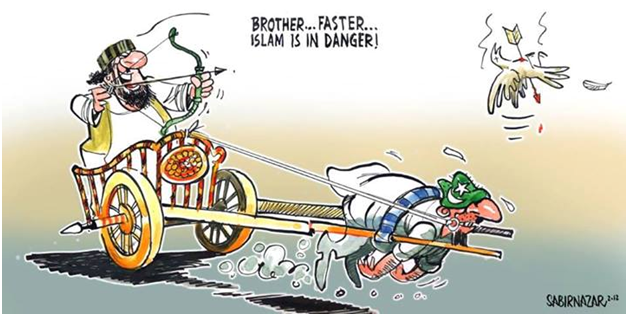
As a frontline state in the so-called 'War on Terror' (WoT), Pakistan is often in the spotlight in popular Western media. The dominant discourse in these representations is mostly characterised by looking at the country through the (largely false) binaries of Islamist/secular, conservative/liberal and traditional/modern. Such tropes of knowledge about Pakistan, in my opinion, are a combination of old-fashioned Orientalism and a continuation of Cold War era-discourses which places the country at the center-piece of the struggle against the new 'enemy' (Islamist terrorism). The consequence of such hegemonic discourses is (usually) an inadvertent homogenisation of a country of 180 million people and an undeserved lack of attention on actual processes of change ongoing in the region. In this paper I will attempt to demonstrate that popular representations of Pakistan have contributed to and perpetuated representations of the country as one of the 'vilest and most dangerous countries of the world' [2]. I will also shed light on some of the ongoing movements and struggles in Pakistan which help to move beyond the hegemonic discourse dominated by bombs, beards and burqas. In this case, I will briefly focus on three ongoing social movements: 1) Okara Military Farms struggle, 2) Faisalabad loom workers strike and 3) the Baloch nationalist struggle. Through these accounts I hope (in the words of the late Howard Zinn) to 'tip the balance' towards a more nuanced understanding of how Pakistani people in varying contexts struggle for their rights to self-determination, emancipation and economic well-being and thus, move beyond clichéd understandings of one of the most populous countries in the world.
Just before his untimely death and in the aftermath of the US raid in Pakistan which resulted in Osama bin Laden's killing, renowned intellectual and once anti-war champion Christopher Hitchens described Pakistan as a country 'completely humorless, paranoid, insecure, eager to take offense, and suffering from self-righteousness, self-pity, and self-hatred' (2011). Referring to abuses of womens' rights, Hitchens declared Pakistan is a society where 'the most elemental of human instincts become warped'. He then went on to list the litany of American objections against the Pakistani ruling classes' efforts in the so called War on Terror (WoT) and finished with the following call to arms for the world's only superpower: 'How could it be “worse” if we listened to the brave Afghans, like their former intelligence chief Amrullah Saleh, who have been telling us for years that we are fighting the war in the wrong country? [italics added]'.
Hitchens' exposition on Pakistan is not a one-off piece of writing by a pro-war author nor is his use of terms such 'us' and 'we' an isolated occurrence. It is the perpetuation of certain epistemologies about the 'Orient' and of defining oneself as against the 'Other'. Characterising Pakistan as one of the 'vilest and most dangerous countries of the world' the use of 'us' and 'we' feeds into what Edward Said called the 'principal dogmas of Orientalism' (1978). It is a process of defining the Orient in opposition to the 'rational, developed, humane [and] superior' West while at the same time defining the 'West' itself. In a particularly prescient chapter titled 'Culture Talk' from his book 'Good Muslim, Bad Muslim', Mahmood Mamdani (2004) traces how the idea of the 'West' has evolved in combination with, and as a result of, European imperialism. Mamdani accounts that the 'West' has been framed in opposition to the 'Other' (in this case, colonised natives) and it has morphed from a geographical entity to a 'racialised', cultural notion referring to people of European origin anywhere in the world. This particular aspect of identity formation in opposition to the colonised native is also taken up by Jean Paul Sartre in his preface to Frantz Fanon's powerful exposition of colonial violence and revolutionary warfare 'The Wretched of the Earth'. In his account of colonial oppression and resistance in Algeria, Sartre says 'High minded people, liberal or just soft hearted... were either mistaken or dishonest, for with us there is nothing more consistent than a racist humanism since the European has only been able to become a man through creating slaves and monsters.'
What is particularly striking in all the above texts, and often gets missed out in popular representations of Muslim countries, is how in both the case of the 'West' and the 'Orient', the formation of identities are deeply tied to political processes of power and domination. Moreover in an attempt to 'understand' the Orient, cultural identities increasingly come to represent and determine political attitudes. So, it comes as no surprise when renowned Orientalist Bernard Lewis titles one of his seminal articles 'The roots of Muslim Rage [italics added]' (1990) and Samuel Huntington (1993) declares that 'the fundamental source of conflict in this new world will not be primarily ideological or primarily economic. The great divisions among humankind and the dominating source of conflict will be cultural.... The fault lines between civilisations will be the battle lines of the future [italics added]'. While such descriptions serve to obfuscate the real political and economic fissures which spark off conflict in different parts of the world, they also serve to essentialise and homogenise vast parts of the human family as adherents of some sort of unchanging, monolith cultures untouched by history and unaware of the need for 'civilisation'. Needless to say such representations feed into legitimising not just formal neoimperialism but also makes the popular narrative blind to actual processes of change and resistance ongoing in parts of the world characterised exclusively in terms of 'Islam' and 'Muslim'.
Such tropes of knowledge have come to be particularly prevalent in the popular discourse on Pakistan. So, for example, in the aftermath of the devastating floods in Pakistan in 2010, there was much wrangling over the question of giving aid to the country. The Daily Beast published an article titled 'How the Pakistani Floods Help the Taliban' and the New York Times ran a story 'Hard-Line Islam Fills Void in Pakistan'. The narrative was stuck on the fact that aid must be provided to the affectees not because they were human beings whose homes and livelihoods had been destroyed but so that they do not fall prey to the network of charities run by Islamist extremist groups. The implication is clear: we should help the suffering people because otherwise they might become a nuisance for us.
Similar binaries are also seen in operation when reporting on other aspects of Pakistan. So an August 2012 article by Reuters details the underground culture of 'partying' in Pakistan where an atmosphere similar to a 'Saturday night at a club in New York, London or Paris' exists. Juxtaposed on this 'modern' context, the article then goes on to immediately talk about 'creeping Islamic conservatism' in the country and how 'lonely liberals' are cowering for cover under the onslaught of Islamist extremism. No mention is made to the contribution of capitalist imperialism in the creation and sustenance of such extremist groups. The article alludes to the changes forced upon Pakistani society by the dictatorship of General Zia-ul-Haq in the 1980s, but suffers from what Mamdani terms a 'collective amnesia' when failing to account for the role of hegemonic powers in fostering such forces in the name of Islamic jihad' against communism. While the role of capitalist powers in the rise of Islamist extremism has been well documented by, among others, Ali (2008) and Mitchell (2002), the Reuters article falls into the trap of perpetuating binaries such as Islamic/secular and liberal/conservative. Moreover, the phenomenon of Islamist violence and extremism also takes on a cultural identity of its own coming to define all Pakistanis not part of the (so called) 'Westernised', 'secular' elite and stripped of the wider context of its genesis in late colonialism and the Cold War.
Neo-Orientalist epistemologies of knowledge are even more apparent in representations of Pakistan's border areas with Afghanistan. These areas, the site of drone attacks by the US military to target 'extremists', are constantly characterised in popular discourse as 'lawless', 'barren' landscapes where terrorists roam about with freedom (see, for example, Roggio, 2011). In an echo of Edward Said's 'exotic' and 'sensuous' Orient, the tribal 'badlands' of Pakistan/Afghanistan are not seen as areas where actual living people reside and live out their lives but areas to be 'tamed' and 'purged' off terrorists through (in this case) remote-controlled, imperial bombardment. Mamdani's 'collective amnesia' is all the more apparent here as little mention is made of the fact that it is the imperial war of the 1980s (with more than $3.9 billion of funding from the Reagan administration) which turned the Afghan-Pakistan border areas into the safe haven for militants that they are today. These areas, their peoples and conditions are stripped off history and context. It is as if history came into being on September 11th, 2001.
In all the focus on security, terrorism and geo-strategy, what gets lost are the people of these regions. The people who are everyday shaping history in different parts of Pakistan, offering resistance to the hegemonic machinations of the neoliberal state in an effort to, as Fanon would put it, say 'no to the butchery of what is most human in man: freedom'. Problems of historiography and representation have already been pointed out by Trouillot (1995) in his demonstration of the systematic underplay of the Haitian Revolution and its links to power and connected modes of racialised thinking. It is only through writing a history of the subaltern and a conscious move away from top-down accounts of change that we can even begin to understand the various struggles of contestation and emancipation ongoing in Pakistan. In the following sections, I will attempt to give a brief account of three contemporary social movements through which people are actively shaping their future and re-shaping entrenched structures of power and control in the country.
Okara Military Farms: 'Ownership or Death'
The Okara Military Farms are part of the canal colonies in Punjab province of today's Pakistan developed by the British Raj in the latter half of the nineteenth century. Agricultural and non-agricultural castes from eastern Punjab were encouraged to settle in these colonies and elites which had helped the British during and after the Indian Uprising of 1857 were rewarded with large tracts of land in these areas (Ali, 1988). Vast areas of land owned by the provincial Punjab government were also leased out in Okara and adjoining districts for use of the British military which included stud farming and horse breeding. These lands were used by the colonial state in its extensive patronage network to ensure the loyalty of the landed and military elites as an insurance against the Bolshevik threat from the north-west. At the time of Partition in 1947, these lands were automatically transferred to the Pakistani military. Although the British had lured the agricultural peasants to the canal colonies with the promise of allotting them land in return for tilling the soil, these promises never materialised and several generations of peasants and farmers worked on these lands under a sharecropping system (called hissa battai) whereby the farmer and his family kept half the produce, while the military took the other half (Akhtar, 2006).
In 2000, just as the military government of General Pervez Musharraf was consolidating its power and planning to pass a law for further corporatisation of agriculture, the military authorities in Okara decided to introduce a new contract system which stipulated that rent was to be paid in cash rather than direct division of farm produce. Moreover, the new contract contained provisions which severely limited use of natural resources by the farmers who depended upon local firewood and mud for building homes. It also contained provisions which would have made it extremely easy for military authorities to evict farmers and peasants on short notice.
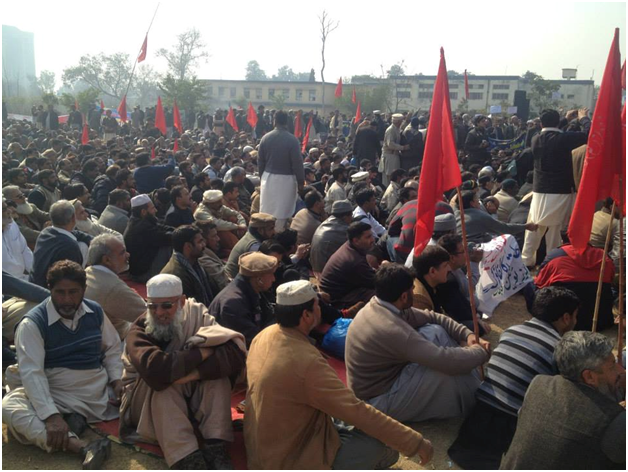
Sensing an attempt by the authorities to legally evict them from them from the land they had lived on and tilled for generations, farmers formed the Anjuman-e-Mazareen-e-Punjab (AMP, Punjab Tenants Organisation) through which they hoped to persuade the military to give up its intentions of a new cropping agreement. The authorities, however, taken aback by the temerity of the farmers who dared to stand up to its might in the heartland of its traditional stronghold of Punjab, used paramilitary forces and the police to besiege eighteen villages in Okara district. The increasing incidences of torture, intimidation and harassment resulted in a spread of the movement to adjoining districts of Punjab and the AMP soon morphed into a kind of 'rural intifada' with a more militant organisation representing farmers, peasants and small landholders (Ali, 2003). As the military's excesses increased, the movement grew bigger and went up to over a million strong with cross-gender and cross-religious alliances challenging the hegemonic power of the Pakistan military in its own backyard. During the struggle it was discovered that the military were not the legal owners of the land and were only lessees of the land themselves on which they had not paid rent to the Punjab government since 1943! This knowledge, combined with the oppressive response of the military, led the AMP to adopt the powerful cry of 'Malukyat yaa maut!' ('Ownership or Death'). Through a tactic of civil disobedience and sheer people power, the AMP managed to fight the military off the land. Today a stalemate exists, with farmers and peasants refusing to pay any rent and the military continuing a low-level program of harassment even though formal democracy returned to Pakistan in 2008 (Toor, 2011). In an interview in 2009, the premier spokesperson of the military even conceded that it is willing to go back to the original sharecropping agreement.
The movement defied popular representations of Pakistan and was symbolic in several ways. Firstly, the movement saw peasants and farmers from across the religious divide come together. 40% of the AMP membership consisted of Christian peasants and farmers who have generally occupied the very lowest rung in the Punjab's caste hierarchy. Second, when the military's suppression increased and the farmers and peasants started getting illegally detained and tortured, it is the women who rose up in resistance and led march and protests with their thappas (sticks used to beat dirty clothes while washing) in the air. These women came to be known as the Thappa Force and resulted in a mass empowerment of women which led them to challenge not just the repressive apparatus of the state but also entrenched structures of patriarchy and religious-based discrimination. When Munawwar Bibi, the Punjab President of the AMP, was threatened by local landlords that they would not give her a Muslim burial because as a woman she was fighting alongside Christians, she sent them a reply saying:
'After my soul departs, the Christians will take me to their graveyard. Do you think I am fighting for a burial spot?'
Moreover, post-AMP mobilisation enrolment of girls in schools in the area has increased and women have refused to go back to the same position of subordination that they were in before they stepped into the battle with the state (Shirkat Gah Documentary, 2010).
The Okara movement is significant not just because it challenges hegemonic representations of the Pakistani polity but also because it represented a serious challenge to the oppressive power of the state. Enduring colonial patterns of military recruitment and critical support by capitalist powers have resulted in the Punjab province being the center of the military's power base in Pakistan. Due to the peculiar nature of the Pakistani and Bangladeshi post-colonial state (with an under-developed native bourgeoisie and a top-down imposed colonial state), a civil-military bureaucratic oligarchy has come to dominate what Alavi has termed 'the overdeveloped state' (1972). Developed during the British Raj with the express intention of 'controlling the natives' and extracting resources for the mother country, the 'over-developed state' continues to retain the pervading mechanisms of control and oppression developed during the era of formal colonialism. Moreover, Alavi posits that due to its grafted nature, it is the state itself which has become the site for contestation between competing interests. It is in this context of the hangover of colonial institutions and the AMP's refusal to seek redress in colonial-era institutions of justice and law that the Okara peasants' struggle signified an unprecedented challenge to the hegemony of the state and its military-centered post-colonial elite.
Faisalabad Loom Workers' Strike: 'God is sovereign and God asks us to fight for justice'
Faisalabad is Pakistan's third largest city and is often called 'the Manchester of Pakistan' due to its being the center of the country's textile industry. Out of the estimated total of 300,000 power looms in Pakistan, almost 200,000 are based in Faisalabad mostly in the form of small units in houses (Williams, 2012). In 2003, the Labour Qaumi Movement (LQM, National Labour Movement) was formed by power loom workers in response to police repression at the behest of local influentials and factory owners. Starting out from just sixty workers, by early 2012 the LQM had spread to at least ten other districts apart from Faisalabad and was beginning to organise workers in a country where only four percent out of a total labour force of 45 million Pakistanis had access to social security constitutionally guaranteed by the state (Memon, 2010).
In early 2010, the Minimum Wage Board had recommended that workers be given a pay raise of 17 percent. This was in the backdrop of almost a 50 percent wage increase for public sector workers and the government's rapid withdrawal of state subsidies on gas, electricity and petroleum (Tariq, 2010). Tied into the privatisation agenda of international financial institutions, this had resulted in prices for some household items skyrocketing to upto ten times their initial value. While the wage increase was recommended by the Board, factory owners were also required by law to pay at least seven percent of the wages into the social security system. This, however, was conveniently avoided due to workers not being issued social security cards which would then give them access to, among other things, state-run pension schemes, hospitals and medicine. The working classes being obviously the most affected by such policy measures and repressive mechanisms began to organise in and around Faisalabad under the banner of the LQM for implementation of the recommended 17% wage increase.
On 6th July 2010, ten strongmen hired by factory owners stormed into the office of an LQM activist Mustansar Randhawa and killed him and his younger brother Naseer. Workers in the adjoining district of Jhang went on strike and at a public rally in Jhang in mid-July, the LQM issued the call for a general strike in Faisalabad. On 12th July, over 250,000 workers in Faisalabad went on strike demanding the recommended wage increase. This resulted in complete shutdown of 100,000 power looms in the city and the provincial government called in police reinforcements from six different districts to break the strike. On the eighth day of the strike, police and factory owners' hired thugs hemmed in a peaceful march of 20,000 workers and pelted them with stones, rubber bullets and shelling. The ensuing battle between police and workers continued for almost 10 hours resulting in several injured and subsequent arrests of 14 workers including 6 chapter presidents of the LQM. The strike, however, continued and on its tenth day a 25,000 strong march picketed the District Commissioning Officer's (DCO) house. After several failed attempts by police and local authorities to raze the camps set up by the strikers, the DCO gave in and ordered the factory owners to increase wages by the stipulated amount, register workers with the Social Security Board and issue them social security cards.
As a result of the strike, some of the earlier arrested workers were released but the six local chapter presidents of the LQM were tried by an Anti-Terrorism Court. The trial was carried out under special laws promulgated by the Pakistani state to expedite cases of terrorism in the wake of Washington's WoT and on October 31st the six labour activists were handed down a combined sentence of 594 years in prison. Since, then there has been a renewed agitation by workers to secure the release of their fellow activists who have been sentenced by the courts for allegedly setting a factory on fire and injuring strike-breakers despite several inconsistencies in the witness accounts and various contradictory pieces of evidence (Zahnd, 2011).
As with the Okara Military Farms Struggle, the Faisalabad loom workers' strike broke away from popular representations of Pakistan. Faisalabad and its adjoining district Jhang are the hub of hardline Islamist movements Lashkar-e-Taiba (LeT) and Sipah-e-Sahaba (SS) which had previously contributed in directing popular agitations towards members of the minority Shia sect (a sect of Islam considered heretics, and frequently targeted, by many violent extremist organisations like the LeT and SS). However, as the struggle of the LQM moved forward workers themselves began to question such divisions among the poor who were united in their fight against the combined might of the local landlords, factory owners and the coercive arm of the state.
In this regard, the case of Bawa Latif Ansari, a local organiser and eminent orator of the LQM, is particularly instructive (Memon, 2010). As a young man, Bawa was part of the LeT which played upon the fact that many of the local landlords in the Jhang area were Shia to stoke feelings against the Shia minority. However as he got involved in the LQM the realisation dawned on him that the material conditions of all labourers of the area were the same regardless of them being Sunni, Shia or Christian. It is there that Bawa's transformation and the transformation of his understanding of Islam started. Religion for Bawa turned into a radical philosophy of liberation and he started using his powerful oratory to instil solidarity among workers' against general exploitation by the landed and industrial classes. During the strike, Bawa's exhortations to workers often emphasised his understanding of religion as an source of strength and social justice:
"God is sovereign and God asks us to fight for justice. The bosses are nothing; we will not bow to them, these pharaohs."
Bawa's experience, the cross-religious alliances observed during the Faisalabad strike and the peoples' reinterpretation of Islam in the light of their own material conditions shows us the importance of Gramsci's 'popular creative spirit' whereby subaltern classes fashion ideas to transcend and legitimise their move beyond structures of power and domination.
The Faisalabad strike is important in another, often over-looked aspect .i.e. the nexus between the coercive and monitoring apparatuses of the state and capital. Authors such as Siddiqa (2007) have already talked about the link between crony capitalism and various institutions of the Pakistani state (primary among them being the military). In the case of Faisalabad, labour activists have also commented on the close relationship between the Labour Department, responsible for ensuring workers' safety and that all workers are registered for Social Security, and factory bosses. Moreover, a recent article by Declan Walsh and Steve Geenhouse in the New York Times also highlights the links between global capital and the factory inspections' industry (2012). In the aftermath of a recent garment factory fire in Karachi which consumed the lives of almost 300 workers, Walsh documents the commodification of 'safety' certificates and the various certification agencies present in the Global North which outsource their inspection to companies in the South. The commodification of industrial safety certificates and inspections can also be seen as part of neoliberalism's creation of 'new spaces' as has been demonstrated before in the case of the corporate social responsibility industry (Sadler and Lloyd, 2009). These companies are in turn under pressure for quick turnover and certification of applications by factory owners. Considering that the aforementioned garment factory in Karachi was producing jeans mainly for a German retailer, the links between prevailing regimes of globalisation and outsourcing of manufacturing to countries of the global South are obvious (Stiglitz, 2002).
Baloch Nationalist Movement: 'You can't get freedom through talk'
Balochistan is, in terms of area, Pakistan's biggest province but has the lowest population among all other provinces. Before the Independence and Partition of India in 1947, a major part of the province, inhabited by ethnic Baloch, came under the State of Kalat (headed by the Khan i.e. leader) which was governed by the British through a policy of indirect rule. However, at the time of Independence the Khan of Kalat acceded to Pakistan while by his own admission exceeding the scope of his mandate (Ahmad, 2012). Since then Balochistan's relationship with the center has been troublesome, to say the least, and the province has been the site of no less than five major uprisings against the Pakistani state and military. The Baloch remember these uprisings as moments of resistance and constant betrayals by the Pakistani state over issues of provincial autonomy, resource control and fundamental rights of self-determination.
As several scholars have pointed out, the Pakistani state's relationship with Balochistan has always been marred by the hangover of colonial forms of domination and control (Toor, 2012). As a resource rich province, Balochistan has some of the biggest gas fields in Asia and the Tethyan Belt (rich in copper, gold and other valuable minerals) runs through the province. In a direct echo of colonial policies, an obsession with controlling of Balochistan's mineral resources has generally led the Pakistani state to ignore the plight and developmental aspirations of the Baloch people. A pertinent example of this is the fact that while the Sui gas field in Balochistan has been supplying gas to the rest of the country since its discovery in 1952, the town of Sui itself had no gas supply uptil 2006.
The state has generally ensured its domination over Balochistan through the coercive presence of military and para-military forces and a policy of co-opting the elite (composed mainly of tribal leaders called sardars). Such colonial patterns of control have been reinforced by 'developmental projects' which exploit the country's mineral resources and deep water coastline but, according to the Baloch, give them little or no say in their profits, implementation and planning. Some of these 'development' initiatives include the Gwadar Port Project (in cooperation with the Chinese government), three nuclear and chemical weapons testing sites, eight naval bases, six missile testing ranges, seven air bases and 58 paramilitary facilities (Tahir, 2010). Needles to say, such projects have contributed to entrenching the military's hegemony over the province and have offered little employment benefits to local Baloch. Moreover, the projects have often led to displacement of Baloch fishermen and other local residents from their ancestral lands while jobs in these projects have gone to workers from other provinces/dominant ethnicities of Pakistan. Thus, the Baloch middle and lower classes have not only to contend with their own tribal elite who have often been part of their exploitation at the hands of the center but have also suffered economically due to the state's preference for employing settlers from other parts of Pakistan even in their own province.
Such patterns of resource extraction and exploitation at the hands of the Pakistani state (and, through it, Chinese and Gulf multinationals) have bred widespread resentment and given rise to armed resistance movements among the Baloch at four previous occasions. An example of the state's brutal tactics against these upsurges is that of the 1973-1978 uprising, where the civilian government of Zulfiqar Bhutto deployed 80,000 troops in the province along with fighter jets and gunships generously provided by the Shah of Iran. General Tikka, who was leading the troops, earned the nickname of Butcher of Balochistan in the province (to go with his earlier one of Butcher of Bengal due to his role in the '71 genocide in East Bengal). Meanwhile, the Shah actively supported the operation due to the presence of a big Baloch population in Iran whom he was afraid might also take up arms if the unrest spilled over the Pak-Iran border.
The most recent uprising was triggered by the rape of a female doctor by an army captain in 2004. The background was provided by the various 'development projects' mentioned above including the deep sea Gwadar Port Project which the then military government of General Pervez Musharraf was building with the Chinese government and had been accused of displacing Baloch fisherfolk and discriminating against locals in employment. The rape incident and the military's successive refusal to investigate 'one of its own' sparked the fifth Baloch uprising. In 2006, a senior Baloch tribal sardar in his late 80s (and historically a pro-federation man) Nawab Akbar Bugti was killed in an airstrike while he was taking refuge in the mountains with his followers. Bugti's killing provided real fuel to the movement and as the uprising took root, the military's excesses increased disproportionately. Moreover, the military establishment, then a close ally in America's WoT, not only legitimised its excesses through painting the secular Baloch nationalist struggle as a war against Islamist extremists but also tried to, and still continues to, encourage actual violent Islamist movements (such as the aforementioned LeT) to gain a stronghold in parts of Balochistan so as to introduce sectarian divisions among the population. To this day, the Baloch nationalist struggle is ongoing while the military and its intelligence agencies have unleashed a novel (and particularly frightening) pattern of literally picking up students, intellectuals and political activists, keeping them in detention for indefinite amounts of time and then dumping their bullet-riddled bodies in open fields, sewers etc (HRW, 2011). Such patterns have continued even though formal democracy has now returned to Pakistan and locals have often remarked that 'all of Balochistan is a cantonment'.
While the most recent Baloch uprising shares the sense of deprivation and discrimination which fuelled earlier movements, it also breaks away from previous patterns and dominant representations in crucial ways. The key distinguishing factor in this movement is the involvement of the Baloch middle and lower classes rather than the tribal elite which had dominated earlier uprisings. A clear demonstration of this is the fact that targeted killings by the intelligence agencies have overwhelmingly been directed towards student activists, Baloch intellectuals and journalists. A particularly revealing case in this regard is of Dr. Allah Nazar who was a student at Balochistan University and an organiser for the (then) peaceful Baloch Students Organisation (BSO) when he was picked up by intelligence agencies in March 2005. He was illegally detained for more than four months in various military and police prisons and brutally tortured to almost the point of death. When released in late August of that year, Dr. Nazar fled to the southern Makran coast of Balochistan, an area where historically no tribal structures have existed as it was not part of the Khanate of Kalat. Here Dr. Nazar, now radicalised by his experiences at the hand of the state, rose to become one of the biggest and most respected leaders of the Baloch nationalist movement. Dr. Nazar's band of guerilla fighters have resisted the military and para-military forces to such an extent that, according to a recent report in Pakistan's most respected daily DAWN, the Makran coast has become a no-go area for state authorities.
Prominent Baloch intellectuals, activists and journalists like Saba Dashtiyari (locally known as the Baloch 'Chomsky'), Jan Dashti and Habib Jalib Baloch have been killed in targeted attacks while local media outlets have faced censorship (Akbar, 2011). Some journalists like Malik Siraj Akbar have even had to take refuge in other countries (the US in case of Akbar). While the Pakistani security apparatus has been obsessed with the (largely imagined) role of India, America and others in fuelling and supporting the nationalist militants, it is the middle class comprising of students, doctors and lawyers which have come at the forefront to resist the hegemonic machinations of a repressive state. Baloch students, united in their collective memory of successive betrayals by the state and no longer willing to put faith in its post-colonial institutions, have increasingly moved beyond talks of provincial autonomy and rights. According to Banok Karima Baloch a 26 year old female activist and CEC member of the BSO:
"The ones [referring to pro-federation parties] who talk about autonomy and rights have a different vision... You can't get freedom through talk."
Baloch sardar Baramdagh Bugti (grandson of the late Akbar Bugti) also said as much during an interview to Malik Siraj Akbar:
"We know the importance of independence... The Baloch are so conscious about their rights today that if I compromise their movement with the Pakistani establishment, my own followers will definitely replace, kill and forget me."
With the changed class character of the most recent Baloch movement, their refusal to place any trust in the institutions of the state and the forging of a collective memory of Baloch struggle for independence, it is people like Dr. Allah Nazar and Banok Karima Baloch who have come to represent the face of the Baloch struggle today. It is a generation which has moved beyond the tribal structures of yore and even beyond the Pakistani establishment's continued attempts to impose a unitary, 'Islamic' identity upon all of Pakistan; and it is in the collective struggle of this generation that we can see efforts to redefine what it means to be a Pakistani today and also move away from dominant representations of the country and its peoples.
Final Thoughts
All three movements illustrated above represent challenges to the hegemony of the state in differing ways. Where the Okara struggle is a cross-class alliance between the rural landless and middle peasant classes, Faisalabad gives us an example of organisation among the urban industrial working class. The Baloch movement, on the other hand, represents an ethnicity-centered challenge led by the middle classes. In their own ways, the three movements break away from earlier described dominant discourses about Pakistan and the Pakistani people. Moreover, resistance against encroaching neoliberalism under the auspices of the post-colonial state (and its imperial guarantors) is also a common thread running through the three mobilisations. Where the Okara incident was directly tied into the military's attempts for further corporatisation of agriculture through concentration of land, Faisalabad provided an example where the industrial working classes are being squeezed by an alliance of capital and state. Balochistan, on the other hand, is an example of the state brutally exercising its extractive role in alliance with international, hyper-mobile fractions of capital. All three movements represent, in their unique ways, (arguably) effective resistance against the marching and interlinked forces of neoliberal capitalism and a repressive state apparatus violently disinclined towards any challenge to its political, cultural and intellectual hegemony.
Thus, it is through the highlighting of such movements and careful study with an eye on their proper historical contexts that we can start to move away from lenses distorted by global regimes of power. In doing so, we realise that understanding a country and its population through the binaries cultivated by War on Terror discourse and rooted in old-fashioned Orientalism leads us down the dark alley of one-dimensional modes of thinking and prevents us from understanding actual processes of change, contestation and resistance ongoing in societies such as Pakistan. Problems of historiography and representation with regards to countries and communities of the global South are not new and it is only through a conscious move towards a discourse centered on the people and their everyday struggles that such tropes of knowledge can be challenged. The challenge, as ever, remains to see history not as the deterministic flow of superior ideas and top-down processes of change but as actively shaped by masses of nameless, faceless people in the struggle over their own bodies, environments and material conditions.
Notes:
[1] I am grateful to my friend Ammara Maqsood (DPhil Candidate in Anthropology at Magdalen College, Oxford) for suggesting the title to this paper.
[2] From Abbottabad to Worse. Christopher Hitchens, Vanity Fair. July 2011. Retrieved from <http://www.vanityfair.com/politics/features/2011/07/osama-bin-laden-201107>
Bibliography:
Akbar, M. S. (2011). Redefined Dimensions of Baloch Nationalist Movement. Bloomington: Xlibris.
Akhtar, A. S. (2006). The state as landlord in Pakistani Punjab: Peasant struggles on the Okara military farms. The Journal of Peasant Studies, 33(3): 479-501
Alavi, H. (1972). The State in Post-Colonial Societies: Pakistan and Bangladesh. New Left Review I, 74: 59-81.
Ali, I. (1988). The Punjab Under Imperialism 1885-1947. Oxford: Oxford University Press.
Ali, T. (2003). The Colour Khaki. New Left Review, 19: 5-28.
Ali, T. (2008). The Duel: Pakistan on the Flight Path of American Power. New York: Scribner.
'Anti-terror' laws target workers in Pakistan. Brian Williams, The Militant. May 2012. Retrieved on Dec 1st 2012 from < http://www.themilitant.com/2012/7620/762062.html>
Balochistan Betrayed. Mahvish Ahmad, Naked Punch. February 2012. Retrieved on 1st Dec 2012 from <http://nakedpunch.com/articles/139>
Balochistan: Pakistan's broken mirror. Madiha Tahir, The National. March 2010. Retrieved on Dec 10 2012 from <http://www.thenational.ae/news/world/south-asia/balochistan-pakistans-broken-mirror#full>
Certified Safe, a Factory in Karachi Still Quickly Burned. Declan Walsh and Steve Greenhouse, The New York Times. December 2012. Retrieved on Dec 10th 2012 from < http://www.nytimes.com/2012/12/08/world/asia/pakistan-factory-fire-shows-flaws-in-monitoring.html?pagewanted=1&_r=4&hp&adxnnlx=1354975283-arhol9d86s1%20CgEpeEg4Ew>
Dr Nazar’s perspective on Balochistan situation. Malik Siraj Akbar, Daily Times Pakistan. April 2011. Retrieved on Dec 1st 2012 from <http://www.dailytimes.com.pk/default.asp?page=2011%5C04%5C13%5Cstory_13-4-2011_pg7_16>
FACTBOX-Lashkar-e-Taiba charity wing in flood relief work. Myra MacDonald, Reuters. August 2010. Retrieved on Dec 1st 2012 from <http://www.reuters.com/article/2010/08/25/idUSSGE67O0HQ>
Faisalabad Power Loom Workers Case: A Miscarriage of Justice. Cindy Zahnd, Naked Punch. November 2011. Retrieved on Dec 1st 2012 from <http://www.nakedpunch.com/articles/132>
Faisalabad: Strike to Continue. Farooq Tariq, Europe Solidaire Sans Frontières. July 2010. Retrieved on Dec 1st 2012 from <http://www.europe-solidaire.org/spip.php?page=article_impr&id_article=18061>
Fanon, F. (1961). The Wretched of the Earth. New York: Grove Press.
Fanon, F. (1968). Black Skin, White Masks. New York: Grove Press
From Abbottabad to Worse. Christopher Hitchens, Vanity Fair. July 2011. Retrieved on 1st Dec 2012 from <http://www.vanityfair.com/politics/features/2011/07/osama-bin-laden-201107>
Gramsci, A. (1971). Selections From the Prison Notebooks. Translated and edited by Quintin Hoare and Geoffrey Nowell Smith. New York: International Publishers.
How the Floods Help the Taliban. Ron Moreau and Sami Yousafzai, The Daily Beast. August 2010. Retrieved on Dec 1st 2010 from <http://www.thedailybeast.com/newsweek/2010/08/12/how-the-pakistani-floods-help-the-taliban.html>
Human Rights Watch. (2011). Pakistan Security Forces 'Disappear' Opponents in Balochistan. Retrieved on Dec 5th 2012 from
In Pakistan, underground parties push the boundaries. Anam Zehra, Reuters. August 2012. Retrieved on Dec 1st 2012 from <http://www.reuters.com/article/2012/08/20/us-pakistan-partying-idUSBRE87J0SY20120820>
Mamdani, M. (2004). Good Muslim, Bad Muslim: America, the Cold War and the Roots of Terror. New York: Pantheon Books.
. Retrieved on 1st Dec from < http://monthlyreview.org/2010/12/01/blood-on-the-path-of-love>
Mitchell, T. (2002). McJihad: Islam in the US Global Order. Social Text, 20(4): 1-18.
Pakistan floods: an emergency for the West. Ahmed Rashid, August 2010. Retrieved on Dec 1st 2012 from <http://www.telegraph.co.uk/news/worldnews/asia/pakistan/7941820/Pakistan-floods-an-emergency-for-the-West.html>
Sadler and Lloyd (2009). Neo-liberalising corporate social responsibility: A political economy of corporate citizenship. Geoforum, 40: 613-622.
Said, E. (1978). Orientalism. London: Penguin Group.
Shirkat Gah - Women's Resource Center (Producer and Director). (2010). Two Steps Forward [Motion Picture Documentary]. Pakistan: Farooq Studio.
Siddiqa, A. (2007). Military, Inc.: Inside Pakistan's Military Economy. London: Pluto Press.
State of Intelligence. Maqbool Ahmed, DAWN. October 2012. Retrieved on Dec 1st 2012 from <http://herald.dawn.com/2012/10/16/state-of-intelligence.html>
Stiglitz, J. E. (2002). "Globalism's Discontents". In The Globalisation and Development Reader, edited by J. Timmons Roberts and A. Bellone Hite, 295-304. Malden, MA: Blackwell Publishing, 2007.
The Clash of Civilisations? Samuel Huntington, Foreign Affairs. Summer 1993. Retrieved on Dec 1st 2012 from <http://www.foreignaffairs.com/articles/48950/samuel-p-huntington/the-clash-of-civilizations>
The Roots of Muslim Rage. Bernard Lewis, The Atlantic. September 1990. Retrieved on Dec 1st 2012 from <http://www.theatlantic.com/magazine/archive/1990/09/the-roots-of-muslim-rage/304643/>
Toor, S. (2011). The State of Islam: Culture and Cold War Politics in Pakistan. London: Pluto Press.
Trouillot, M.R. (1995). "An Unthinkable History: The Haitian Revolution as a Non-Event". In Silencing the Past: Power and the Production of History. Boston: Beacon Press.
US Predators target 'good Taliban' commander in South Waziristan. Bill Roggio, The Long War Journal. October 2011. Retrieved on Dec 1st 2012 from <http://www.longwarjournal.org/archives/2011/10/us_predators_target_1.php>
| Ayyaz Mallick is a first year graduate student at York University Canada. His concentration is in urban politics and development studies. |