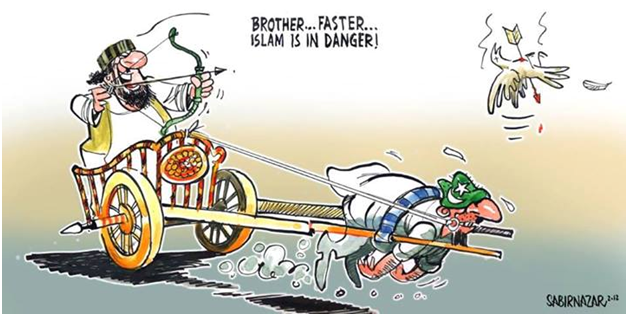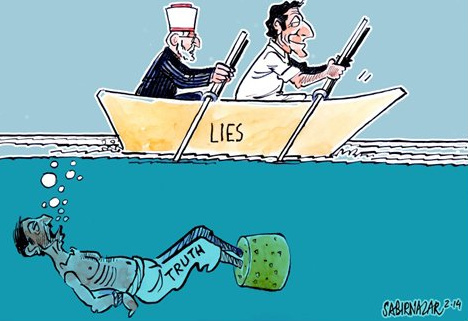
Considering the daily mass murders of people of Shia faith in Syria, Pakistan, Iraq, and Afghanistan and designation of Ahmedis as non-Muslims, it is not clear if they are included or excluded from Ummah
The Egyptian President, Dr. Mohamed Morsi, recently paid his maiden (one day) visit to Pakistan. As is the case in all official meetings and discussions held among various “Muslim heads of states”, both Mr. Zardari and Dr. Morsi used lofty words and hyperbolic phrases during their talks and public announcements.
For instance, President Zardari said: “Pakistan and Egypt should work together for the common good of the Ummah and for peace in the region.” The Arabic word Ummah is commonly used by mosque imams, mullahs and self-proclaimed ‘Islamic scholars’ for describing Muslim population. Considering the daily mass murders of people of Shia faith in Syria, Pakistan, Iraq, and Afghanistan and designation of Ahmedis as non-Muslims, it is not clear if they are included or excluded from Ummah.
Recognizing that:
1. the populations of both Egypt and Pakistan include significant minorities;
2. the two countries have horrible record in protecting even the most basic rights of their Muslim people and especially of minorities;
3. both countries have huge security establishments but are failing miserably even to provide personal safety and minimum security to their people and more specifically to women and children;
Consequently, such proclamations of promoting common good and regional peace are nothing more than empty and meaningless rhetoric.
Amazingly, Mr. Zardari is reported to have also included the following statement in his welcoming remarks:
“The government and people of Pakistan highly value their relations with the Egyptian brethren.....”.
Apparently, little more than half of the women population of Egypt or perhaps also of Pakistan does not count.
Mr. Zardari seems to be either totally ignorant or unconcerned about the reality of the situation in both these countries. He seems to be much more eager to distribute large doses of ‘Islamic opium’ to the Egyptians and Pakistanis.
Common sense dictates that he should have given an ‘inclusive and religiously neutral’ statements about the daily safety, security, socio-economic economic well-being of the people of both countries. Instead, he chose to express his superficial concern for the entire world Muslim population and for all Arab/Muslim majority countries.
However, being a life-long member and now leader of the Muslim Brotherhood, Dr. Morsi was not going to miss this opportunity either. He was equally well-prepared to paint himself bright with an Islamic colour.
In his reply, President Morsi also resorted a similar language: “ ... that both countries were two pillars of the Islamic world and have an important role to play in the Ummah as well as the region”.
Recognizing that:
1. since taking power, Dr. Morsi has been unable to stop the spread of a deadly and
destructive civil war in his country;
2. as was the case with his predecessor, dictator Hosni Mubarak, Morsi government
too is looking towards the West and especially the U.S. for more loans and financial
aid just to ensure its political survival;
3. numerous Arab/Muslim majority countries especially Syria, Iraq, Pakistan,
Afghanistan, Yemen, Somalia etc. are suffering from increased deadly sectarian
violence resulting in mass murders of innocent people especially women and
children and massive destruction of public properties;
4. oil rich Gulf Arab states led by Saudi Arabia and Qatar are pouring huge amounts of money to arm fighters in order to create havoc in Syria. At the same time, Iran is doing the same for assisting the Shia sides;
It seems more logical and also prudent that instead of uttering big words such as Ummah and talking about ‘regional peace’, these two leaders should have focused on establishing peace and political stability in their own respective countries and the surrounding neighbourhood.
For instance, in the case of Pakistan, there is much greater need and enormous benefits for improving mutual relations and enhancing peace with its two neighbours namely India and Afghanistan.
Similarly, both Egypt and Pakistan must do much more to prevent violence against and horrible mistreatment of their Muslim and non-Muslim minorities.
The visionary Muslim leader and father of secular and modern Turkish state, Mustafa Kemal Ata Turk, said: “ YURTTA SULH, CIHANDA SULH”[By establishing peace at home, one can contribute more to the world peace].
Considering that:
1. the population of Turkey is close to 80 million and is about 98% Muslim;
2. the country adopted a secular democratic constitution in 1923 which guarantees equal rights for both women and men;
3. today, Turkey is included in the top 20 industrialized, socio-economically advanced and stable democratic countries in the world.
Muslim leaders such as Mr. Zardari, Dr. Morsi and others will be much better off following Ata Turk’s advice.
| Dr. M. Husain Sadar is a Canadian of Pakistani ancestry. He lives with his Family in Canada’s national capital city, Ottawa. |