One major theme was a number of panels where communalism and fascism were discussed. Little in these can be called mere repetition of well aired information. Serious attempts were made to come to grips with the changing tactics and strategy of fascism
 Historical Materialism journal is currently a key English language journal of Marxist politics. It is of course possible that others will have their own views, and we have no quarrel over that. But there are four major English language publications. New Left Reviewand Verso have published much that is valuable, but they have always been kind of high theory with no clear orientation for building a revolutionary party (or parties). Monthly Review has existed for an even longer time and has steeredequally clearly away from that central task. Unlike NLR, MR had a strongeremphasis on Marxist economics, and also on political movements. Socialist Register has had importantinterventions, but as an annual, its scope was a little more limited. Historical Materialism has been more committed to revolutionary strategy and party building, and it has sought to develop that in a number of ways. It hasbeen publishing a series of outstanding works on Marxism, focusing often onpolitics, and though its partner in hard bound publications, Brill of Leiden,are absolutely atrocious in their pricing, the agreement with Haymarket Booksfor paperback editions of all the titles, and more recently with Aakar Books forSouth Asian editions of at least selected titles, show a concern that activistsshould get the books.
The HM Conferences in London arealso important steps in political work. The call for papers is clear that it isnot another academic programme, but one where the political project of Marxismis clearly central. And this has made HM Conferences the best clearing housefor serious Marxist thinking. This inturn led HM editors to the realization that Conferences held only in Londonwill mean an extreme concentration of British, West European, and at most NorthAmerican participants. Thus, in 2011, two of us were fortunate enough to getsome funding and attend the HM London Conference, but Sobhanlal Dutta Gupta,for example, could not.
HM decided to have conferences atvarious places. There have already been several North American HM conferences.But now there were plans for conferences from Australia to Russia. Theseincluded one at Delhi. The organizers of the Delhi conference were a smallgroup of very sincere and dedicated comrades. Kamal Mitra Chenoy, Harsh Kapoor,Jairus Banaji, Rohini Henseman, Brinda Bose, M J Pandey, Meena Dhanda, GautamMody, and a number of others were involved. Apologies if missing people whoworked hard. Kamal got JNU sponsorship. ICSSR pitched in with a grant. Thismade it possible to put up a large number of the participants.
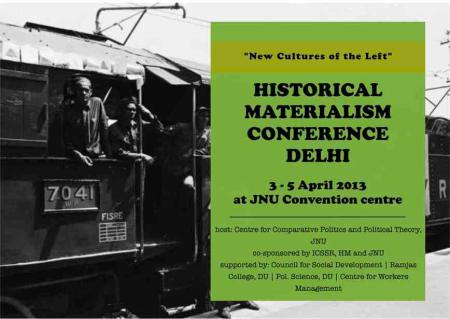
The Conference was planned over along period. By June 2012, Harsh Kapoor had circulated the Call for Papers, andit had been put up in a number of websites. The response was so strong that theorganizers had to meet and quickly decide to extend it by a day. The originalplan for a two day conference was turned into a three day conference – 3-5April 2013. Stress was given to Indian and other Asian and Asia-Pacificspeakers. And a serious attempt was made to ensure that people would not speakat more than one session. Finally, the focus was on the state of leftism in Indiaand the challenges before it.
We were connected to theorganization of the conference only in a small way and did not discharge ourduties much. But we were involved in trying to put together a long panel, whichdid not fully work out. We wanted two papers on the building of revolutionaryparties – looking at what Leninism can mean today, as well as Luxemburg’scontinuing relevance. We wanted one paper on Kashmir, one on the issue ofUnited Front versus Popular Frontism, and the continuing relevance of that fortoday’s left practice, one on permanent revolution, and one on environment as aclass struggle issue. Eventually the paper on Luxemburg and the one on Kashmirwere presented in other panels separately, by Soma Marik and Nagesh Raorespectively. Bodhisattwa Ray, Kunal Chattopadhyay and Rohit Prajapatipresented three papers in a common panel. And Tithi Bhattacharyya, who wasexpected to present the paper on permanent revolution, could not get funding tocome from the US. Serves her right for being a commie professor at Purdue whosteps on the administration’s toes. But we missed that, as we wanted a seriousdiscussion on Davidson , the Arab Spring, and India, from the perspective ofpermanent revolution.
The paper on Rosa Luxemburg waspart of a panel on the revolutionary party. One of the papers was reads out asthe author had not come. A second paper by Dhruv Jain talked about the lateAlthusser and Badiou. Soma’s paper was trying to look at the differences in theapproaches of Lenin and Luxemburg in terms of their different projects.Luxemburg was primarily concerned with the German Social Democracy in many ofthe essays and pamphlets that are often discussed. It was argued that two orthree essays and letters across fifteen years do not constitute a sustainedpolemics, so she was not an “anti-Leninist”. On the contrary, when working inthe underground she and Lenin shared many common concerns. In Germany, it was she who was aware, muchbefore Lenin, that the reformists and the bureaucrats were becoming dominant inthe party. Her writings on the general strike, for example, were attempts tofight these forces. Discussion included a valid point that she made differentcomments at different times, for example on cadre education. Pranav Janiremarked that she and Lenin had important differences on the national question,but the paper presenter responded that she had not been talking about thenational question at all.
The panel on revolutionary partyand programme generated a good discussion, primarily on the issue ofenvironment as a class struggle issue. Rohit Prajapati gave an outstandingpaper on the subject, the result of most of a life time spent trying to workout the theoretical and practical dimensions of that very theme. He said thatenvrironmentlists often took the wrong end in their discussions. For example,he cited the Hema Chemicals case, where the first victims of hexavalentChromium were the workers, while environmentalists woke up only when communitiesbegan to be affected by dumping. Similarly, the focus on consumption ignorescapitalist production. There were quite a few interested people, and ananimated discussion followed. Bodhisatwa Roy presented what in many ways was aRadical Socialist stance on the contemporary relevance of the concept of aLeninist party, as well as important areas where it needed reworking – notably genderingthe party to ensure women workers got equal space, and developing the programmein specific ways, keeping in mind that unlike in the era of Lenin the workingclass was not so easily oriented to socialism. Discussion on this paperincluded a short exchange on Alex Callinicos’ exclusion from the Conference. RSmembers expressed the view that they would have been willing to confront him onwhat they saw as possible rape cover up and certainly aggressive sexism of theSWP, rather than exclude him, but they also pointed out that none of thepersons present were party to this action and therefore the discussion shouldfocus on the issues raised in the paper. One member of the audience said thatwithout a socio-economic analysis and a programme discussion of the party wasnot useful. The paper on United Front explained what the early CommunistInternational had called the United Front of the Working Class and how that wasdistorted by Stalinism in two ways – as “United Front from Below” in itsultra-left swings and as “Popular Front” in its right wing swings. It wasargued that both had left deep legacies in India, with the Maoists taking overthe former and the CPI and CPI(M) the latter. The mainstream left had, as aresult, repeatedly abandoned working class independence of even the minimalkind for a search for so-called anti-fascist lesser evil bourgeois forces.Building a revolutionary working class party must begin with abandoning thesefalse and pernicious strategic orientations.
One major theme was a number ofpanels where communalism and fascism were discussed. Little in these can becalled mere repetition of well aired information. Serious attempts were made tocome to grips with the changing tactics and strategy of fascism. Jairus forexample pointed out that Modi’s being projected as a central leader wasdifferent from the Sarsanghchalak leading the RSS, because the RSS supremo isnot a public figure the way Modi has been made. And he was also arguing thatthe key failure of the left is to assume that electorally combating thefascists is anti-fascism. This would also be a point Rohit Prajapati would makefrom the audience, saying that the number of seats won by Modi in oneparticular Gujarat election is no marker of the strength of fascism, sinceideologically it has been advancing strongly. Subhash Gatade looked at dalitexperiences and fascism, and again pointed to the failure of the left. Theassumption of too much of the left that they only have to teach out of oldtexts and have little to learn is a major problem here.
The one really dull session weattended was the Labour History session. Chitra Joshi presented a survey ofliterature. Prabhu Mahapatra managed to argue that class is virtuallynon-existent, just a short while after a massive general strike in India, andJan Bremen as chair asserted this was analysis at its historical materialistbest. Only Dilip Simeon struck a “discordant” note by actually looking at thepolitics of labour. As we said at the beginning, this is our take, not a formalreport by any organizing committee. We do not dispute the scholarly reputationsof the participants. But we suspect Historical Materialism was not well servedin the session. Unionisation, its necessity, were passed over. That women haveto give sexual services were not taken into account when discussing numeroussub categories of labour, so sex-workers were not included as a category. Theyargued that they were looking away from industrial workers to other sectors oflabour. While factory labour is of course not the sole form of labour, the factthat unionization is an important way in which labour can bargain was more orless ignored and buried. No political solution to exploitation seemed to beexplored. This raises fundamental questions about the politics of such labourstudies.
On the other hand, the sessionreleasing the Indian edition of Vivek Chibber’s book Postcolonial Theory and the Specter of Capital was scintillating.While there have been Marxists previously who have written about this school,the Irfan Habib style of attack (“theyhave their patrons in the USA”) is disgusting ad hominem and not academic incontent, and therefore fails to impress anyone other than the dedicated fan ofthe speaker. Sumit Sarkar and others, including some of the present authors intheir humble capacities, have written little bits. But this is a sustainedstudy of the principal works in English of this school, and a Marxist expose ofthe essentially ideological nature of their endeavor.
The session on Love andOppression – Socialist Feminist Perspectives, was well attended. Trina Banerjeehad a paper on Utpal Dutt’s plays, focusing mainly on Kallol and Teer. Sheargued that Dutt raised radical questions on gender and sexuality, oftenthrough his female characters. Though she took up sexuality, some questionsremained inadequately explored, not so much in the context of Dutt, but thewider discussion she was seeking to generate. There is an important question,which Dutt’s plays discussed by her also raise. What sort of love does theemancipatory movement, and then social emancipation, bring about? If for women tolove is still to be trapped in social relations that make the man the centre ofher life, if she is deskilled, this time in the name of sacrificing for the revolutionso that he can forge ahead, then how is the revolution supposed to emancipate women?Some discussion, by Mary John and others, took up the question of how the charactersthat are represented, through performance, are not adequately dealt with interms of Dutt’s styles or metaphors. Albina Shaqeel spoke on honour killings. Sheprefers to use the term honour within quotes. She skillfully dealt withcaste-gender relations and the specific forms of exploitation in every milieu.One was however not clear why it is billed a socialist-feminist perspective,given the panel it was placed in. She argued that much is left to be done bythe women’s movement vis-a-vis khap panchayats, biradari systems and so on. Onefeels that since the women’s movement is not one homogenous movement, and thereare debates over struggles from within the community, this required a betterdiscussion. Another question is, how far is the feminist movement capable ofdeveloping a counter culture while remaining within the existing capitaliststate and society. To try to do so could land it in forms of politics thatwould lead to compromise with the rulers. Another issue of importance is thequestion of culture and education. Text books that create typical pictures ofthe feminine have to be contested. But how the last two papers were socialist-feminist was not clear to us.
The session on Red Green Alliancewas chaired by Praful Bidwai. Daniel Tagioff talked about integrating Reds andGreens, but the two seemed separately located at the end of his paper. Theissue today is not whether to express pious hopes about alliance of Red andGreen, but the concrete foundations on which this is to be done, the demandsand the class struggle axis along which working class has to fight. Only thepaper of Ishay Landa saw environmental concerns from a class struggleperspective. Without that, merely piling data will get us nowhere. Oneproblematic aspect of non-class Green politics is the failure to focus on capitalistproduction. This leads to quickly sliding to a stress on consumption. As manyof us, including Rohit and the present authors, pointed out, within capitalism,without discussing who produces and what is produced, who consumes becomes asecondary issue. Pritam Singh’s paper looked at the growth of the BRICeconomies, their growth, and the impact on environment. Without disagreeingwith his contentions, some of the participants argued that unless one alwayskept in mind the imperialist powers and the way capitalism functioned in thosecountries, there was a good chance of attacking BRIC countries while lettingimperialism off the hook.
The Leftword Books had a panel.The paper by Archana Prasad was valuable. She argued that the relationshipbetween collective memory and the realities of struggle should be studied toget answers to contemporary concerns through the historical lessons of thosemovements. She looked closely at the Worli movement and Godavari Parulekar, asit is less highlighted than the Telangana movement. Prasad is using the text,the memoirs of Godavari Parulekar, to reach to surviving participants of themovement to see what their collective memory says about the struggle today. Thememory kept alive later mobilisations.
Tom Bramble of SocialistAlternative, Australia, presented a paper. Historically there have been a bigdebate between those of the IS Tendency and those of various orthodoxTrotskyist tendencies over “state capitalism”. However, in the last decade orsomewhat more, the Deng and post Deng Chinese Communist party trajectory hasled to a very evident development of capitalism in China. The work of ChineseMarxists like Au Long Yoo have been clear on that. Bramble looked at theimplications of the rise of China as a major capitalist power and a rival ofthe US, with potentials for conflicts, including armed conflicts in theAsia-pacific region.
The panel on the Crisis of theIndian Left dealt mostly with Bengal, Bihar and Kerala, with the major stresson the left in power. The left, it was asserted, has a weaker base in Kerala,so in order to come power it has repeatedly been forced to forge alliances withother forces, including doubtful ones like Muslim communalists. In West Bengal,it stayed in power for a long time, but pure violence, bureaucratic methods,maneuverings, rather than independent mobilisations were the means of stayingin power. Apoorvanand started by staying that he was supposed to be talkingabout Violence and Revolution, but in the light of Sudipta Gupta’s killing, hewas reformulating his speech. While condemning Gupta’s murder, he pointed outthat the Left Front had done the same kind of violence when in power. Duringdiscussions, certain serious features came up. None of the papers had focused onthe working class. How do we look at revival of the left while ignoring the workingclass? Secondly, it was pointed out that the political culture of themainstream left in India admits neither pluralism, nor serious attention tocasteism. In West Bengal, the number of upper caste MLAs went up regularly, while the Left was inpower. Indeed, proportionately West Bengal topped the list. In the same way,while the left pays lip service to fighting communalism, it simply means tryingto reduce BJP seats. It has repeatedly compromised with Muslim communalism. Oneneeds to remember how a small communalist organization was allowed to holdKolkata to ransom and how Taslima Nasreen was thereafter unceremoniously thrownout of the state for good.
The panel on Nepal’s MaoistRevolution had two papers. Feyzi Ismail, a young SOAS scholar, presented a goodanalysis, looking at the politics of the Maoists, and arguing that community,rather than class, was the central axis of their politics. Saroj Giri presenteda disappointing paper. According to Giri, the Maoist politics was wonderfulupto the time they entered the peace negotiations, and then they moved from revolutionaryto neo-revisionist and parliamentary revisionist positions. The Maoists, saidGiri, had given full support to the LGBTs and had put up an LGBT candidate inthe elections. Subsequently, though, they have degenerated. For Giri, clearly,revolution consists of having guns in your hand. The Party and not the workingclass is the active subject. And once you give up the gun your revolutionaryvirtue is spoilt.
The most interesting plenaryattended by any of us was the plenary on the Arab Spring. Gilbert Achcar saidthat imperialism is retaining its power by stoking Islamophobia. He also feelsthat the Islamic Brotherhood coming to power is good, because now people willbe able to understand what they really stand for. This was immediatelycontested. For an Indian left audience, this was like telling them that it isgood to have the RSS come to power, because then the people will realize whatthe RSS really is. This is a terribly defeatist argument. Mariane Lucas said that anti-imperialistslogans are not enough, because Islam as religion is anti-feminist, dictatorialand fascist. We have to fight against these components while raisinganti-imperialist slogans. In other words, there are two enemies of the Arabproletariat. The feeling of the bulk of the audience was that all religions areanti-feminist, so to pick out Islam is to side with imperialism. The overallspirit was that from the perspective of the left the Arab Spring is a positivedevelopment, but the outcome depends on successful left regroupment andstruggles.
There were three to four parallelsessions from 9-30 to 5-45. So you could hardly be everywhere. In fact it was abit exhausting. We did not go to any of the film shows, as a result.
We came away enthused, with greatinteractive sessions, and we gained a lot of insights. One hopes HM will organizesuch India-based sessions regularly, while taking care that the pluralistnature of the conferences are maintained. Round table formats for the parallel sessions would have been better for discussions.