
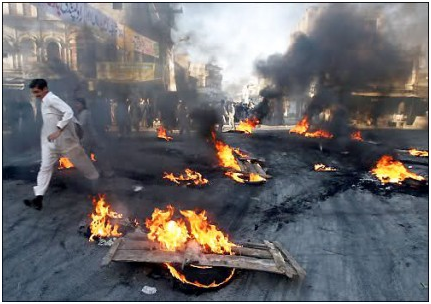
 A steep decline in loss of human lives due to violence was observed during the month of March 2014, a phenomenon that could be attributed to the peace negotiation drive initiated by the government and the observance of ceasefire by the Taliban and the government for the whole month.
 From 571 deaths in the month of February, the number came down to 385, more than 30% reduction in loss of lives during this month. Does it mean that all the acts of terrorism ceased to occur during this month or they took a new shape and form? To seek an answer to this question this report will take a closer look at all incidents of violence that took place during this month.
The targeted operation in Karachi continued to remain a subject of criticism for some political and religious parties while the government showed no change in its policy related to the operation. Targeted operation alongside the target killing, abduction, and dumping of dead bodies continued on in the city leaving many questions unanswerable for bringing peace to the violence ridden city of Karachi.
The sectarian violence also registered a downward trend during this month but an event of blasphemy turned the violent people into committing other crimes like desecration of worship places of Hindu community and thus creating fear among Hindus living in Sindh and Balochistan.
All these events and other facts reported in the national newspapers are collected to make this report as informative and factual as possible. Errors and omissions, as always a possibility in all statistical works including this one, are expected. However, such mistakes do not grossly affect the basic objective of this report. This report mainly covers the following topics:
OVERVIEW
Deaths due to violence in the country during March 2014:
The casualties of violence during the month of March 2014 were 736 (388 dead and 348 injured), nearly 30% lower than the last two month’s figures for fatalities (Refer to graph 1 and table 1). The ceasefire announced by the Tehreek-e-Taliban of Pakistan could be cited as a reason for this substantial reduction in death rate. All forms of violence except target killings showed a declining trend and the major beneficiaries of it were FATA and KP regions. This decline in death rate also proved that the Taliban had a major role in violence the country has been facing for a long time. The situation in Sindh and Balochistan remained unchanged because of the nature of causes and the actors that trigger violence in these provinces (Refer to graph 2). Karachi, as usual, remained on top in loss of human lives and even the capital of the country was among those locations of the country that were highly affected of violence during the month under review (Refer to graph 3). Although a ceasefire was claimed to have been observed by the Taliban and government agencies during the month of March, the number of government officials killed during this month was 53 as opposed to 66 for the last month (Refer to graph 4). Last month, 166 militants were killed in different security operations while the figure reported for this month is 39 only. It shows that the government was more observant of its commitment to ceasefire than the militants.
Graph 1: Deaths due to violence in Pakistan (Jan 2013 – Mar 2014):
Graph 2: Number of people killed in provinces due to violence:
Graph 3: Number of persons killed in cities:
Graph 4: Victims of violence in June 2013:
Ceasefire and its observance:
The announcement of ceasefire by the Taliban and the government became controversial when several incidents of violence were claimed by the splinter groups of the Taliban. On 3rd March, two suicide attacks followed by indiscriminate firing at Islamabad district courts left 11 dead and 30 injured. Ahrar-ul-Hind, a splinter group of the Taliban whose name was never heard before, claimed to have carried out this dreadful attack where innocent people were shot at without any feeling for old, young, and females. It was a kind of replay of Mumbai attack at a small scale. Among the victims were a judge and a young female lawyer who had opted to come back to this country after completing her education in USA. On the same day, a blast took place near a Frontier Corps vehicle in Landikotal killing two FC personnel[1]. Nobody claimed responsibility of this attack while the Taliban condemned this incident.
Second incident took place in Kurram Agency on 6th March when a convoy of paramilitary soldiers became victims of a remote controlled bomb blast leaving at least six soldiers dead and 11 injured. The Ansarul Mujahideen militant group, which has been active in the tribal areas for around three years, later claimed responsibility for the attack. “We have carried out this attack to avenge drone victims. We are not part of the Tehreek-e-Taliban Pakistan (TTP) so we aren’t bound by their ceasefire,” the group’s spokesperson Abu Baseer told journalists by phone from an undisclosed location[2].
Two more violent incident occurred in Peshawar and Quetta on 15 March 2014 leaving 22 persons dead and nearly 90 injured [3] [4]. Ahrar-ul-Hind again took the responsibility of carrying out these deadly attacks that had put to death many innocent men and a couple of women and children too.
These incidents of terrorism and militants’ attacks left more than 40 persons dead and nearly 140 persons injured. The denials issued by the Taliban were of no value for the people whose loved ones had either lost their lives or become crippled.
These incidents of militancy raised a serious question as to how seriously the commitment of ceasefire was followed by the government and the Taliban.
Casualties of militancy:
The casualties of militancy (militants’ attacks[5] and terrorism[6]) were 310 (76 deaths and 234 injuries) during the month of March. All of these incidents took place in FATA, Balochistan, KP, and Islamabad (Refer Table 2).
Victims of these incidents were civilians (47) and government officials (31). Among the government officials were Baloch Constabulary, Frontier Constabulary, Khassadar, and Judge (Refer to table 3).
Table 3: Fatalities of government officials due to militancy – March 2014
Casualties of security operation:
The security operations carried out by the different security agencies of the country left 76 persons dead and 10 injured. Nearly 80% of the victims of security operation were from Sindh (39) and Balochistan (29) and only 10% victims were from FATA (8). The total casualties of security operation were 86 as against 310 casualties of militancy. These figures speak for themselves as to how the militants fared in following their commitment for ceasefire. Yet, a statement issued by the spokesman of TTP, Shahidullah Shahid, blamed the government of increasing attacks on militant hideouts and raids on houses of its members in tribal areas[7]. According to the press reports, only two security operations were carried out in Khyber agency during the month of March and they were in retaliation to the militants’ attacks. Here are the press reports:
Khyber firefight: Three militants killed in Bara clash [8]
By Our Correspondent
Published: March 1, 2014
BARA: Three members of the Lashkar-e-Islam militant group were killed in a clash with paramilitary troops in the Bara tehsil of Khyber Agency on Friday. Three others, including a commander and two Frontier Corps officials, were also wounded. An official said that fighters from Mangal Bagh’s Lashkar-e-Islam were passing through the mountainous area of Shalobar in Purdil Abad when they encountered paramilitary soldiers. The militants opened fire at the personnel, injuring two of them, and three LI members were killed in retaliatory fire, the official said. A commander, identified as Abdul Wali, was injured in the firefight.
Gunship helicopters kill five suspected militants in Khyber[9]
2014-03-02
KHYBER AGENCY: In response to the militant attack on a polio team in Jamrud which left at least 11 dead on Saturday, security forces’ personnel launched a massive assault Sunday morning on militant hideouts in parts of Bara and destroyed a number of them. Security sources confirmed that gunship helicopters struck the headquarters of Mullah Tamanche involved in the attack on polio workers. The Ayubi Markaz of Mullah Tamanche in Bara was destroyed in the airstrikes whereas five suspected militants were killed, the sources said. Gunship helicopters also targeted militant hideouts in Kalanga and surrounding areas and a number of them were destroyed.
Attacks on Polio team and their guards:
While the Taliban were very prompt in denouncing the acts of violence carried out by their splinter groups in Kurrum agency, Islamabad, Peshawar, and Quetta, they failed to show a similar reaction to the killings of twelve (12) Frontier Constabulary personnel in Jamrud that were escorting Polio team. When the security forces retaliated to this breach of ceasefire by one of the Taliban’s commanders, Mullah Tamanchi, the Taliban came out with their condemnation and a threat to resume their attacks across the country. During this month, 18 persons lost their lives for providing a service that saves the children of the country from getting crippled (Refer to the Table 4) and the lack of concern and sympathy with the victims of such violence doesn’t speak very well of the Taliban. Since the Taliban have always opposed the polio vaccination and taken violent actions against it, all those who died during this month either working as Polio team members or providing security to Polio team were suspected to be the result of the Taliban’s campaign against Polio vaccination in the country.
Sabotage activities in FATA and KP:
Other than lethal attacks, the Taliban are also suspected of having their involvements in sabotage activities that cause damage to government and public properties. After the announcement of ceasefire it was expected that there will be an end or considerable reduction in their sabotage activities as well. The data we collected disproves such expectations. During the month of March, a number of government and public properties were fully or partially damaged due to bomb and rocket attacks in FATA and KP. Public schools, health units, bridge, houses, and hujras were targeted in these attacks (Refer to Table 5). The sabotage activities carried out in Balochistan and Sindh are not included in the following table because of the actors and factors involved in those regions are different from KP and FATA though the Taliban have made their penetrations in these regions as well.
Instead of blaming the government, the Taliban have to come up with substantial proof to support their claim against the insincerity of the government in following the ceasefire commitment. The available data doesn’t prove their claim in any way.
Sectarian violence:
A 50% reduction in sectarian violence was noticed during the month of March and Karachi was the main place where most of these crimes took place. Fourteen out of fifteen persons who lost their lives on sectarian grounds were from Karachi and eleven persons of them belonged to Shia community. It’s very unfortunate that the Shia community always appears to be the highest victim of sectarian violence despite being a minority in the country. Another minority that suffered violence and desecration of its worship places during this month was the Hindu community. On 15 March 2014, a frenzied mob in Larkana set a Hindu Dharamshala on fire over alleged desecration of holy pages by a Hindu boy.
Next day, angry residents of other cities and towns of upper Sindh as well as in Suhbatpur, Dera Murad Jamali, Dera Allayar, Gandakha and Usta Mohammad in Balochistan went on protests and caused disturbance and destruction in the area. Three protesters and one policeman were injured during clashes in Usta Muhammad, while 10 shops owned by Hindus were set ablaze, according to senior police official Syed Ashfaq Shah. There was no violent reaction from Hindu community against the destruction of their properties and desecration of their holy place. Meanwhile, Larkana’s Hindu Panchyat President Kalapna Devi expressed her shock and sorrow over the incident. “I strongly condemn the desecration of the Holy Quran and demand the accused be punished if he really has committed [blasphemy]”, she told The Express Tribune[10]. Despite showing no violent reaction by the minority Hindu community, the incidents of desecration of their holy places continued on at different locations in Sindh. One Mandir was desecrated in Hyderabad and another one in Tharparkar.
Desecration of holy places has become such a norm in the country that no respect is shown to Muslim or non-Muslim holy places when intolerance becomes a religion for the perpetrators of such unholy crime. During this month, a shrine of a Muslim Sufi Saint in D.I. Khan also came under hand grenade attack by some unidentified persons in Kulachi tehsil (Refer Table 6).
Target killings in Karachi:
There was no decrease in the number of victims of the ongoing target killings in Karachi during this month (Refer graph 4). Despite a peace agreement between the two main rivals of the Lyari gang war – Uzair Baloch group and Baba Ladla group, loss of human lives in Lyari remained the highest during this month (Refer graph 5). The victims were either on the side of one of the gangs in the area or they were in the middle of the cross fires while the fight was going on between the rivals. Would the peace between the two main rivals bring a permanent peace to the affected area is a question that remains to be answered in the coming months. Like the militancy ridden FATA and KP regions, Karachi also has a variety of militant groups engaged in different unlawful activities. In Lyari alone, the victims of violence during this month were found affiliated to the nine different following groups:
Uzair Baloch group
Baba Ladla group
Lala Orangi Wala
Faisal Pathan group
Shakeel Badshah group
Ghafoor Bugti gang
Shakeel Commando
Sheraz Comrade Group
Ghaffar Zikri group
With so many groups operating in one part of the city can explain the complexity of the problem in bringing peace to the area.
Graph 5: Deaths due to target killings in Karachi – Mar 2014
Graph 6: Locations of violence in Karachi – Mar 2014
Throughout the country, 40 dead bodies were found during the month of March and 20 of them were located in Karachi alone. Even a person in his mid-20s was found slaughtered in North Karachi. Security operations carried out by the police and rangers left 39 suspects dead and several hundreds of criminals were also arrested in the city. The target killings on sectarian grounds caused deaths to 11 persons belonging to Shia community, 2 persons of Sunni community, and 1 person from Christian community.
The victims of violence in Karachi belonged to different groups of Lyari gangs followed by the activists and supporters of political and religious parties like MQM, ASWJ, PPP, ISO, PMLF, Shabab-e-Milli. Robbers, land grabbers, and other criminals are also active in Karachi posing multiple challenges for the law enforcement agencies to deal with. According to the press report, the Rangers claimed that during the last six months of targeted operation they have recovered bulletproof jackets, mixed ammo and over 3,236 weapons – including RPG-7, uni-barrel rocket launchers, hand grenades, light machine guns, SMGs, rifles, shotguns, pashpasha rifles, sniper rifles, pistols, explosives, improvised explosive devices and detonators[11].
Like FATA, KP, and Balochistan, the Police and Rangers in Karachi are faced with criminals that have weapons like rocket launchers, light machine guns, IEDs, and SMGs. To counter such well-armed criminals, the law enforcement agencies appear to be less equipped and untrained. This may be one of the reasons why police department is losing their personnel to the target killings and other forms of attacks and why crime rate is not declining in Karachi.
Conclusion:
All indicators of violence, with the exception of target killing, showed a sharp decline during the month of March (Refer to table 7) and it is a good sign for restoring peace in violence ridden country of Pakistan. The incidents of violation of ceasefire commitment are serious issues that need to be paid attention by both the parties, the Taliban and the government. The whole intent and purpose of the peace talks are going to be jeopardized if sincerity and honesty are not maintained by them.
Sectarian violence and desecration of holy places don’t portray a very good picture of a country that claims to be the follower of one of the highly respected and leading religions in the world.
The unchanging situation of target killings in Karachi while the targeted operation is going on raises serious questions about the effectiveness of the operation and the authorities need to revisit their policy and find solutions that can really bring tangible results.
[1]http://tribune.com.pk/story/678270/blast-and-firing-in-landikotal-kills-2-fc-personnel/
[2] http://tribune.com.pk/story/679540/restive-frontiers-kurram-convoy-attack-leaves-six-soldiers-dead/
[3] http://tribune.com.pk/story/683145/ahrarul-hind-claims-responsibility-for-peshawar-quetta-blasts/
[4] http://www.thenews.com.pk/Todays-News-13-29103-Peshawar-Quetta-bomb-attacks-kill-21
[5] suicide attack, hurling of hand grenades, indiscriminate firings by the groups of militants, etc.,
[6] installation of bomb, IED, landmine, etc.,
[7]http://www.dawn.com/news/1095008/ttp-accuses-govt-of-stepping-up-attacks-in-tribal-areas
[8] http://tribune.com.pk/story/677465/khyber-firefight-three-militants-killed-in-bara-clash/
[9] http://www.dawn.com/news/1090532/gunship-helicopters-kill-five-suspected-militants-in-khyber
[10] http://tribune.com.pk/story/683725/communal-riots-hit-sindh-balochistan-cities/
[11]http://www.thenews.com.pk/Todays-News-4-236690-Killer-of-90-people-in-Rangers-custody