 The National Security Advisor to Prime Minister, Sartaj Aziz, in an interview with BBC Urdu on November 16 (1), has for the first time, at least implicitly if not categorically, confessed to the policy of ‘Good Taliban, bad Taliban’. While drawing a distinction between ‘good’ Taliban and ‘bad’ Taliban, he said: "Why should America's enemies unnecessarily become our enemies?...When the United States attacked Afghanistan, all those that were trained and armed by us together were pushed towards Pakistan. Some of them were dangerous for us and some were not. Why must we make enemies out of them all?"
Having realized that Sartaj has shot himself in the foot, Pakistan’s Foreign Office (FO) immediately issued a counter. The explanation offered by FO spokesperson, Tasneem Aslam, was predictably unimaginative: “The advisor made the statement in a historical context…As for [the] present, Pakistan has launched operation Zarb-i-Azb and taking action against all groups without any distinction or discrimination.”
Meantime, Pakistani media outlets flashed a statement by former military ruler, General Pervez Musharraf. ‘The departure of Nato combat forces from Afghanistan could push India and Pakistan towards a proxy war in the troubled state, former military ruler General Pervez Musharraf warned in an interview with AFP’ (2).
Timing is important here. Both statements, conveying a veiled threat to the USA, were delivered at a time Chief of Army Staff, General Raheel Sharif, dashed to the USA. It seems, the strategists in Islamabad/Rawalpindi correctly understand that Washington would not like an Iraq-like mayhem post NATO-pull out in Afghanistan. Hence, inverting the conventional wisdom, they are trying to tell Uncle Sam that certain beggars can also be choosers.
Fact of the matter is, a proxy war on Afghan soil has raged since the 1950s. Until the Mujahideen, succeeded by the Taliban, came to power, Kabul always allied with New Delhi and remained suspicious of Pakistan(3). Post-Taliban, Kabul yet again was more friendly towards New Delhi while Islamabad by backing Taliban, made an attempt to displace India as well as convert Afghanistan into Pakistan’s political backyard.
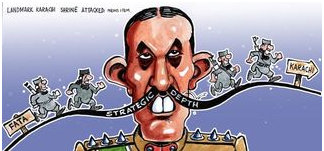
This intervention in Afghanistan is partly an expression of Pakistan’s ‘strategic depth policy’, partly, it has historical roots. Since 1947, Pakistan has attempted to convert the Durand Line into a mutually recognized border. Kabul has resisted the latter move even under the Taliban.
For the last about two decades, India has patronized non-Pashtoon factions (gathered under the umbrella of Northern Alliance) while Pakistan has lent support to fundamentalist Pashtoon factions such as the Taliban and Gulbadin Hikmatyar’s Hizb-e-Islami. Having pursued this policy, Islamabad has universally antagonized non-Pashtoon population while Taliban or Hizb-e-Islami do not represent all the Pashtoons. In other words, Pakistan has pursued a disastrous policy in Afghanistan.
Since 2001, India has been active in rebuilding Afghanistan. Earlier this year, India announced a $ 2 billion package for Afghanistan, biggest ever foreign aid committed by New Delhi. Pakistani role in rebuilding Afghanistan has been negligible, by contrast. Also, Pakistan lacks the financial muscle to lend a helping hand in rebuilding Afghanistan. If anything, by backing the Taliban, Pakistan has contributed to Afghanistan’s destruction.
Therefore, in a way, by alienating Afghans Pakistan has lost the proxy war already. Basing myself on various opinion polls and my personal experience as a frequent visitor to Kabul, I can say that Pakistan is very unpopular in Afghanistan. However, Pakistan is not ready to change the course. Unfortunately.
It seems, whether NATO fully withdraws or stays on in Afghanistan, Pakistan is likely to intervene in Afghanistan. India, in turn, will not withdraw especially when Modi is in charge. Through Gen Musharraf and Sartaj Aziz, the message sent out to the USA is: give us more money, else, we have the ability to unsettle Afghanistan post-2014. However, from the viewpoint of Pakistani masses, these policies will prove disastrous for Pakistan itself. Taliban will not be able to run down Kabul as was the case in 1997. Afghanistan has changed. Objective realities and subjective factors are pitched against Pakistan. .The proxy war in Afghanistan will have a blow back. The working classes will pay the price for the blowback. It is, therefore, vital that the people reclaim the foreign policy. It can not be left to myopic strategists and unprincipled politicians.
Notes:
1. http://www.bbc.co.uk/urdu/pakistan/2014/11/141117_pak_usa_strategic_cooperation_sq
2. http://www.dawn.com/news/1145291
3. http://www.viewpointonline.net/2014/07/vp210/pakistan-s-afghan-misadventure-durand-line-to-strategic-depth/3869-pakistan-s-afghan-misadventure-durand-line-to-strategic-depth