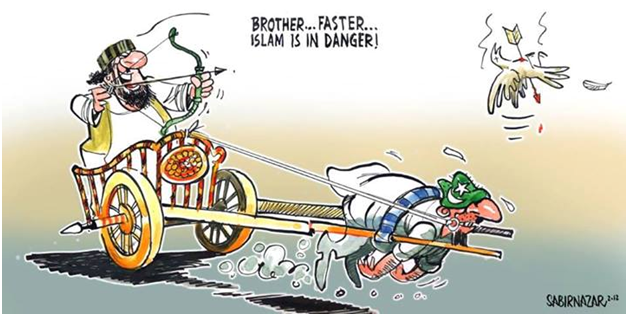
Even in the ‘golden age’ of Islam, every king fought their own wars, sometimes against other Muslim kings to defend their throne other times to enlarge their empires. The kind of ‘jihad’ espoused by Syed Ahmad Barelvi or the Taliban and Osama Bin Laden has been vanishingly rare in Islamic history practiced only by extremist sects
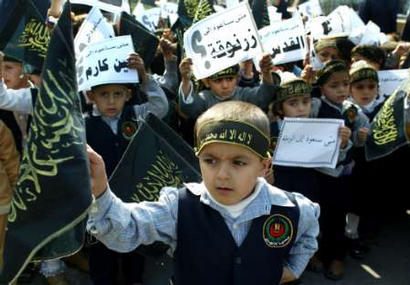 Another historical fallacy posits that Muslims have abandoned ‘Jihad’ (literally ‘striving (in the way of Allah)’) and if we would only return to this noble endeavor, we could return to the ‘glory days’ of Islam. This fallacy has persuaded countless hundreds of thousands of Muslim youth to leave their homes to go to far off places where Muslims are involved in any armed struggles to join them. While their passion is laudable, the involvement of people who are foreign to a struggle often complicates and hinders matters rather than helping including conflicts with those they are supposedly there to assist. The Afghan jihad against the Russians is a case in point where people from all over the world including Arabs, Pakistanis, Somalis and many others showed up to join the ‘jihad’. Once the Soviets left, their internal conflicts came to the fore resulting in a horrific civil war that claimed thousands of lives and wrecked what was left of Afghanistan.
A rare example of the type of ‘jihad’ described above in Muslim history is the Kharijites (literally "Those who Went Out") a general term embracing various Muslims who, while initially supporting the caliphate of the fourth and final "Rightly Guided" caliph Ali ibn Abi Talib, later rejected him. They first emerged in the late 7th century AD, concentrated in today's southern Iraq, and are distinct from the Sunnis and Shiites. Religiously they were strict traditionalists. The high point of the Kharijites' influence was in the years 690-730 around Basra in south Iraq, which was always a center of Sunni theology. Kharijite ideology was a popular creed for rebels against the officially Sunni Caliphate, inspiring breakaway states and rebellions throughout the ‘Maghrib’ and sometimes elsewhere. They considered the smallest sin to be reason to brand other Muslims as ‘kafir’ (infidel) and proclaimed proudly that all non-Kharijites were inhabitants of ‘Dar-ul-Harb’ and the massacre of their women and children was religiously sanctioned. This, of course, is similar to our current jihadists who proclaim every sect except their own infidels, who tore apart Kabul and Afghanistan with their infighting after the Soviet withdrawal and are now busy doing the same in Pakistan. The Kharijites were a powerful force in the Umayyad era and revolted many times but could never gain political power due to their intransigent beliefs and eventually faded out under the Abbasids.
Ibn Khaldun has mentioned several individuals in history who rallied their followers to begin a ‘jihad’ for religious supremacy. He is of the opinion that those who proffer these beliefs in the name of religion are either lunatics who need proper treatment or should be prosecuted for rebellion and sedition. Most, he believes, are rogues who covet political power under the guise of religion and adopt these tactics as a reaction against obtaining power legitimately.
The truth is that in the history of Islam, there have been only two occasions where the concept of Jihad was applicable. One was the Crusades and the other, the Mongol invasions. As we have seen though, never during those times did the ‘Ummah’ unite as one to fight the invaders nor was ‘Jihad’ ever proclaimed. The Fatimids, the Mamluks, Salahudin Ayubi (‘Saladin’) and other Muslim rulers resisted the Crusades on their own but not once did other Muslim kingdoms come to their aid nor was a ‘jihad’ ever proclaimed. The Mongol invasions were different still. Here, the prevailing Muslim kings actually invited the Mongols to attack their rivals and in some cases assisted them. In the Muslim cities sacked by the Mongols, religious sects were constantly fighting and would often vie with each other to see who could assist the invaders. Later, Muslims joined the Mongol armies in large numbers and helped sack Baghdad.
Thus, even in the ‘golden age’ of Islam, every king fought their own wars, sometimes against other Muslim kings to defend their throne other times to enlarge their empires. The kind of ‘jihad’ espoused by Syed Ahmad Barelvi or the Taliban and Osama Bin Laden has been vanishingly rare in Islamic history practiced only by extremist sects like the Kharijites and Ibn Khaldun’s views on them seem accurate.
 |
The author is a Psychiatrist practicing in Arkansas, USA. Email: |