It is better to be original native than to be a fake Arab. Let’s unlearn false stories about our forefathers and own ourselves by exorcism of Saudi specter!
Within the Cold War, there was inter-Arab war being fought in the Middle East---over the question of political legitimacy in the Arab world---between puritanical deviation propagated by Saudi Arabia and Arab nationalism based on socialism and the rhetoric of revolutionary anti-imperialism. When secular socialism had catastrophic defeat, a widespread perception proliferated the Arab world that the defeat was due to the un-Islamic nature of the major Arab states. “Return to Islam” thus became call of the day which, ultimately, opened the way for radical Islamic forces.
Saudi royal family played vital role behind this propaganda because House of Saud was not only afraid of Soviet communist influence in the region but also a threat from Arab social revolution which had already befallen the monarchies in Iraq, Egypt and North Yemen. To contain Nasser’s secular radicalism, Saudi family deployed deadly weapon of Wahabism: religious-looking Saudization campaign which became popular among young ones for its power to appeal muscles, antagonism and baser instincts more than nourishing wisdom, love, empathy and compassion.
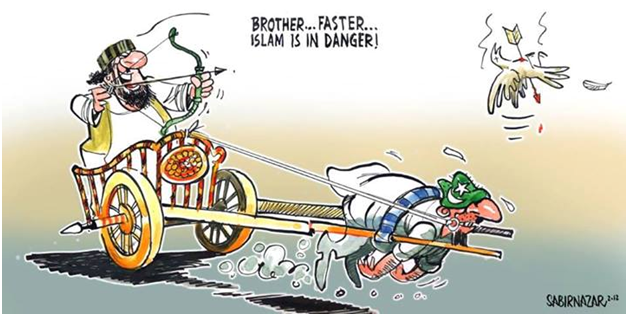
The family, no doubt, was exploiting Islam as pretext for its hegemony. As their outward love for Islam was concerned; it was because they had always used it as a maddening tool to manufacture herds of firebrands for facilitating expansionism. When Soviet forces entered into Afghanistan, Pakistan brought in Wahabi Trojan horse as a gift from the holy lands.
Wahabism was an alien tree in our soil. So, the local communities, especially in Pakistani villages and towns, resisted it for they had never tasted religion so bitter. However, when Wahabis presented their Islam as the only authentic version and Saudi Arabian tribal norms as only valid Islamic way by quoting scripture and traditions; they got most of them surrendered.
Behind this rapid spread of Saudi political Islam there were several reasons besides a forcefully contrived “political will”.
The first reason for young people to accept this kind of Islam has two factors: firstly, Wahabism applies sacred coverings to baser emotions (anger, hatred, jealousy, greed, lechery etc), secondly, almost the same streak of religiosity was (and is) being propagated through text books in Pakistan.
Another interesting reason for the popularity of Wahabi Islam is its being devoid of serious thought. It is religiosity for the people who still want to live at apish level. So, it was best for a generation already fed on emotional slogans. It was attractive for it could answer every trivial question which an average mind can ask: what is forbidden? What is permitted? Who is Kafir? Who is Mushrik? How to kill a hen? How to take bath after mating?
The last question carries special attraction for youth living in semi-tribal and closed societies. Wahabis, however, have lot more ingenious methods to make Pakistani society even more closed:
“If women are unveiled and set free; young men would never catch the fire for hoors in heaven. Their hearts will get locked in their (women’s hair) locks”.
Our sane Wahabi teacher would disclose their method in this way.
To reduce it to absurdity, everything which points to some wider perspective, to the philosophy, to the anecdote, to symbol or to the intellectual debate is forbidden. By introducing these trends, Saudization has pushed serious thinking further away which is already too late within Islam.
Yet another aspect which proved to be poisonous for Pakistan is their taking extreme positions wherein finding golden-rule of moderation, among Wahabis, is like trying to fish in the scorching desert. It is something against the very nature of our society and native flavours of religiosity. In Sunni and Shia Islam, for example, if one question was asked, there were four possible answers and none of them was declared to be final one. In other words, there was constant room for Ijtihad. For Saudi Islam, there is only one answer and if one chooses not to believe in it; one deserves nothing less than death.
In the light of above, if we look at the current violent nature of our society; we can easily find this alien Saudi mode of religiosity a trendsetter in almost every incident brining forth vicious behaviours. By answering the above mentioned questions in the negative and blameworthy manner, Saudization has become responsible for not only inter-sect violence but the atrocities committed against non-Muslims in the name of Islam.
Another gravest havoc this ideology has played in Pakistan is confusing religion with politics besides the deadliest one trend of literalism.
Before Wahabis used texts to brutalise young imagination, the scripture was taken as something too sacred to be understood literally. It was only read aloud to invite goodness within. This Saudi brand, however, introduced literalism and now we see everyone chanting: “verse number this, chapter number that”. The net result of this alien trend is that now we cannot tell a Sunni from a Salfi. Now everyone claims to understand literal meaning of scripture. When a Salfi approaches people by chanting, verse number this chapter number that, they had to surrender because they, by now, too agree that Scripture is literal message of God.
Sunni before them, especially with Sufi bent of mind, were of the opinion that verses of scripture were symbols and they have hundreds of hidden meanings. Sufis had strictly censured the practice of saying, “God says this, God says that”. Now, after Salfis have broken in, everyone believes that scripture has unembroidered meanings which makes it easy for anyone to declare other kafir, mushrik and, so, liable to death.
The most dangerous and baseless, misconception created by Saudization is that Saudi Arabia is the prototype of Islamic civilization. So, this primal fallacy needs more serious consideration.
When Ziauldin Sardar, in Islam Postmodernism & Other Futures, says that twenty-first century will mark the end of civilization as we know it; and herald the world of civilizations—Indian, Islamic, Chinese and Western—he inserts “Islam” (the ideology or a religion) as a civilization by ignoring that it is not “only” religion or ideology which makes the foundation of a civilization. If religion or ideology makes a civilization, why don’t we say that all communist countries make a communist civilization? Instead, we say that China represents Chinese but not socialist/Maoist civilization. And, at the same time while India has become the biggest democracy in the world, may we call India a democratic civilization?
Interestingly, even Iqbal was not in favour of presenting his beloved hijaz as the prototype of Islamic civilization for he knew its cultural and aesthetic poverty. So, he looked somewhere else. In his famous couplet, for instance, he says to Islam:
“You shall not be wiped out with the fall of Iran; Ecstasy belongs to wine not to the cup”. It was not just an imaginative flight but he repeats the similar thought in his chapter Muslim Community:
“The conquest of Persia gave to Muslims what the conquest of Greece gave to Romans”.
We know that Greece gave wisdom, knowledge and above all culture to Rome and so did Iran (tried to give) to Arabs. The glory, grandeur, poetry, anecdotes, which common Pakistani boast of, has nothing to do with Saudi Arabia.
It clear that it is not ideology or doctrine which makes cultures and civilization but all those practices which weave the delicate milieu of art, description and communication which enjoy relative sovereignty from doctrinal or political sphere and are more effected by aesthetics and their basic aim is pleasure or artistic elation in more sophisticated sense.
In the light of above, we cannot juxtapose Islam with Saudization and call it Islamic Civilization for Saudization is adopting Wahabi doctrine that is strictly anti-social, anti-community and believes in waging war against everything which is related to beauty, creativity or makes human person happy. Beauty, creativity and art are means (and sometimes end as well) but their end is aesthetic nourishment and happiness. If any region, country or group do not tolerate or nourish innovation or aesthetics, it cannot be called civilized or cultured but otherwise.
It is for this reason that Saudization in Pakistan has been trying to tear apart our tolerant cultural fibre into pieces for it does not know about its worth and delicacy as swine does not know anything about pearl. Our music, songs, dance, colourful customs, rituals, folklores, expressions, and legends make our societies dynamic, rich and vibrant. These are being mocked at by Salafis as un-Islamic and so forbidden.
In fact, this culture is celebration and expression of an advanced Indus-Gandhara civilization. If Saudization represents a culture or civilization at all, it is of very closed and obsolete tribal nature which is rusting and dying its own death in its very embryonic stage. It has no power to look down upon the customs and values of our society which is hire to world’s greatest civilizations. Saudization of Pakistan is in fact the myopic act of selling construct to buy debris.
Saudi brand of religiosity, moreover, rejects community and adopts the policy of social withdrawal or avoidance and becomes, once again, the greatest danger for our delicate social strand. Wahabism’s crowning achievement, in Patrick Haeni’s words[1], is establishing Wahabi ghettos which are created less at family or community level but within a group of isolated Saudized dreamers.
While they are preaching for exodus (collective migration to Saudi Arabia) to Muslims in the West, Wahabi approach in Pakistan or other Muslim courtiers is entirely different. Oliver Roy observes in Globalized Islam; Search for New Ummah[2] that in West Wahabis (following the example of Hezbollah or Hamas) form ghetto-counter-culture which has broken from European societies but in Pakistan, they are struggling for overthrowing jahiliyya (ignorance of God’s law) to replace it with Sharia. They consider Sharia to be divine which consists of fiqh or jurisprudence that is nothing more than legal opinion of classical jurists of expansionist era.
In the course of the time, however, we are witnessing some radical changes in this self-consuming approach. Violence, which was once envisioned as a sign of victory, has now been replaced by sacrifice. By now, combatants do not consider themselves “just” but “pure”. It means that they are no longer interested in community, culture or civilization but want to preserve their self-assumed purity in ghettos. Another striking shift in their approach comes forth from the fact that the figure of the new armed militarism is no longer the mujâhid (holy warrior) but shahîd (martyr). This paradigm shift, from Pan-Islamism to Post-Islamism, on the one hand can be interpreted as a sign of defeatism and on the other hand as far more dangerous desperation. It is a sign that fire, while burning it out, may consume anything.
By decrypting above signs of Post-Islamism, Saudi political doctrine appears to be on its last legs. It, however, has already eaten into the very vitals of a fragile country like Pakistan. It was fragile because it has, in Ghalib’s terms, some fatal flaws in its very construct. One of the fundamental of the flaws, apart from objective resolution, is a complacent assumption that Pakistan is a “fort of Islam” and so is bound to exist till doom’s day. On this Pakistani leadership, if it is really religious, should keep Christ’s last warning in its minds, “they who live by sword, shall die by sword”. Moreover, what Saudized missionaries are doing in Pakistan is nothing but pushing us closer to that doom’s day. Another tragic flaw is still written on our walls, “Rise with the ‘flag’ of Islam to sway the world”. So, even before this noxious import, we had nothing but two war imageries and one disease: fort, flag and folly.
If Pakistan wants to avoid this looming doom’s day; it will have to undo Saudization. Our leadership will have to talk to Saudis not as slaves but as confident heirs to far greater and advanced Indus and Gandhara civilization. To do so, Pakistan will have to re-link its newer generations to the native wisdom of sub-continent, of Indus valley, of Gandhara, of Seraiki region.
Moreover, Pakistan will have to teach its coming generations that current scholarship traces the journey of human thought, from subcontinent to subcontinent, in this way: when ancient Persian Empire had greater influence in sub-continent they, at the same time, were trading with Greece and Greeks were interested in our wisdom of subcontinent. It is therefore we see ancient Greek poet Orpheus retelling the stories, which our forefathers had told us, to Greek children. Later on, Pythagoras, Parmenides, Heraclitus and even Plato borrowed Orpheus’s line of thought. In 1st century, Plotinus systemised our wisdom into full-grown esoteric structure in his Enneads which provided basis to Christian mysticism which enriched this wandering cult with wisdom. Greek philosophy and esoteric trends were, later on, passed to Muslims through Nestorian Christians in Syria. It was therefore when Arab world expelled great Sufi mystics and philosophers, they found Indus-Gandhara valley very hospitable for they carried back its native wisdom.
Embracing our own roots is more matter of pride than shame! It is better to be original native than to be a fake Arab. Let’s unlearn false stories about our forefathers and own ourselves by exorcism of Saudi specter!
[1] Swiss Minarets Ban: Islam in Question, Religioscope Switzerland
[2] New York, Columbia University Press, 2006
|
Jamshed Iqbal is a media critic, freelance writer & peace activist. |