While Jamaat was at the helm in Peshawar, NATO supplies were safely travelling from Karachi to Torkham and beyond
The Jamaat-e-Islami was a brainchild of Maulana Maudodi (1903-1979). His views bear an extraordinary resemblance to the ideas of seventeenth century Saudi revivalist, Ibn Wahab. He argued that the abandonment of purity had caused the decline of Islam, and the only solution would be to a total reversal of that decline.
Maudodi’s stay at Hyderabad during his formative years helped him closely observe the communists’ work pattern. He synthesised his own version of party: Linen and Ibn Wahab rolled into one. Hence, a band of 75 muslayheen (reformers) gathered at Lahore and, on August 26, 1941, launched a new political party a party: Jamaat-e-Islami Hind. Maudodi was appointed its Emir: Linen-cum-Ibn Wahab.
The band of muslayheen could not breathe in Lahore’s secular atmosphere. To keep its purity, it moved to a small town, Pathankot, and established a commune: common housing, common mess and a common economy. The Emir, however, was afforded a separate flat (and a servant) where he lived relatively better off. Call it jealousy or call it a dispute over bread and butter, or whatever – the muslayheen were soon fighting each other. A leading commune member, Maulana Naumani, playing the role of Abu Zar Ghufari (the first dissident in Muslim history in the seventh century), found it unacceptable to have such contrasting life styles in same commune. The royalties from Maudodi’s books and sale of magazine should be ‘nationalised’, demanded Naumani. This was socialism.
Maudodi was a thorough and accomplished anti-socialist. He stood for a neo-liberal market economy and cited Quranic verses to justify private property. Quran rescued Maudodi. But Naumani was not ready to surrender either. Defeated on economic questions, he brought confessional charges against Maudodi: Maudodi’s beard was the wrong size; he was often late for dawn prayers; wife had been immodestly dressed in the presence of a male servant (Ali: 175-176).
The infighting led to a split and Naumani parted ways with Jamaat. In 1956-58, Jamaat would suffer another split. Led by Amin Ihasan Islahi, dissidents deserted Jamaat, accusing Maudodi of opportunism. Having suffered electoral defeats in Punjab and East Pakistan, Islahi became disillusioned with electoral politics (Bahadur: 89-92). But we are running ahead of story.
Like other puritan outfits, the JI was not in favour of Jinnah’s concept of Pakistan. Jinnah’s Muslim League attempted at least twice to woo Maudodi, but in vain (Ibid: 42).
This was a serious problem after 1947. Jamaat began to claim that Maudodi “was actually the author of one of the many schemes of partition that were being circulated in the thirties. Mawdudi’s biographers carefully edited quotations from his writings prior to the Lahore resolution...to make out the case that he was advocating – the partition of India…The third volume of Mawdudi’s famous collection of articles, Musalman Aur Siyasi Kashmakash, which contained attacks on Pakistan, was omitted and only the first two volumes were published under a new title, Tehrik Azadi Hind Aur Musalman. The first two volumes consisted of articles which attacked the concept of territorial nationalism and the Indian National Congress.’ This was just one attempt (Ibid: 45-46). In March 1948, Maudodi declared that a Muslim could live in India only if he could prove that not one iota of Islam was left in him. He further claimed that at that rate, there would no Muslims would be left in that country within ten years (Ibid: 114). One wonders if members of his own Jamaat’s chapter in India are still in the realm of the faithful
The creation of Pakistan that Maudodi vehemently opposed had actually blessed him with new opportunities. His services were now required by imperialist fundamentalists in Washington to counter communism in Pakistan. Or did Maudodi voluntarily offer his services for the cause?
‘The Jamaat held its second all-Pakistan Conference from 10-13 November 1951 at Karachi...Mawdudi presented a general review of the external and internal situation of Pakistan in his inaugural speech...he felt that there was danger of communism in North Africa, Egypt and Iran if the United Kingdom, the United States and France continued their old policies and he wanted better sense to prevail among them...He advised the Western powers to seek the cooperation of the Muslim countries in their anti-communist drive’ (Ibid: 64-65).
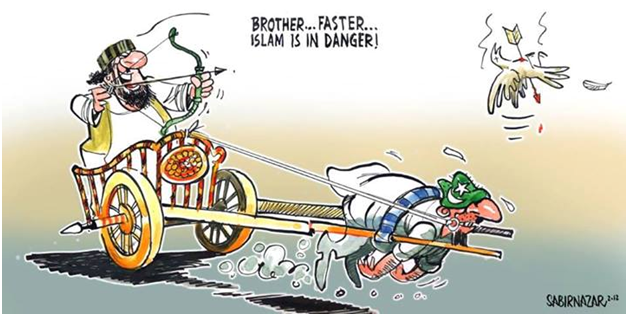
The main imperialist instrument to keep Pakistan under control, was – and still is - the Pakistan Army. The JI dedicated itself to the service of military regimes. Manto in his fourth letter to Uncle Sam, pointed out:
‘Regardless of India and the fuss it is making, you must sign a military pact with Pakistan because you are seriously concerned about the stability of the world’s largest Islamic state since our mullah is the best antidote to Russian communism. Once military aid starts flowing, the first people you arm are these mullahs. They would also need American-made rosaries and prayer-mats, not to forget small stones that they use to soak up the after-drops following a call of nature. Cut-throat razors and scissors should be top of the list, as well as American hair-color lotions…If this gang of mullahs is armed in the American style, the Soviet Union that hawks communism and socialism in our country will have to shut shop’ (Manto 2008: 624).
Nonetheless, the first military regime of General Ayub Khan in its early period kept beards at arms length and imprisoned the Jamaat leadership. Consequently, in the presidential election, Jamaat decided to back Fatima Jinnah, even if as recent as 1962 Maudodi had spoken against women being dragged into politics, administration and defence services. Members raised a hue and cry, while rivals mocked Jamaat’s double standards. But as always, Sharia came to Jamaat’s rescue. Abdul Hamid Siddiqi, the editor of Tarjuman ul Quran, issued the fatwa:
‘We admit that making a woman Head of State is not correct from the point of view of religion but this reality is also not hidden from our sight that it would be a far greater sin according to Shariah to help in the existence of an oppressive dictatorship than to make a woman a Head of State’ (Bahadur:106-109).
In a few years time, the oppressive dictatorship would be facing a movement chanting for socialism. Jamaat brought forward a new explanation. It acknowledged that, like Jamaat itself, the Ayub government was right-wing and warned the government that oppressing its right-wing allies would benefit the left. That in turn would mean that the dictatorship could not be rescued.
Ayub was humiliated by the movement of workers and students. Maudodi beat a hasty retreat. He rejected the thesis that Islamists belonged to the right-wing. Islamists, he declared, belonged neither to left nor to right, but to the centre. (Ibid: 119).
Jamaat-e-Islami described Yahya Khan, the new military dictator who came in to replace the old regime, as a ‘soldier of Islam’. Why? Because he had greased Maudodi’s palm with Rs 6.5 million to contest the forthcoming elections to stop the PPP. But only four Jamaat candidates were able to pass the hustings (Ibid: 125).
As Pakistan went for second time to elections in March 1977, Jamaat was rejected yet again. Bhutto and his PPP emerged victorious. But Washington Shura had something else in store for Pakistan. Bhutto was judicially murdered in 1979; the same years that Maulana Maudodi died.
Before heading for his well-deserved place in heaven, however, Maudodi had blessed the common executioner of both Bhutto and democracy: General Zia ul Haq.
The JI beards accepted ministerial positions in Zia’s khaki cabinet. A close Zia-JI nexus developed during this period. They had much in common. Above all, they had same mentor: the USA. And the USA now needed them more than ever before, for Jihad in Afghanistan. Zia would lead the faithful in Jihad, while Jamaat would be the conduit through which to supply the Mujahideen
AS a result of its close collaboration with Zia, JI was seen by the masses as “martial law’s B Team”. When in 1985, Zia staged his non-party election debacle, none of the JI leaders managed to win elections: the B Team had been defeated yet again. The dismal electoral performance by the beards of all sizes was repeated in four general elections that followed in 1988, 1990, 1993 and 1997.
The JI had joined the pro-military electoral alliance, Islamic Democratic Front, in 1988 and in 1990. As a part of the alliance, it managed to clinch a few seats. However, when it stood ‘independently’ in 1993 at the head of an alliance, the Pakistan Islamic Front, it suffered further misery, winning only three National Assembly seats and just 3.1 per cent of the votes. It boycotted the following general elections, under instruction from its Khaki masters in order to clear the way for Nawaz Sharif’s Muslim League. The Khakis had instructed JI to stay away in case it divided right-wing votes, thus letting Benazir Bhutto win.
When the jackboots in 1999 were back in the driving seat, Jamaat was quick to baptise Musharraf Raj. In turn, Jamaat was lavishly rewarded in the 2002 general elections. The alliance jointly led by Jamaat and Jamiat Ulema Islam, was effectively handed Khyber Paktoonkhwa, along with a share in the Balochistan cabinet for MMA.
While Jamaat was at the helm in Peshawar, NATO supplies were safely travelling from Karachi to Torkham and beyond. To fool its electorate, anti-US statements were issued every now and then. The World Bank and USAID generously helped the MMA government (This author wrote in detail back in 2006, for details: http://www.zcommunications.org/funding-mma-punishing-hamas-by-farooq-sulehria).
The MMA provincial government took every absurd possible action (brilliantly documented by Nazish Brohi in her book The MMA Offensive), except providing relief to its unfortunate electorate. Hence, Jamaat cleverly boycotted the 2008 election while Jamiat was thoroughly punished.
REFERENCES
Ali, Tariq (2003) Clash of Fundamentalisms. London: Verso
Bahadur, Kalim (1977) The Jama’at-i-Islami of Pakistan. New Delhi: Chetana
Manto, Sadaat Hasan (2008) Bitter Fruit. Ed, Tr Khalid Hasan. Delhi: Penguin
 |
Farooq Sulehria is working with Stockholm-based Weekly Internationalen (www.internationalen.se). Before joining Internationalen, he worked for one year,2006-07 at daily The News, Rawalpindi. Also, in Pakistan, he has worked with Lahore-based dailies, The Nation, The Frontier Post and Pakistan. He has MA in Mass Communication from Punjab University, Lahore. He also contributes for Znet and various left publications in Europe and Australia. |