One wonders if our media mujahideen will learn any lessons from Lollywood
Last year, on September 21, six cinema houses were set on fire. In fact, our film industry has deservedly earned the puritan wrath. In 1978, Lollywood first began to take up blasphemy as a theme with Ghazi Ilam Din. Directed by Haider, the film is notable for its portrayal of Hinduism and English rulers (Angraiz Sarkar). Hindus are presented as miserable, corrupt, and sexually debauched while the British are scheming. Muslims, meanwhile, are poor and hard working. Ilam Din (Haider) is depicted as a blessed Muslim from the moment of his birth. When a mullah recites Azan (call for prayers) in his ear, the new-born Ilam Din stops crying and listens to Azan attentively. In contrast, Raj Pal (Afzal Ahmed) is greedy, scheming and fond of a Red Light Area girl [also a Hindu].
Raj Pal wants to publish an inflammatory book to provoke the Muslims. The white ruler has assured him that no harm will come his way. When the book hits the stall, Muslims begin to protest. Raj Pal is sent to jail by District Court, the book is banned.
A Christian High Court judge, however, not only overturns the ban but also orders Raj Pal’s release. This annoys Muslims. A Pashtun, Abdul Aziz Kohati (Badar Munir), goes to Raj Pal’s office intending to murder him, but in a case of mistaken identity, kills his relative instead. Eventually, Ilam Din stabs Raj Pal to death.
Like Abdul Aziz’s mother, Ilam Din’s mother (Najma Mehboob) is proud of her son’s actions. Both mothers keep praying that their sons embrace martyrdom (Shahadat). Aziz is sentenced to life imprisonment, but Ilam Din is sentenced to death. Agitated Muslims decide to appeal against the verdict in the High Court and engage India’s foremost Muslim lawyer, Muhammad Ali Jinnah (Qavi Khan). A fundraising campaign is mounted to pay Jinnah’s fee. Jinnah, however, scorns the Lahorites for offering him a fee: ‘Don’t you know my name is Muhammad Ali. I won’t take any fee.’
But his defence is ineffective because Ilam Din, despite attempts to persuade him otherwise by Lahore’s Muslim leaders, refuses to deny his act. As a result, Jinnah’s defence seeks to justify the murder as a response to blasphemy; he also pleads for the introduction of blasphemy laws in the country.
The authorities are concerned that the execution of llam Din could lead to a breakdown of law and order so they send him to Mianwali Jail where he is hanged. While Ilam Din is embracing death, Jinnah is addressing a rally in Lahore, telling people, “As long as Muslims do not create a separate country, Raj Pals will be born over and over again (paida hotay rahain gay)”. The film ends with the arrival of Ilam Din’s dead body in Lahore, and as his dead body is taken to Miani Saab, the film ends.
In 2002, Gujar Art Production produced a remake of Haider’s film, Ilam Din Shaheed.
Meantime, International Gorillay was released in the context of Salman Rushdie’s controversial novel The Satanic Verses. This film portrays Salman Rushdie as its main villain. The protagonists are three Pakistani brothers. In a dramatised version of the Islamabad police firing on a mob on February 12, 1990 when five demonstrators were killed and 83 injured, their younger sister is killed by the police while demonstrating against Rushdie. The three brothers decide to avenge her and Islam’s honour by killing Rushdie, portrayed as a criminal mastermind, working for an international organisation devoted to destroying Islam. Hiding in the Philippines, guarded by a private army led by an Israeli general, he seeks pleasure in torturing Muslims by making them listen to readings of The Satanic Verses. The protagonists arrive in the Philippines and start their hunt for Rushdie, who escapes them repeatedly thanks to the use of multiple decoys. The Israeli general's sister is sent to seduce one of the Muslim guerrillas but ends up falling in love with him and ultimately converting to Islam. The film ends with a gunfight opposing the four Pakistani ‘guerrillas’ and Rushdie's army. The heroes defeat the villains and, as Rushdie attempts to flee the scene, three giant copies of Quran appear in the sky and fire energy beams at the writer, incinerating him.
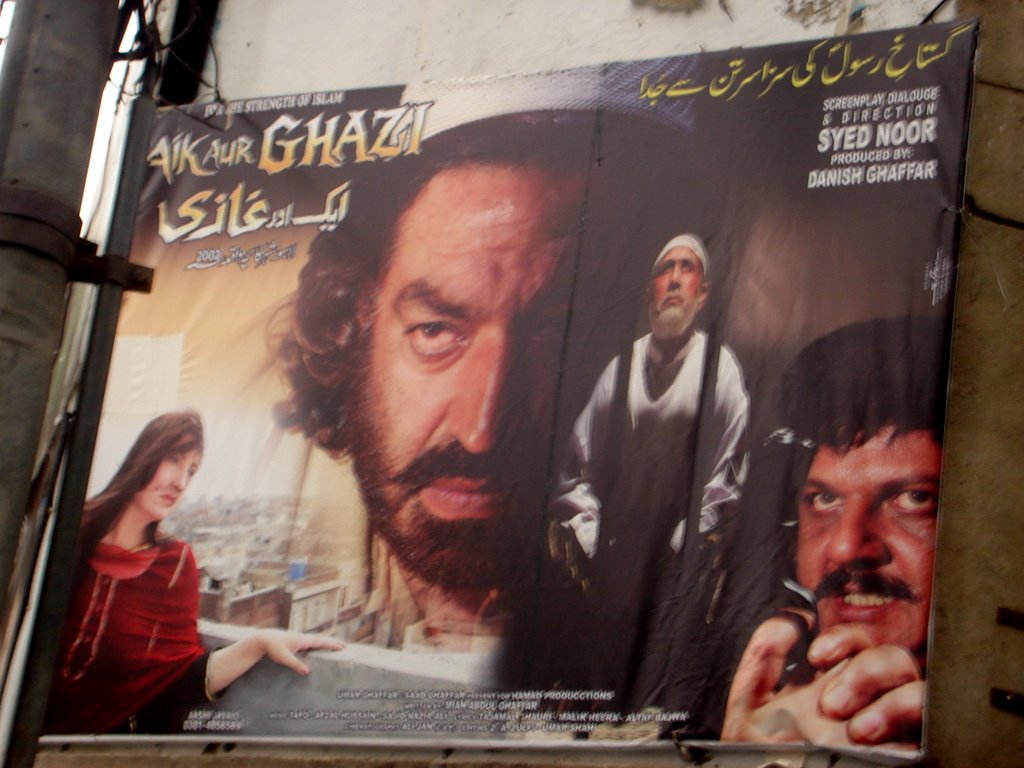
Released soon after Salman Taseer’s murder, Aik Aur Ghazi, director Syed Noor claims, is based on a ‘True story from Lahore 2002’ (Lahore shehar ka sacha waqi’a).
‘Tariq’ (played by an actor I did not recognize), Syed Noor’s ‘Ghazi’, is a loafer and gambler, but has a religious bent of mind. His father, Haji Saab runs a small business and is widely respected in the neighborhood for his piety. He is ignorant of Tariq’s waywardness as Tariq lives a double life: gambler in reality, practicing Muslim in front of his father. Since a Lollywood production is no masterpiece unless peppered with song-and-dance sequels, hence, Tariq is also seduced by Mohni (Saima) living next door. Saima is shown dancing atop a chobara (rooftop), presumably in Lahore’s Walled City.
Tariq, over a gambling dispute, murders a rival. In revenge, rivals kill Tariq’s young brother. This leads to more revenge: Tariq kills two more rivals to avenge his brother’s murder. Unable to bear the loss of a young son, Tariq’s father also dies of a heart-attack Lollywood-style. He himself lands in jail where he develops a dispute with ‘Zulfi’, another killer. However, the blood-thirsty killers are transformed when Yusuf ‘Kazab’ (impressively played by Shafqat Javed Cheema) arrives. The jail inmates hurl abuses at him while Zulfi hatches a plan to murder Yusuf ‘Kazab’. A calm and composed Yusuf, every time insulted by jail mates, politely replies, ‘You are ignorant. I will pray for you.’
While jail mates were aggressive, authorities were showing respect to Yusuf who does not claim to be a prophet. Instead, he claims to have been blessed with Khilaphet-e-Uzma (Supreme Caliphate). In the court, witnesses accuse him of declaring himself a prophet during a Friday sermon at a Lahore mosque, however, Yusuf himself insists upon his faith in Prophet Muhammad who bestowed Khilaphet-e-Uzma upon him. The court nonetheless finds him guilty of blasphemy.
Meantime, Zulfi managed through his uncle to smuggle in a pistol. However, Zulfi is transferred to another jail and he passes the pistol on to Tariq. Both want to decapitate the ‘blasphemer’ in a bid to seek redemption. The jail authorities smell the murder conspiracy. Hence, a search is conducted. Tariq hides the pistol in his ration-box. During the search, a jail official empties the ration-box by dangling it upside down. The nature intervenes mysteriously as everything falls out except the pistol. Despite a search, authorities were not sure about Yusuf’s safety. It was decided to transfer him to Rawalpindi jail. This would have thwarted Tariq’s plan. But a low-rank corrupt jail official, who knows Tariq’s intentions, has his conscience transformed. He connives with Tariq. Hence, when Yusuf is brought to jail compound, the official brings Tariq to the spot. As police play the silent spectator, Tariq guns Yusuf down. Having finished the job, he kneels down (sajda) while the entire jail staff salutes him amid cries of Allah-o-Akbar. One wonders if our media mujahideen will learn any lessons from Lollywood!
 |
Farooq Sulehria is currently pursuing his media studies. Previously, he has worked with Stockholm-based Weekly Internationalen. In Pakistan, he has worked with The Nation, The Frontier Post, The News, and the Pakistan. He has MA in Mass Communication from the University of Punjab, Lahore. He also contributes for Znet and various left publications internationally. |