Seeing the covetous and fearful nature of religious goodness, a secular person’s free good deed becomes more valuable. If we could feel clearly, goodness really becomes goodness when it flows spontaneously from one’s being
What essentially is ethical in being religious or what is religious in being ethical? This question could be important question in Pakistan these days if the country had some developmental and behavioral concerns. While the question has been a spotlight of scholarly debates between religious scholars and freethinking moral philosophers; it could have been resurrected in the wake of late Salman Taseer’s assassination, if we truly had responsible media, for it was not just a case of foul murder but a moral precedent. The question should have been asked on seeing popular reaction with heavy downpour of videos on YouTube comparing governor’s secular lifestyle with assassin’s, in popular parlance, religious one.
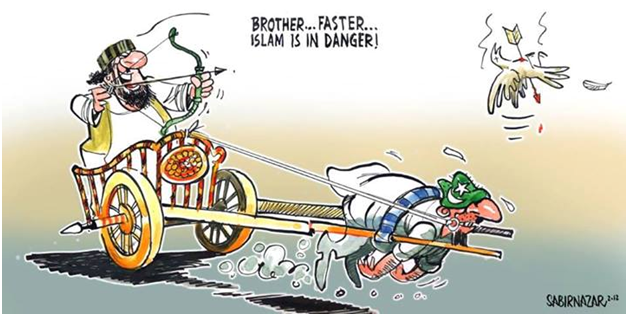
If we go through the hundreds of comments and thousands of “likes” on these videos, we could easily sum up popular verdict as, “The one who is not observing religion as we do can be anything but moral; valid ethical action is impossible without believing in (our version of) religion, and a person leading secular life is essentially blasphemous so justified to be murdered”.
So, “No (our) religion, no morality” is the popular fallacy. It was fog of this basic fallacy wherein two heinous crimes of this year were muffled.
Let’s consider and weigh this dangerous paradigm rationally and existentially.
If we ask ourselves about the sources of morally valid actions; we will find that these actions are based on empathy and affection; human’s native capacity to feel with or for others. If we further ask ourselves, “have these native capacities something to do with some particular religion?” The answer would be “No”. For empathy, love and compassion are intrinsic human values independent of religion.
Motherliness, for example, is the excellence of selfless care and sacrifice and none of the religions can hegemonies it. Therefore, we cannot say that a Hindu mother has lesser capacity to love her kid than a Muslim mother does. As mother is mother; human being is human—having capacity gifted by nature to be empathetic and compassionate—and so ethical.
If the verdict of humanity is not enough, we can see the matter from the rational viewpoint.
Having somewhat deeper look at human civilizations would reveal that there are some universal ethical principles across the world agreed by whole human family. If this undisputed agreement was not there; even two persons would not have been able to live harmoniously even for a day.
For example, if a family makes a moral code by establishing that “lying is good and saying the truth is evil”, such a family, I am sure, will be broken in a few days. But, what we see on earth, are not just families: there are not only societies, states but civilizations—far older and advanced than our own. How did these civilizations survive if they, having their peculiar religions and values, were essentially immoral?
Let’s test this widespread fallacy “that only a religious act is the good act” on logical merits.
In religious philosophy, the position that “ethical rules are God’s commands” is known as Divine Command Theory (DCT). According to this theory, good people do not try to figure out on their own what’s moral. Obedience to God's commands is the key to the moral life.
When people say that non-practicing Muslims and people who confess other religions lack the proper attitude of obedience and submission to God are immoral, they are putting forward this theory.
On logical examination we see that the theory is based upon two basic attributes of God: omnipotence and (total) goodness. However, a closer analysis of implications of these attributes reveals them to be of mutually paradoxical nature as it is logically impossible for the same being to be, at the same time, omnipotent and good. For example, if we say that God is totally good, we have to let up on His omnipotence: as God’s essential goodness places some limits on what He can and what He cannot command.
Majority of Pakistani religious scholarship, like early Protestants, is struck with these implications of omnipotence; If God is omnipotent, He can decree anything at all. There can’t be antecedent concepts of “good” or “evil” that God himself has to adhere to.
Students of philosophy and religions, however, might know that DCT was refuted by Plato four centuries before the birth of even Christianity by saying, “God wills them; his willing them makes them good. Nothing is good until God wills it. God’s commands become arbitrary”.
So, we have seen the fallacies of the erroneous notion in point that it is neither capable of standing theological test nor the rational one.
One may be tempted to say that “faith-based good deeds are rewarded with heaven and evil deeds punished by hell”. This argument, if it is an argument at all, declares fear and greed to be very ground of ethical actions and a conditional good act is not a good act at all. Moreover, the basic foundation of this argument is unethical as how can a person be good if his relationship with God is based upon greed and fear? Can we call a friend a friend if we find in him traces some greed and fear keeps him attached with us?
Then what about the person who is doing neither an act of goodness with neither for nymphs in heaven nor the fear of fire in the hell? Isn’t he (or she) more ethical than a person who presumes to love his God out of greed or fear?
Seeing the covetous and fearful nature of religious goodness, a secular person’s free good deed becomes more valuable. If we could feel clearly, goodness really becomes goodness when it flows spontaneously from one’s being. This is what religionists’ favorite Iqbal has said in his famous couplet, “Unselfish acts have greater rewards”.
In the light of above discussion, we can see that if religious communities in Pakistan keep on dictating people as what to speak what not speak, they will be committing an existential crime. Their dictation would be an offence against our own nature.
Popular religionists say that freedom of speech is a satanic idea; we assume that defending freedom of speech is defending the biology of an animal who calls himself human. We say that denying freedom of speech is rejecting humanity. They say that human rights are foreign agenda. We term them universal existential rights. Human rights are existential rights because through them we confirm our humanity.
We are dreaming animals. We can dream for a better world! Our dreams and our imagination, as human beings, make our lives richer than they actually are. If human persons were not equipped with this faculty; they would still have been living in caves—or stored in the books of apes as extinct creatures. Restricting the dreams, dictating that we are to curtail our dreams to certain limits is not only unnatural but, once again, a crime against humanity.
In short, coming back to where we started, if we take religion away as a justification, if we secularize the ethics; a great paradigm shift will occur. Heroes would become villains and, may be, villains will appear as great heroes. The one who was trying to save a poor woman will become a beacon of humanity and his assassin, along with his instigators, would be unveiled as unforgivable criminals. May be we would find him a Saint who was slain as a devil and his assassin a devil with a saintly mask!
|
Jamshed Iqbal is a media critic, freelance writer & peace activist. |