Rs 25 b would be spent this year alone in Pakistan on this primitive ritual. Can we not spend this huge sum of money in a more rational and productive way? Millions have lost so much during the recent floods. Can’t this money be spent on their rehabilitation?
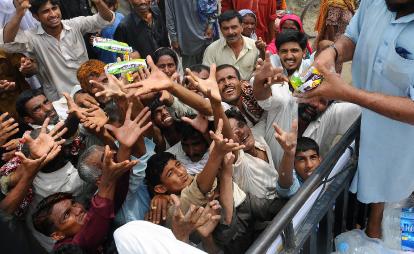 That time is fast approaching when we witness identical scenes all over the country. Tens of thousands of animals, for no fault of theirs, would be butchered in broad daylight for no good reason. Prior to this, our fellow beings would be paraded on streets and markets. Some prospective customers would like to have a view of the lamb's front teeth to ascertain its suitability for the kill. The seller would stretch its upper and lower jaws so that the buyer can have a good view. I don't know the proportion of faith and that of social pressure on performing this ritual, but the animal is doomed.
As a compulsive act, conditioned over years, the ritual is performed either to fulfill a divine command, or due to social pressure, regardless of the fact whether it is affordable or not. The massacre of millions of animals in a short span of time also damages the supply chain and creates an inflationary surge later.
Children have a special fascination with animals and they quickly develop emotional bonds with them. They are the first ones to express their excitement and affection, almost as unaware of
the animal’s fate as the animal itself. To them it is unacceptable that the animal be slaughtered.
It can be safely assumed that children witnessing blood, death agony and death itself, an experience for which they are not psychologically prepared, causes distress and may have negative effects on their personality development. However, rather than preventing children from observing gruesome scenes of gore, they are generally ignored while some cultures even encourage them to see the gruesome act, live.
It has even been quoted from Islamic sources that “preferably, slaughter the animal yourself or place your hand over it while the ritual is being performed or at least witness it.” Perhaps we prepare ourselves for jihad where blood would be shed of humans who are guilty of having a different faith.
As Muslims we also feel superior to the followers of all other religions, hence, our rituals should also be superior. And to propagate our religious teachings, it is always good to demonstrate our rituals in front of the non-believers. Consequently in Sindh where there is a large Hindu population, we find it satisfying to slaughter a sacred animal close to areas where Hindus can witness the agony and death of their gaomata by the superior Islamists. This would also invoke fear in their hearts, lest they also face the same fate if they indulge in some wrong doing in the holy land.
On the fateful day professional and nonprofessional butchers carrying knives and razor sharp cutters would visit places where the innocent creature would await its unavoidable fate. The butchers, with assistance from the accomplices would get hold of the animal that is not very capable of posing any effective resistance. And then pull it down with full force, placing knees below its trunk and then slitting its throat with an extremely sharp metal blade.
As the jugular vein is severed blood gushes out in showers and the animal undergoes muscular spasms. However the dying animal is not even allowed to spurt as many hands hold it till the last breath.
Blood oozing out from houses, and on the roads, creates small pools of blood. This is accompanied by offal, entrails and carcasses of various animals, causing sewerage problems and massive environmental pollution.
Numerous health related problems follow. Simultaneously one also observes stalls collecting animal hides, from Jamaat-e-Islami to Jamat-ud -Dawa to obscure welfare societies.
The meat is then distributed in plastic bags within the mohalla. The raans are reserved either for some important relations or preserved in freezers along with the bulk of meat to be consumed in the following days. The housewives then cook liver and chops for the family and the meat is then consumed by the family as if preparing for a long spell of meatless days. Excessive consumption of meat may cause health problems later on, as temptation to consume protein during these days is fairly high.
In a matter of days, billions of rupees in the form of meat enter our digestive system and excrete as filth. Underutilized meat is also buried under sand in the Islamic Kingdom of Saudi Arabia as there is no consumption whatsoever.
In the evenings the so called religious scholars appear on TV and apprise us of the inner feelings of the sacrificed animal as to how elated and proud it felt while going through the process. How many levels of accomplishment the one who sacrificed the animal has achieved in the eyes of God. What words would be exchanged between the lamb and the master when they both will meet in paradise.
As per one estimate around 25 billion rupees would be spent this year alone in Pakistan on this primitive ritual. However, if we take half of the estimated amount, it comes to 12.5billion.
Can we not spend this huge sum of money in a more rational and productive way? Millions have lost so much during the recent floods. Can’t this money be spent on their rehabilitation? Can we not help the poor and needy who cannot afford to send their children to school or cannot pay for an expensive surgery? There is a sizable number of prisoners in jails who have completed their prison terms, yet are still behind the bars, as they do not have the money to pay for the fine imposed.
Perhaps, in a country rapidly drifting towards fanaticism, this is not foreseeable in the near future. We would prefer to stick to the primordial ritual where inanimate objects, animals and humans were sacrificed at the altar of dogma.
Rational thinking is fast disappearing from the society. Rituals, primitive thought patterns and militancy are rapidly gaining ground.
While millions of poor men women and children in the sacred land are facing hunger and disease, billions of rupees would be spent by the blessed on slaughtering animals.
| Waseem Altaf is a social activist. |