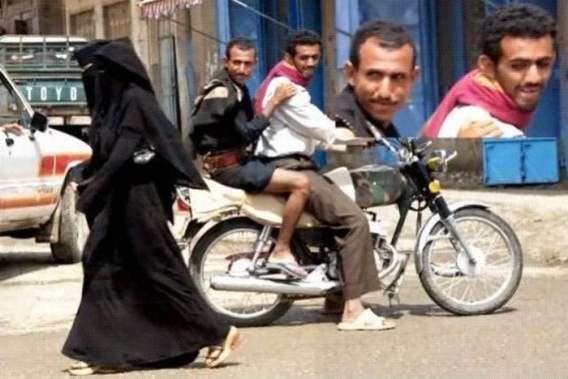
 One often hears a hijaban (especially the Arabised Pakistani females) justifying her headgear as an act of modesty and purity which 'protects' her from lustful males and the 'sinful temptations'. Perhaps the Saudi-inspired hijaban fails to understand that this concept of modesty which she is flaunting as her own choice has actually been inculcated in her by her polygamist patriarchal counterparts who have been maneuvering chaddar, chardeewari and chastity to control her physical and social freedom.
The education imparted by her textbooks repeatedly reminds her that modesty is the greatest ‘virtue’(sharm o haya aurat ka zaiwar hai ) and her subservient role as a pious mother, sister and daughter –not an individual- is supposed to be confined to the domestic sphere otherwise the ‘honour’ and ‘pride’ of the nation or society would be lost. The sentiment is vigorously expressed by the Urdu poet Akbar Allahabadi:
Be pardah nazar aien kal jo chand bibiyan
Akbar zameen mein ghairat e qaumi se gadh gaya
In fact, a conservative society like Pakistan, often views women as a private property thus dictates a certain cultural or psychological code of conduct for women which furthers the male dominance. Harem, hijab, chastity and shame are social tools to maintain the manipulative machismo and shape passive female sexuality. In a societies where women have no right as to choosing their attire, where shame has been attributed to their physical and sexual existence, how could one think of a woman’s right to her own body, sexual orientation or reproductive health. It is not surprising that despite playing their socially defined ‘pious and chaste’ characters, hundreds of women are killed in the name of honour in this country but their murderers are patronized by the misogynistic laws and society.
The feeble stereotype created for women also justifies the cruelty inflicted on women like rape, forced conception and domestic violence leaving them unable to speak up against the culprits while invoking a persistent sexual guilt. According to Aurat Foundations' report on violence against women,1000 cases of rape were reported in 2010 and the number could be higher since most of the rape victims did not want to talk due to shame and fear of society. This feeling of guilt and embarrassment has been incorporated into the consciousness of the rape victim by a chauvinist male society to exert its unbridled phallic power.
Suppressing women's sexual identity through veil, modesty, virginity and shame are concepts similar to breeding submissiveness in the ‘slaves’ of colonial era who hated themselves for being 'Nigers'.
Shame is not only a socially unacceptable and negativebehavior, it has served as a maneuver of oppression to subjugate the sensual being and psychological growth of women. With shame comes the acceptance of superiority of males in all realms of sexual activity thus imposing a passive sexual response on a woman. Rights activists now openly identify shame and sense of hounr as the major impediments in curbing the acts of violence. Hijab or any modest dress code exclusive to women is actually a symbol of controlled sexual choices for female of society.Why should only women have to ‘cover’ their body from head to toe? Why do the societies, enforce ‘modesty’only on women - tagging guilt to the very beginning of their existence making them look down on their own physical being while the males inherit an inborn phallic pride?
Our orthodox society's discriminatory approach towards the sexual roles of male and female is also quite interesting. An array of traditional and popular advertising across the country enchants the male customers to buy elixirs for impotency, but aborting an unwanted pregnancy is a hush-hush matter. The span of a man’s sexual life is believed to be infinite but a woman is ‘presumed to be eligible’ for sexual pleasures only till her menopause. The mindset actually views sex as a means of procreation and acknowledges the female sexual activity only as a means of reproduction as prescribed by the holy books.The Urdu word for ‘menopause’ i.e. san e yas which means ‘age of despair’ denotes the sexual stigmatization of an ‘infertile’ woman. Similarly, virginity is a virtue for Pakistani women and any woman having a physical relation other than marriage is either legally punished under Hudood Law or socially ostracized and considered slut since she does not qualify for the traditional pious woman. Yet, the local wisdom assumes it quite natural and morally acceptable for a patriarchal Muslim man to indulge in multiple sexual relationships to satisfy his desire.Polygamy allows a man to further exploit women sexually but promiscuous behaviour of a woman is deplorable for the male-domination because it allows a woman to explore her sexual choices as a free individual not a married slave. Swear words, though they ridicule feminine pride, are very common in our culture yet the social norms restrict a ‘noble’ woman from uttering them because they empower her to explicitly express her emotions with a sexual imagery while putting the shame aside.
The assumption of inferior female sexuality or male sexual supremacysurely is not a divine or scientific premise rather the manipulation of patriarch rule backed by a ‘God’ as its sacred head and unanimously approved by almost all religions. If the women believe in sexual equality they have to break away from the clichés of virginity, chastity and piety and give in to these social norms just as much asthe men of their society do.
 |
Duriya Hashmi is a passive activist, blogger and aspiring film maker who writes to vent anguish and believes in art as a catalyst for change. Her cyber self can be followed at |