
While the attention was squarely focused on the Raymond Davis issue, Shahbaz Bhatti was assassinated. Some tried to blame CIA for his murder. We have a history of looking away and plenty of experience in the active process of forgetting. What genocide in Bangladesh?
 In the wake of Salmaan Taseer’s assassination, I felt guilty: guilty of being desensitized to the violence of Pakistan’s state and society to its marginal and disenfranchised; guilty of not seeing what was in front of me and around me but was part of business as usual; guilty of not having tried to feel or imagine what life must be like for someone whose targeting is sanctioned by the state and (tacitly or explicitly) condoned by society, and by extension (if I were to give myself some leeway), me; guilty of not doing anything to usher in a just order.
I believe that one should aspire for and work towards a just society. But what could one do? There is that middle class family man excuse for inaction that I can always hide behind: I am just a regular guy with a family to support. I don’t want any trouble. My first and foremost commitment and responsibility is towards my family. … But who wants to feel impotent and powerless anyway? Life, with its bottomless reserve of hardships, is hard as is. Is it not better not to have anything to act on, especially when that action can have repercussions? To think of violent reprisals as the reason for inaction is to make a victim-hero out of oneself and hence justifiably take refuge in the all too human instinct of self-preservation. The repercussions I have in mind are more mundane: It is the questioning of one’s part in the violence, the complicity of one’s neighbors, friends, and family in violence and cruelty through their seemingly benign bigotry, social prejudices, and a sense of righteousness of one’s community – a community that can do no wrong.
While the attention was squarely focused on the Raymond Davis issue, Shahbaz Bhatti was assassinated. Some tried to blame CIA for his murder, claiming that it was done to take the spotlight away from the Raymond affair. The “foreign hand”, politicians, and “the agencies” serve as the usual suspects and convenient foils. No need to dig further. No need to look oneself in the mirror. We are all decent people after all.
We have a history of looking away and plenty of experience in the active process of forgetting. What genocide in Bangladesh? It was India’s instrumentalization of Bengalis that led to a war between a “moth-eaten” Pakistan and a belligerent hegemon, India. The reports of mass rapes are, well, Indian propaganda. Those more committed to justice as the cornerstone of their socio-political views, all too often fall prey to a sense of balance, whereby if both sides commit violence then both need to be condemned in the same breath; context, larger inequities and proportionality be damned. The story thus becomes: Bangalis were killing Biharis. Good old Pakistan went in with good intentions, and in the fog of war a lot of violence occurred on all sides. The soldiers were basically good people, doing their job and following orders. Blame the higher ups. They are the “few bad apples” responsible for whatever might have happened. End of story [1].
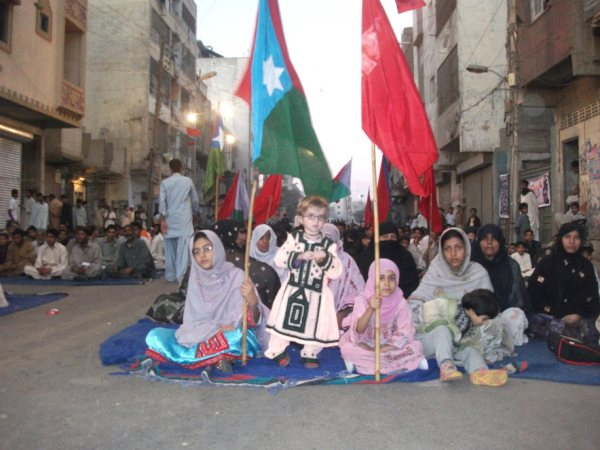
Similarly, the ongoing State aggression in Baluchistan is covered over with the tropes of secession and tribalism: What repression in Baluchistan? [2] Baluchis want to dismember Pakistan. Their leaders are opportunistic tribal warlords, who only want to increase their own wealth and power. There is no such thing as the Center’s belligerence, or siphoning off Baluchistan’s resources to the metropole a la colonialism. Baluchistan is not Kashmir, not Palestine, and not French Algeria. Baluchistan is an integral part of Pakistan. Those resources are Pakistan’s resources. That land is Pakistan’s. That land is Pakistan. Sindhi, Baluchi, Punjabi, Pakhtun, Muhajir – we are all Pakistanis. We stand for unity (by that we really mean uniformity, or rather conformity — in “our” image).
But the siege [3] that the marginalized are put under, catches up with the rest. As inhumanity is normalized, repression becomes the way of life. One stops noticing the ill-treatment meted out to the disenfranchised segments of society. Their structural marginalization, enshrined in laws (as, for instance, in the case of Ahmadis [4]) and embodied in social attitudes (Don’t touch those Christians [5]. Don’t drink in their glass!), becomes the background that one takes for granted as business as usual and “forgets” [6] that it is even there. That’s where the “average, decent guy” or “the silent, moderate majority” is complicit in the spectacular murderous manifestations of the social reality, such as murders of Salmaan Taseer and Shahbaz Bhatti, that catch national or international attention, and are brushed aside as a case of “few bad apples.”
Typologies come in handy for such brushing under the rug: moderates, extremists, fundamentalists, secular, liberals, progressives etc. – words that generally stand for good and bad, in public discourse. Then there are the debates about whether the majority of a people or a group is badists or goodists. Bigots with their own axes to grind, and the reform-minded with the self-image of lone-heroes, contend that the majority of a people/group are badists. The counter-argument runs that the majority of a people/group are goodists and that there is only a tiny sliver of radical badists. That is the “few bad apples” explanation one heard when Abu Gharaib came to light. Good and decent people don’t turn to violence, or justify it, or legitimize it, or collaborate and participate in inhumane treatment of the marginalized. Nope, just a few bad apples do. People like me, the average decent guys, don’t.
I am reminded of an Amitava Kumar quote [7]:
I do not really know why someone who is a fundamentalist at any point stops being one. Nor can I explain the opposite process. Those questions cannot really be answered satisfactorily. It seems to me more accurate and important to contend that one is never wholly or only a fundamentalist. And vice versa.
But even that statement points to a typology through which one may continue the self-deception, though it gets me closer to seeing my own reflection in the executioner.
References:
[1] For a brief primer see Manan Ahmed, “Path to Victory” http://www.chapatimystery.com/archives/homistan/path_to_victory.html ; Saikia, Sayeeda Yasmin, "Beyond the Archive of Silence: Narratives of Violence of the 1971 Liberation War of Bangladesh." http://www.scribd.com/doc/44817463/Beyond-the-Archive-of-Silence, History Workshop Journal 58 (2004): 274-286; Saikia, Sayeeda Yasmin, ‘Listening to the “Enemy”: The Pakistan army, violence, and memories of 1971,’ pp. 177-209, Crisis and Beyond: Pakistan in the Twentieth Century, ed. Naveeda Khan (London and New Delhi: Routledge, 2009).
[2] For a brief primer see Manan Ahmed , “The Baluchistan Issue” http://www.chapatimystery.com/archives/homistan/the_baluchistan_issue.html ;
Frédéric Grare, “Pakistan: the Resurgence of Baluch nationalism”, Carnegie Paper No. 65, January 2006, http://www.carnegieendowment.org/publications/index.cfm?fa=view&id=17865
[3] Manan Ahmaed, “Dominance Without Toleration” , http://www.chapatimystery.com/archives/homistan/dominance_without_toleration.html ; Manan Ahmed, “We are all Ahmadis: A History” http://www.chapatimystery.com/archives/homistan/we_are_all_ahmadis_iv_a_history.html ; “Even our little children are afraid that if they say something wrong at school, they will be charged with blasphemy.” … “In our churches, homes and workplaces we feel fear. It’s very easy to make this accusation because of a grudge, or for revenge. Anyone can accuse you.” Orla Guerin, BBC News, Punjab province, 6 December 2010, http://www.bbc.co.uk/news/world-south-asia-11930849
[4] Manan Ahmed, “We Are All Ahmadi III: Laws” http://www.chapatimystery.com/archives/homistan/we_are_all_ahmadi_iii_laws.html
[5] “The other workers declined to touch the water bowl because Ms. Bibi had carried the container …” Jane Perlez, “Pakistani Sentenced to Death May Get a Pardon”, The New York Times, November 22, 2010, http://www.nytimes.com/2010/11/23/world/asia/23pstan.html
[6] Manan Ahmed, “We are all Ahmadis: Erasures” http://www.chapatimystery.com/archives/homistan/we_are_all_ahmadi_v_erasures.html
[7] Amitava Kumar, “Husband of a Fanatic: A Personal Journey Through India, Pakistan, Love, and Hate”, New Press, 2005, p180
 |
Salman Hussain is an IT professional with an MBA in Project Management, living in the U.S. He reads history and anthropology, and is interested in studying labor migrations, especially to the Gulf. He blogs at Greased Cartridge ( http://greasedcartridge.wordpress.com/) |