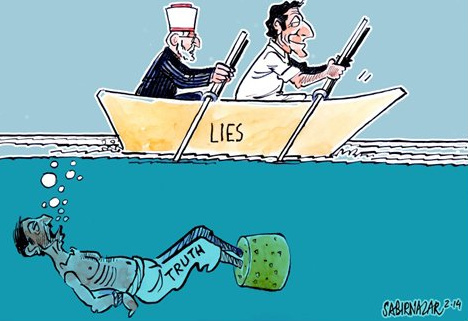
India's leading environmentalist, Vandana Shiva had her "heart just sank" as she got off the flight, December last year, at Copenhagen airport, when the first thing she "saw was a Coca-Cola bottle" as sponsor for "Hopenhagen". Sponsored by notorious corporate giants, Hopenhagen was a big campaign during the climate summit COP15 held last year. Talking to Democracy Now's Amy Goodman, on December 14, Vandana Shiva said: " Coca-Cola should not be the symbol of finding solutions for the climate crisis". She pointed out: if you've been to Plachimada, India, where 1.4 million litters, were extracted by Coca-Cola every day, to make these soft drinks and to do the bottling of water, "the women had to rise up against Coca-Cola. The women had to say, 'Shut this plant down, because we are having to walk ten miles to get clean and safe water.' That would not be Hopenhagen. The women of Plachimada would not see hope in a Coca-Cola bottle".
Plachimada is a little village in Kerala where the women organised and shut down a Coca-Cola plant in 2004 and this triggered a movement across India. It is because communities across India living around Coca-Cola's bottling plants are experiencing severe water shortages, directly as a result of Coca-Cola's massive extraction of water from the common groundwater resource. The wells have run dry and the hand water pumps do not work any more. When the water is extracted from the common groundwater resource by digging deeper, the water smells and tastes strange. Coca-Cola has been indiscriminately discharging its waste water into the fields around its plant and sometimes into rivers, including the Ganges, in the area. The result has been that the groundwater has been polluted as well as the soil.
''Water shortages, pollution of groundwater and soil, exposure to toxic waste and pesticides are having impacts of massive proportions in India. In a country where over 70% of the population makes a living related to agriculture, stealing the water and poisoning the water and soil is a sure recipe for disaster", claim the activists campaigning against Coca-Cola.
The arrogance of Coca-Cola in India is not going unanswered. In fact, the growing opposition to Coca-Cola- primarily from Coca-Cola affected communities- has spread so rapidly and gained so much strength that Coca-Cola had to hire a public relations firm, Perfect Relations in a bid to spin the problems away instead of addressing them.
"Three plants have been shut down", Vandana Shiva says. "Coca-Cola does not bring hope, and Coca-Cola should not be the symbol of finding solutions for the climate crisis", she told Democracy Now. As expected, corporate media in India, fearing to lose advertisements, have been either avoiding covering or downplaying these struggles. And India is not unique. Nor was Hopenhagen any exceptional case.
An even big scandal was recently exposed by famous US paper The Nation. In an article called 'The Wrong Kind of Green', Nations' Johann Hari exposes major environmental groups like Conservation International, WWF, Sierra Club, The Nature Conservancy (TNC), and National Wildlife Federation taking big money from world's top polluters like BP, Shell and Ikea.
The process was initiated by president of the National Wildlife Federation in 1980s. The disease by now is widespread in the USA particularly. The corporations that commit environmental atrocities on global scale, just buy 'character certificates' from these NGOs.
For instance, in Bolivia, BP was looking to build a pipeline that would pass straight through a virgin rainforest. There was a lot of opposition on the ground and from other environmental groups including World Wildlife Fund and The Nature Conservancy. But then BP came up with a plan to provide several million dollars in funding for conservation projects, and World Wildlife Fund and several of the other groups changed their position and backed the BP pipeline in order to obtain these funds.
Similarly, when it was revealed that Swedish giant Ikea was manufacturing furniture made from trees ripped from endangered forests, the World Wildlife Fund rescued the company saying, of course wrongly, that Ikea 'can never guarantee' this won't happen.
The nasty ties between green NGOs and corporations were fully exposed at Copenhagen summit where these NGOs were legitimising and advocating policies that showed a disregard for scientific knowledge and demands put forward by indigenous groups or countries Africa and Latin America. Lumumba Di-Aping, G77's chief negotiator at Copenhagen summit, was so angry at these NGOs that he compared their subversive role with CIA and KGB. He commented: 'Never thought that one day I will accuse a civil society of such a thing. Diving the G77, or helping divide G77, is simply something that should be left to the CIAs, the KGBs and the rest. It's mind-boggling. And I say this having been the beneficiary of absolute support from civil society. Many of you may not know this. I come from southern Sudan. We've been through wars for almost 90 percent of our lives since independence. So I'm not sure what happened exactly to the civil society that I know, or at least knew.'
On accepting hefty corporate donations, these green NGOs campaign for a system that will cause the rainforest to die sooner than global warming requires and are dismissing the real solutions to global warming as unworkable or politically unrealistic.
Also, these 'grassroots, non-profit' NGOs re-fashion themselves in the image of corporations sponsoring them. Their leaders prefer to be called presidents and CEOs. They make so big salaries that they end up among the top one percent of U.S. taxpayers. The average salary for a CEO in many of these organizations is between $400,000 and $500,000 a year. There are people like Steve Sanderson, who runs the Wildlife Conservation Society and has a $225,000 a year expense account. These CEOs spend most of their time traveling around the world, often in the company of CEOs or retired moguls and Hollywood stars. They often travel on private jets that the corporations provide for them. They often rented yachts and gasoline-guzzling Land Rovers in order to wine and dine and show some of the most beautiful and pristine places in the world to their corporate donors in order to 'fundraise'. According to one commentator, these NGOs have become satellite PR offices for the corporations that support them. Johann Hari thinks these NGOs are: 'polluter 'funded leeches sucking on the flesh of environmentalism, leaving it weaker and depleted.'
When green cozy up with top polluters
Source: Viewpoint