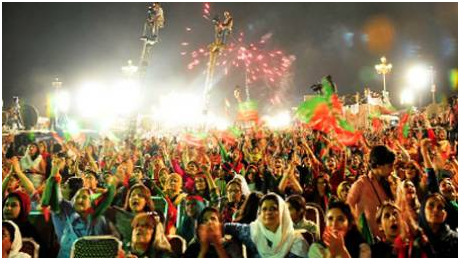
Opposition leader and chief of Pakistan Tehrik-e-Insaf (PTI), Imran Khan, launched his long march on August 14 to protest against what he considers rigging in the general elections held last year. He is demanding that Prime Minister Mian Nawaz Sharif resign to pave the way for fresh elections. PTI’s Azadi March (Liberation March) has caught the imagination of many in Pakistan, however the expectation of 100,000 motorcyclists leading the “million march” was not been realized. It failed miserably. A few thousand marchers who left Lahore riding in expensive cars from the residence of Imran Khan at Zaman Park, spent six hours on The Mall. It was a tactic to give the impression that people would not let them move forward. The Azadi March is being complemented by an ‘Inqlab March’ (Revolution March) by Pakistan Awami Tehrik (PAT). The government allowed the 'Revolution March’, led by religious scholar and chief of PAT,Tahir-ul- Qadri, only after an initial bid to repress it so that people could not join it from Lahore. Tahir Qadri, a Canadian citizen, has talked about changing the system and replacing it with a more progressive set up. The PMLN ( Pakistan Muslim League Nawaz) government’s strategy to arrest the workers at district-level and cordon off provincial capital Lahore and federal capital Islamabad with large containers worked well in controlling the number of participants.
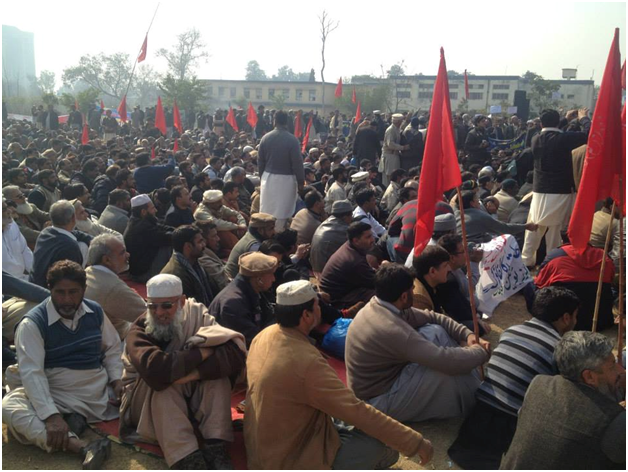
Awami Workers Party has termed the two marches reactionary and appealed to the working class not to participate in the marches led by rich politicians and mullahs. Both marches have reached Islamabad separately at the time of writing these lines. The unity of the two was hit hard by the big egos of both the leaders, Imran Khan and Tahir Qadri, on the question of who would lead the rallies.
Meantime, Nawaz Sharif has been repeatedly asked: “why the march and what is our fault?” He asked the question in his long awaited nationally televised speech on August 12.
Imran Khan says that the May 2013 general elections were rigged and is demanding a new mid-term election under a government of technocrats. He later took a U-turn on the issue of a technocrats’ interim government after the president of PTI, Javed Hashmi, objected and refused to be part of the long march.
The issue of rigged elections came a “little”--- 14 months--- late. During the period, Imran Khan formed the provincial government in Khayber Pukhtoon Khawa (KPK) province and PTI is still in power over there.
He did not adopt the strategy of India’s Aam Admi Party (AAP) whereby AAP leader Arvind Kajriwal left the Delhi state government on principled grounds. Imran Khan was at ease with the federal government starting negotiations with the religious fundamentalist Tehreek-e-Taliban Pakistan (TTP). As was expected, the talks did not go very far and a military operation was launched in June this year.
Initially, Imran Khan raised questions about the launch of the military operation, his main objection being that he was not consulted. Later, it turned out that the interior minister Choudry Nisar of ruling PMLN was not consulted either. However, Imran Khan endorsed the military operation reluctantly and offered help from his PTI government in KPK.
Within a month of launching the military operation, Imran Khan announced in a public meeting that he would march to Islamabad to finish off the rule of a “corrupt royalist” government. This announcement puzzled many commentators about the real motives of the long march.
It seems that Imran Khan, who always tried to please the religious fundamentalists, is again on the same path. A military operation could not be opposed publically, so he started a campaign against PMLN on the issue of election rigging.
It is worth noting that during the general elections of 2013, most of the political parties like Pakistan People’s Party, Awami National Party, and Mutihida Qaumi Movement were attacked by suicide bombers.
They were not allowed to canvas publicly by the fanatics. Both PMLN and PTI were not attacked by the fanatics a single time. The reason was simple: both were seen as sympathetic towards the extreme religious groups including TTP.
Now both the conservative right wing parties are at loggerheads on the issue of power sharing. Both are in power, one in the Centre and the other in KPK province. Imran Khan wants the power at the Centre, within just 14 months of the general elections. It seems an untimely decision as the PMLN has not lost all the popularity it enjoyed after PPP failed miserably during its five year term from 2008-13.
Earlier another stalwart Muslim religious scholar Tahir Qadri had announced that his long waited “Inqilab” (Revolution) march would also be launched on August 14. Tahir Qadri’s Pakistan Awami Tehreek(PAT) is a religious political grouping active in the field of education and health and has a worldwide charitable network . Both PAT and PTI have presented the most serious challenge the PMLN government has faced during their one and half years in power.
Both are using revolutionary vocabulary to attract the masses. Azadi (independence) and Inqilab (revolution) marches are an insult to the real meaning of the two slogans. Imran Khan’s PTI is supported by the rich of Pakistan. It has become a new right-wing conservative capitalist party, while the Pakistan Awami Tehreek is a counter revolutionary party using revolutionary slogans. The PAT wants religion as dominant political force to guide the state.
They are gaining popularity because the Nawaz government has failed miserably to do anything for the poor. There is a fast implementation of a neo-liberal agenda. To fulfill the conditionality of IMF for a USD 5 billion loan, the PMLN government’s first act was to double the price of electricity. It has also raised the prices of gas and other services for the same purpose.
A wholesale privatization of major public sector institutions has been announced despite massive opposition by several political parties and trade unions. Pakistan economy got a little breathing space after the massive loans by the IMF besides the Saudi “gift” worth USD 1.5 billion.
Still Imran Khan’s Azadi March is badly timed and the reasons presented by PTI leadership are not convincing for many. If it was just against the rigging of general elections, why did it take fourteen months for Imran Khan to announce an all-out agitation?
The issue of election rigging is just a cover for Imran Khan. The real motives include the covert opposition to military operations, PMLN insistence to try General Musharaf and to cover the poor performance of PTI’s KPK provincial government during the last 14 months.
The real question is: what will happen after the dharna (sit in) in Islamabad? The PMLN has made it clear that it will not give in. The Lahore High Court has declared these dharnas as unconstitutional. Imran Khan says that he will not come back without securing resignation of the prime minister. Tall claims have been made by both Imran Khan and Tahir Qadri. It seems that both are expecting some sort of military intervention. There is no other way to remove this government. However, military intervention seems unlikely at present:
1. The two marches lack support in Sindh and Balochistan. That is an important factor why the military might not take power in hand.
2. There is a total opposition, at least in words, by all major political parties except the PTI, of course. Even PTI leadership is paying lip-service to the cause of democracy.
3. There is still a vibrant lawyers’ movement and an activist judiciary that is totally against a military take-over and they are not going to validate the military coup as was the case in the past when the judiciary would endorse every khaki coup.
4. Another reason would be the opposition of the social movements and organizations, and peasant and trade unions to such a takeover.
5. The present civilian government is not unpopular to an extent where any military coup would be accepted and justified. Imran Khan is acting in haste. His ‘rigging formula’ is not being accepted by the majority, it seems. His appeal is still confined mainly to Punjab. He has used very dogmatic language. He has not made a good case against the PMLN government. It could have been another situation if he had launched his campaign a year or so ago.